Why Café Coffee Is So Expensive: Where the Money in Your Cup Really Goes
The beans in a café drink cost very little, so why is the cup so much more than coffee at home? I've talked with café owners, worked out the numbers and looked at the whole supply chain. Here's where the money in a café coffee really goes, why the coffee itself is one of the smallest costs, and what it means for farmers, baristas and you.
We choose products independently. We may earn a commission through links on this page; your price stays the same. Affiliate policy
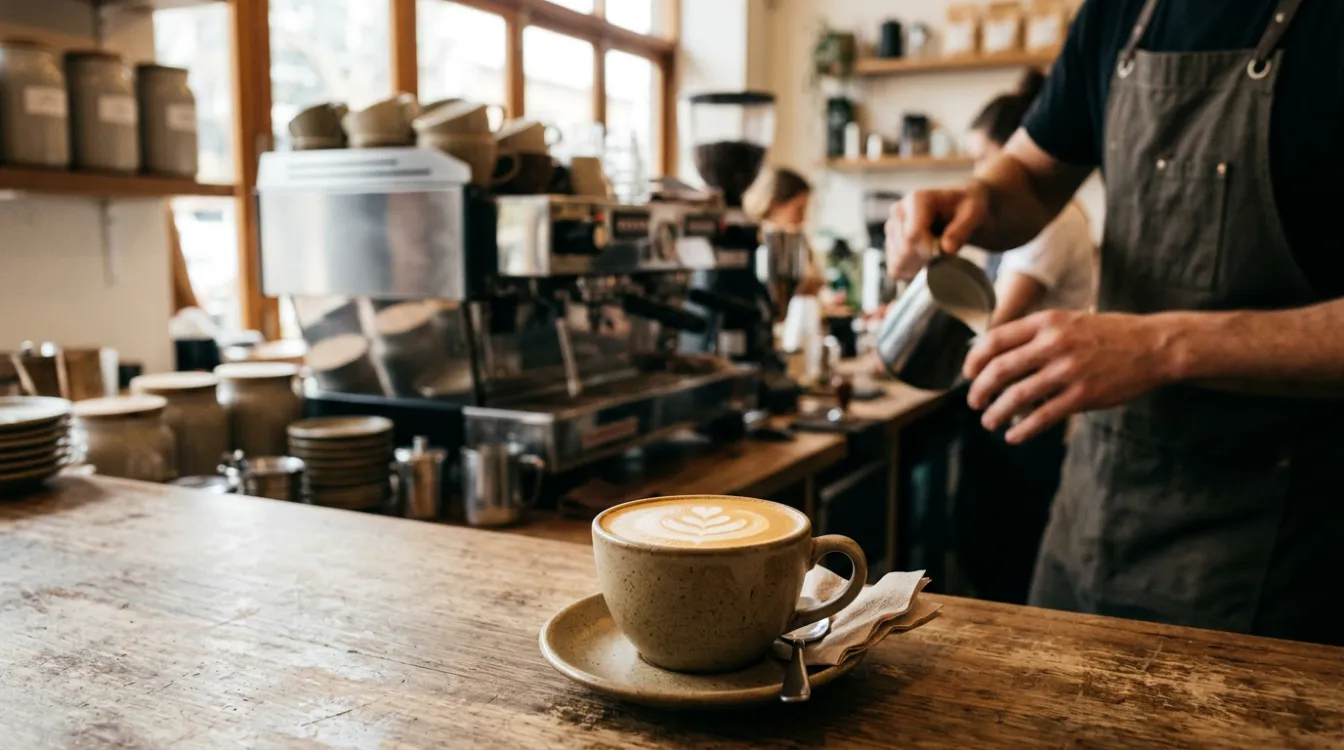
Café coffee is expensive mainly because of the costs around the coffee. In a typical breakdown, labor takes about 35% of the price, product (coffee, milk, cups and lids) about 30%, rent about 15%, other overhead about 10%, and profit about 10%. The coffee beans themselves are only a small part of the product cost. Because coffee is such a small share, switching to cheaper beans saves cafés very little per cup, while paying more for responsibly sourced coffee raises the price only slightly. Farmers typically receive just a few percent of a café drink's price.
Why does café coffee cost so much?
Almost everyone has had the same thought at a café counter: the beans for this drink can't cost much, so why does the cup cost so much more than coffee at home?
It's a fair question. A bag of good coffee makes dozens of cups at home, and the coffee in a single café drink is only a small fraction of a bag. Yet a latte in a busy city café can cost many times what it would cost to make yourself.
The answer isn't a single villain. It's a whole chain of costs, most of them invisible from the customer side of the counter: the people making the drink, the rent on the building, the machines, the milk, the cups, the electricity, the taxes and, finally, a fairly thin slice of profit.
In this guide I'll break down where the money in a café cup really goes, why the coffee itself is one of the smallest pieces, and what that means for farmers, baristas and you.
Where the money goes: a typical breakdown
Every café is different, but industry estimates and conversations I've had with café owners point to a similar rough split of the price of a typical drink.
Rough share of a café drink's price (typical estimate)
These numbers move around depending on location, size and business model. A downtown café in a major city may spend far more on rent, while a drive-through might spend less on rent but more on equipment and labor. But the overall pattern holds: labor and occupancy together usually cost more than all the ingredients combined.
The coffee: a small piece of the cup
The coffee in a single drink usually accounts for only a small share of its price. A typical espresso uses around 18 to 20 grams of coffee; a cup of drip coffee uses a similar amount or less.
Even specialty coffee, bought at higher prices than commodity coffee, adds up to a modest amount per cup. That's why choosing a cheaper coffee saves a café surprisingly little per drink, often just a small fraction of the price. Cutting quality to save money barely changes the economics but can noticeably change the taste.
What "product cost" really includes
When café owners talk about product cost, they mean far more than beans:
- Coffee: espresso blends, single origins, decaf.
- Milk and milk alternatives: often the biggest ingredient cost in milk drinks. Oat, almond and other plant milks usually cost the café more than dairy, which is why many cafés charge extra for them. My guide to plant-based milks in coffee compares the options.
- Cups, lids, sleeves and straws: takeaway packaging can cost a café as much as the coffee in the cup.
- Syrups, sauces and toppings: flavors, chocolate, whipped cream.
- Sugar, stirrers and napkins: small items that add up across thousands of drinks.
- Waste: spilled milk, dialing-in shots each morning, drinks remade for customers, and pastries that don't sell.
Labor: the biggest single cost
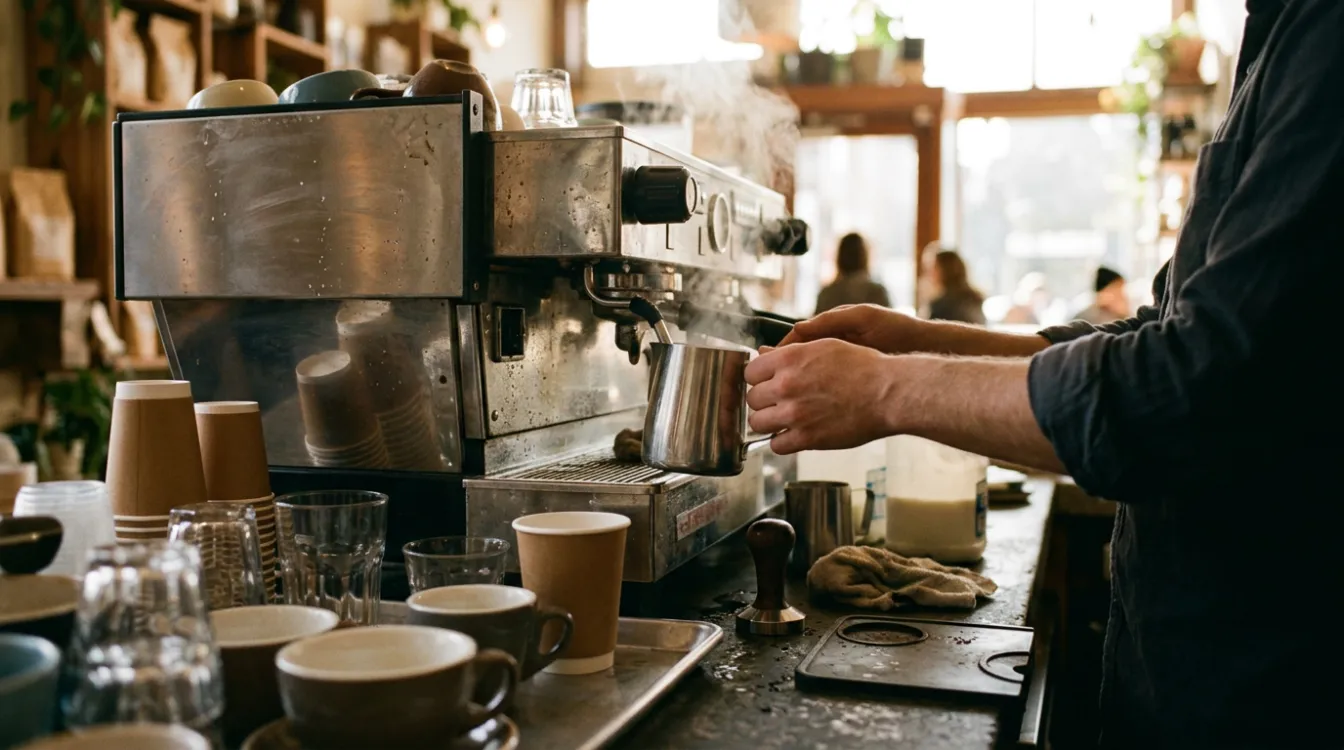
Labor is usually the largest single cost in a café. It's not just the barista making your drink; it's everyone needed to keep the café running.
- Baristas working every shift, including slow hours when the café still needs to be staffed.
- Shift leads and managers handling scheduling, ordering, cash, training and problems.
- Payroll taxes, insurance and benefits that add to the cost of every hour worked.
- Training time: good baristas take weeks or months to train, and the café pays for that time.
- Paid breaks, sick days and holidays in many countries.
Making specialty coffee well is skilled work. A barista has to dial in espresso, steam milk properly, pour latte art, keep the station clean, handle a rush and look after customers, all at once. My article on a day in the life of a barista shows what that looks like from behind the bar.
Why labor costs are hard to cut
A café can't simply staff the counter only when it's busy. Customers arrive unpredictably, and a long wait drives them away. So cafés must pay for staff during quiet periods too. That means each drink sold has to carry part of the cost of the slow hours.
In many cities, wages have also risen in recent years, which is a good thing for workers but adds directly to the cost of every cup.
Rent: paying for the address
Rent is often the second-biggest cost for a café, and it's where location matters most.
A café's business depends on foot traffic. The best spots, near offices, train stations, busy streets and shopping areas, are exactly the places with the highest rents. A café in a prime spot might pay many times what a café on a quiet side street pays for the same space.
Occupancy costs also include:
- Service charges and building fees.
- Property taxes passed on by landlords in many leases.
- Fit-out costs: building the counter, plumbing, electrical work, seating and design, often a big upfront investment.
- Seating space: tables and chairs take up rent-paying floor space, even when customers stay for hours with a single coffee.
When you sit in a café for an afternoon, part of what you're paying for is that seat, the Wi-Fi, the restroom and the heating or air-conditioning.
Equipment, utilities and other overhead
Behind every great coffee is expensive equipment that has to be bought, maintained and eventually replaced.
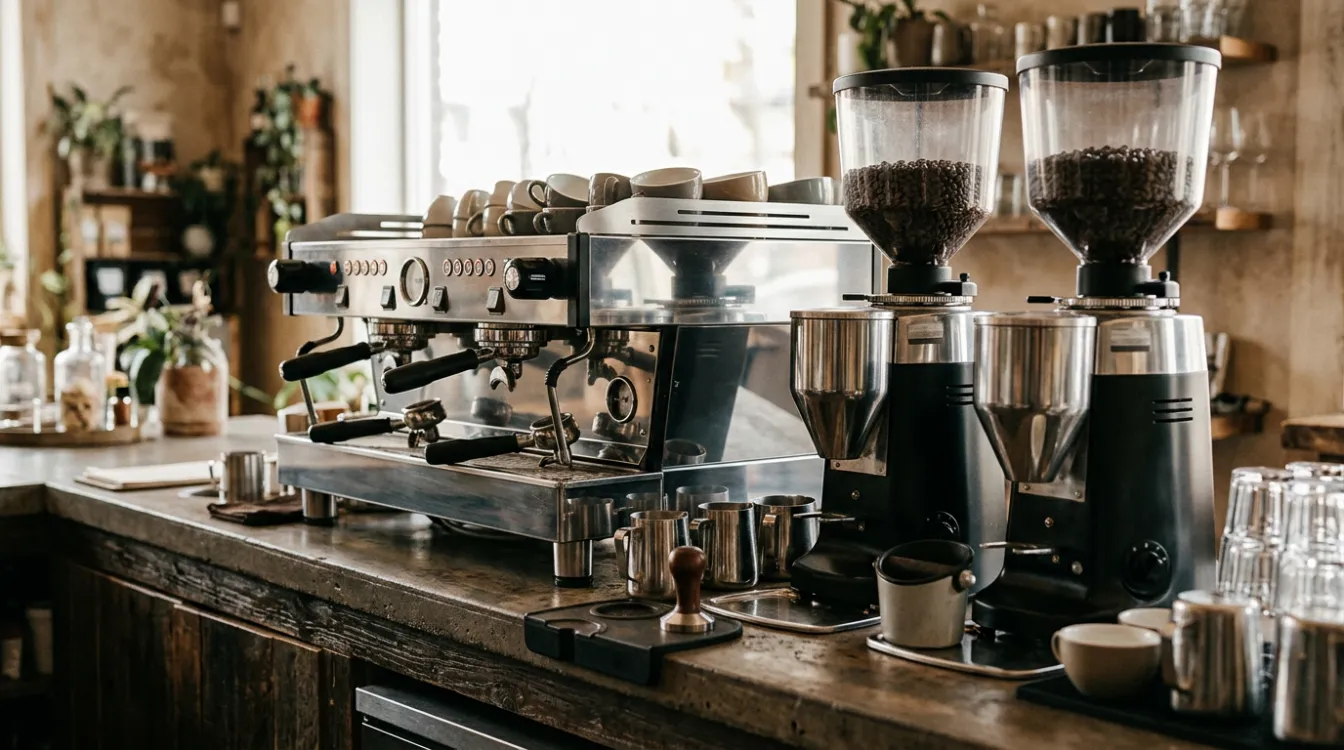
- Espresso machines: commercial machines are built for heavy daily use and cost far more than home machines. My guide to espresso machine types explains why commercial dual boilers and multi-group machines are so robust.
- Grinders: most specialty cafés run several grinders, for house espresso, decaf, guest coffee and filter.
- Water filtration: essential for taste and to protect machines from scale.
- Refrigeration: milk fridges, display cases and storage.
- Dishwashers, brewers and blenders.
- Point-of-sale systems and card readers, along with card processing fees on most transactions.
- Repairs and servicing: a broken machine during a rush is a disaster, so cafés pay for regular maintenance.
Utilities and the rest
- Electricity: espresso machines run hot all day, along with fridges, lights and dishwashers.
- Water and waste disposal.
- Insurance: property, liability and staff.
- Licenses and permits: food safety, signage, outdoor seating.
- Accounting, marketing and software.
- Cleaning supplies and pest control.
Each of these is small on its own. Together they take a meaningful share of every drink.
Profit: thinner than you think
After paying for ingredients, labor, rent and overhead, many independent cafés are left with a modest profit margin, often somewhere around 10% or less, and some barely break even.
That margin has to cover:
- Paying back the initial investment in building the café.
- Saving for new equipment and repairs.
- Surviving slow months, bad weather, roadworks or a new competitor nearby.
- Giving the owner an income, especially in small cafés where the owner works long hours behind the bar.
Many cafés close within their first few years. High costs and thin margins make it a tough business, even when the coffee is excellent.
A worked example: one cup, many costs
It helps to picture the price of a single drink as a stack of small slices. Let's take a typical milk drink in a busy specialty café and split its price into 100 parts.
| Cost | Share of the price | What it pays for |
|---|---|---|
| Labor | About 35 parts | Barista time, managers, payroll taxes, training |
| Product | About 30 parts | Coffee, milk, cup, lid, sugar, waste |
| Rent | About 15 parts | The location, seating, fit-out |
| Overhead | About 10 parts | Machines, repairs, electricity, insurance, card fees |
| Profit | About 10 parts | Reinvestment, owner income, safety buffer |
Within those 30 parts for product, the coffee itself might be only a few parts. Milk and the takeaway cup often cost the café as much or more.
So when we focus on how little the beans cost, we're looking at only a tiny slice of the picture.
Why home coffee is so much cheaper
At home, you don't pay yourself for your time, you don't pay rent for your kitchen counter (at least not separately), and you already own the cups.
- Labor: your own time, unpaid.
- Rent: already covered by your home.
- Equipment: a home machine, used for a few cups a day.
- Product: coffee and milk, with no packaging.
That's why home coffee is so much cheaper per cup. But it also means you're doing the work, cleaning the equipment and buying the beans. A café is selling convenience, skill, consistency, atmosphere and a place to sit.
If you want café-quality coffee at home, good beans and a decent grinder matter most. My guides to coffee grind size and espresso brew time are good places to start.
What reaches the farmer?
One of the hardest truths about coffee economics is how little of the final price reaches the people who grow it.
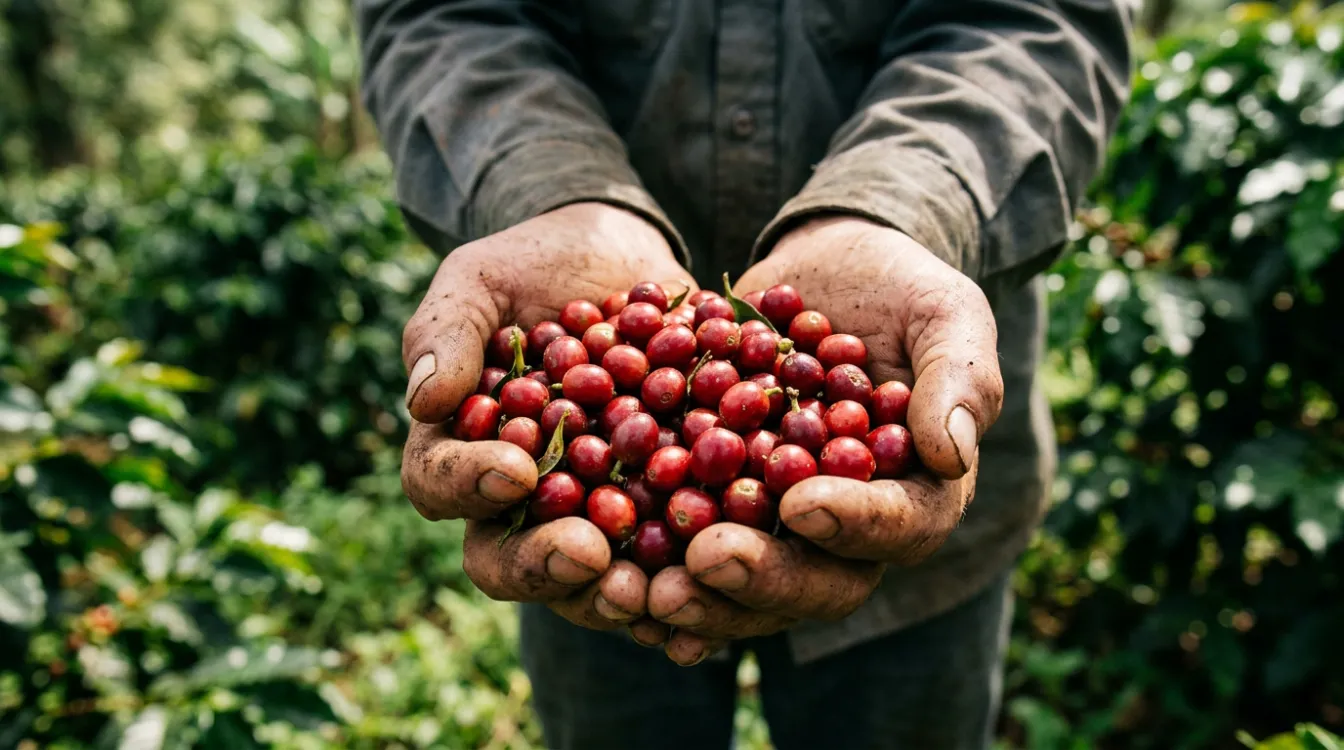
Coffee passes through many hands before it reaches your cup: farmers, local collectors or cooperatives, processors, exporters, importers, roasters, distributors and finally cafés. Each step adds costs and margins.
For a café drink, the farmer's share is usually a very small fraction of the final price, often just a few percent. Even for whole-bean coffee sold in shops, farmers typically receive only a minority of the retail price.
Why farmer prices are so volatile
Most coffee is traded on commodity markets, where prices swing with weather, harvest size in major producing countries, currency movements and speculation. In some years, the market price falls below what it costs many farmers to grow coffee.
This affects millions of smallholder farmers, many of whom farm only a few acres. Low prices can push families out of coffee, encourage farmers to switch crops, or make it hard to invest in quality and sustainability. Climate change adds further pressure; my guide to climate change and coffee explains how.
Specialty and direct trade
Specialty roasters often pay well above commodity prices for high-quality lots, and some build direct relationships with farms. That premium helps reward quality and gives farmers more stable income, though it's still a small part of the café drink's price.
Certifications such as Fairtrade, Rainforest Alliance and organic also aim to improve conditions. My guide to coffee certifications explains what each one promises and how much it really delivers.
Responsible sourcing costs more, and it's worth it
Responsible sourcing raises costs. Paying farmers fairly, buying traceable lots, investing in long-term relationships and supporting sustainability programs all cost more than buying the cheapest commodity coffee.
But as we've seen, coffee is a small share of a café drink's price. Paying significantly more for better, fairly sourced coffee raises the cost of each cup only slightly. A café that pays farmers well and charges a little more per drink can make a real difference along the supply chain.
That's why I'd rather pay a bit more in a café that's transparent about where its coffee comes from. My article on why single-origin coffee is so expensive explores the costs behind traceable coffee.
Why prices differ between cafés
Not all cafés price their drinks the same way. Different business models have very different costs.
| Café type | Typical strengths | Main cost pressures |
|---|---|---|
| Large chains | Buying power, efficiency, brand | Marketing, prime locations, scale |
| Independent specialty cafés | Quality, skilled baristas, community | Rent, labor, higher-priced coffee |
| Drive-throughs | Speed, convenience | Equipment, labor, land |
| Kiosks and carts | Low rent, simple setup | Limited menu, weather, volume |
| Café-roasters | Fresh, own-roasted coffee | Roasting equipment, extra staff |
| Hotel and restaurant cafés | Convenience, captive customers | Shared overhead, service style |
Chains benefit from buying in huge volumes and standardizing everything, which keeps product costs down. But they also spend heavily on marketing and prime locations. Independent cafés usually can't negotiate the same discounts, but they may save on marketing and focus on quality.
What café owners told me
Over the years I've talked with several café owners about money, usually over a coffee after closing time. A few themes came up again and again.
"The coffee is the cheap part"
Almost every owner said the same thing in different words: customers focus on the beans, but the beans are rarely the problem. One owner told me that switching to a noticeably better coffee changed his costs far less than a single extra staff shift each week.
"Rent decides everything"
Owners in busy city centers said rent determined their prices more than anything else. One owner moved from a prime corner to a quieter street, kept her menu identical and was able to hold her prices steady for longer, even as other costs rose.
"Slow hours are expensive"
Several owners mentioned mid-afternoon lulls. The café still needs to be open, clean and staffed, with machines hot, even when only a few customers come in. Those quiet hours are paid for by the busy ones.
"Waste is invisible but real"
Every morning, baristas pull shots to dial in the grinder. Milk gets poured away when it's over-steamed. Pastries go unsold. Drinks get remade. Owners told me waste is one of the hardest costs to control and one of the easiest to underestimate.
"We'd love to pay more"
Many owners wanted to pay their staff more and buy more fairly sourced coffee, but felt limited by what customers would accept. They often described pricing as a balancing act between fairness and staying in business.
The hidden life of a single latte
It's easy to forget how much work goes into a single cup. Here's what happens before and after your latte reaches you:
- On the farmCoffee is grown, picked by hand, processed and dried, often over months.
- Export and shippingGreen coffee is sorted, bagged, checked for quality and shipped across the world.
- RoastingA roaster profiles, roasts, cups and packs the coffee, then delivers it to the café.
- Opening the caféStaff arrive early to switch on machines, dial in espresso, stock milk and set up the bar.
- Making the drinkThe barista grinds, tamps, pulls the shot, steams the milk and pours the latte.
- Serving and cleaningThe cup is served, the table is cleared, the cup is washed, and the bar is cleaned between drinks.
- Behind the scenesSomeone orders supplies, does payroll, pays rent, fixes the machine and deals with taxes.
Each step has a cost. The price of a latte has to cover a small slice of all of it.
What you're really paying for
When you buy a coffee in a café, you're paying for much more than a drink.
- Skill: a well-trained barista can make a drink you'd struggle to make at home.
- Consistency: the same drink every time, made with dialed-in equipment.
- Convenience: no beans to buy, no machine to clean, no time spent.
- Space: a place to meet friends, work or simply sit.
- Atmosphere: music, design, lighting and the buzz of other people.
- Service: a friendly face, recommendations and sometimes a chat.
- Community: many cafés become neighborhood hubs, hosting events or supporting local causes.
Seen that way, the price of a café drink makes more sense. It's a small luxury that pays for an entire small business.
Why some cafés struggle in certain seasons
Café income isn't steady through the year. Many cafés see clear seasonal swings, and those affect pricing too.
- Summer can be busy for cafés in tourist areas but quiet for those near offices and universities.
- Winter holidays may bring a rush of shoppers, followed by a slow January.
- Weather matters: rainy days can keep customers at home, while sunny days fill outdoor seating.
- Iced drinks season shifts sales toward cold brew and iced lattes, which need extra prep and storage.
Rent, wages and loans must be paid every month, busy or not. Prices therefore have to be set high enough to carry the café through its slow periods, not just its best weeks.
Why some drinks cost more than others
Café menus often have big price differences between drinks that seem similar. There are good reasons:
- Milk drinks cost more than black coffee because milk is a major ingredient cost, and steaming it takes extra barista time.
- Plant milks often carry an upcharge because they cost the café more than dairy.
- Larger sizes use more milk and more coffee, but the labor stays similar, so the price per ounce usually drops as size increases.
- Flavored drinks add syrups, sauces and toppings, plus extra time to make.
- Pour-over takes several minutes of a barista's undivided attention, so it often costs more than batch-brewed drip coffee. My guide to pour over vs drip coffee explains the difference.
- Single-origin and rare coffees such as Geisha cost much more to buy. My article on the most expensive coffee explores why some lots fetch extraordinary prices.
- Cold brew and nitro need long brewing times, extra equipment and refrigeration. My guide to nitro cold brew explains the equipment involved.
Why café prices keep going up
Café prices have risen in many countries in recent years, and several factors are behind it:
- Green coffee prices: poor harvests and weather problems in major producing countries have pushed commodity prices up sharply at times.
- Milk prices: dairy and plant milk costs have risen with feed, energy and transport costs.
- Wages: higher minimum wages and a tight labor market mean higher payroll costs.
- Rent: commercial rents in busy areas continue to climb.
- Energy: electricity and gas costs affect machines, roasting and refrigeration.
- Packaging: takeaway cups and lids, especially compostable or recyclable ones, cost more.
- Transport and shipping: fuel and shipping disruptions add costs throughout the supply chain.
- Card fees and software: more payments are by card or app, each with a fee.
Because cafés already run on thin margins, they usually can't absorb these increases and have to pass them on to customers.
Why cafés sell food, beans and merchandise
If coffee alone barely pays the bills, how do cafés survive? Many rely on more than drinks.
- Pastries and breakfast: food raises the average spend per customer. A coffee with a croissant brings in much more than a coffee alone, with only a little extra labor.
- Lunch menus: sandwiches, salads and soups help cafés stay busy beyond the morning rush.
- Whole beans: selling bags of coffee to take home adds income without using seats or barista time.
- Brewing equipment: grinders, drippers and kettles appeal to customers who want to brew better at home.
- Merchandise: mugs, reusable cups and tote bags build the brand.
- Catering and wholesale: some cafés supply offices or other businesses, which spreads costs over more sales.
Food brings its own costs, though. It spoils, it needs refrigeration and kitchen space, and it must meet strict food safety rules. Unsold pastries at the end of the day are pure loss, which is why many cafés discount them late in the day or donate them.
For café owners, the goal is balance: a menu that brings customers in, keeps them happy and makes each visit worth enough to cover the costs of keeping the doors open.
The average spend matters most
Many owners think less about the price of one drink and more about the average spend per visit. If most customers buy one small black coffee and stay for two hours, the café struggles. If customers buy a coffee and something to eat, or come back several times a week, the numbers start to work.
That's why loyalty programs, friendly service and good food matter so much. A regular customer who visits every morning is worth far more to a café than a one-time visitor, and cafés price and plan around keeping those regulars happy.
How cafés decide what to charge
Café owners don't just add up costs and pick a number. Pricing usually combines several approaches.
Cost-based pricing
The starting point is often the cost of each drink. Owners calculate what each drink costs to make in ingredients and packaging, then aim for that to be a target share of the menu price, often around a quarter to a third. The rest has to cover labor, rent, overhead and profit.
Competitor pricing
Cafés keep an eye on nearby competitors. If every café on the street charges about the same, a café that charges much more needs a clear reason, such as better coffee, a nicer space or faster service.
Value and positioning
A specialty café serving rare single-origin coffee by skilled baristas positions itself differently from a quick takeaway kiosk. Customers expect to pay more for a premium experience and less for a basic one.
Menu design
Many cafés design menus carefully. Popular, high-margin drinks are placed prominently. Size steps are set so the larger size feels like better value. Add-ons such as an extra shot, syrup or plant milk are priced individually, so customers pay for exactly what they use.
Psychological thresholds
Owners often avoid crossing round-number thresholds that customers notice, raising prices in small steps instead of large jumps. When costs rise sharply, they may change sizes, recipes or add-on charges rather than raise the headline price of a basic coffee.
Specialty cafés vs commodity coffee
The coffee a café chooses affects both taste and costs, though perhaps less than you'd expect.
| Factor | Commodity coffee | Specialty coffee |
|---|---|---|
| Bean quality | Mixed grades, often darker roasted | High-graded, carefully sorted |
| Traceability | Often limited | Often to region, farm or lot |
| Price paid to supply chain | Tied to commodity markets | Usually higher, quality-based premiums |
| Effect on café drink price | Small | Small, but noticeable at the top end |
| Flavor | Consistent, often roast-forward | More distinctive, origin-driven |
Specialty cafés also tend to invest more in training, equipment and water, which adds to costs. But they offer flavors and quality many people can't easily match at home. My guide to coffee cupping explains how specialty coffee is graded.
Is café coffee worth the price?
That depends on what you value. If you want the cheapest caffeine possible, brewing at home wins easily. If you value skill, convenience, a place to meet people and supporting a local business, café coffee can be worth it.
For me, it's both. I brew at home most mornings using beans from cafés I like. Then I visit those cafés a few times a week for a drink I couldn't make as well myself, a chat with the barista and a change of scenery. That way I enjoy great coffee every day and still support the businesses I want to keep around.
Understanding where the money goes has made me less annoyed by café prices and more appreciative of what goes into every cup. It has also made me more willing to pay a little extra at cafés that are open about paying farmers and staff fairly.
Our tip: Ask your barista which coffee is on today and where it comes from. Cafés that care about sourcing are usually happy to tell you, and it's a good sign of where your money goes.
Why small cafés can't just copy chains
Chains can negotiate lower prices for milk, cups and equipment because they buy in enormous volumes. A small independent café pays more for the same items, so it has to compete on quality, service and atmosphere instead of price.
Why café prices vary between countries
A cup of coffee can cost very different amounts depending on where you are. The biggest drivers are usually local wages and rents, not the coffee itself.
- High-wage cities such as major Western European, North American and Australian cities tend to have higher café prices, largely because labor and rent cost more.
- Coffee-producing countries sometimes have lower café prices for local coffee, but imported equipment and milk can still be expensive.
- Espresso-bar cultures, like Italy, often keep a short espresso drunk standing at the bar relatively affordable. Higher prices may apply if you sit at a table, because you're paying for the space and table service.
- Taxes such as sales tax or VAT add a share to the price that goes to the government, not the café.
- Tipping cultures change how staff are paid and how customers experience the total cost.
Even within one country, prices can vary widely between a rural café, a suburban chain and a downtown specialty bar.
How to enjoy café coffee for less
I love cafés, but I don't buy every coffee there. A few habits help balance cost and enjoyment:
- Choose simpler drinks. Black coffee, filter coffee or a plain espresso usually costs less than a large flavored latte.
- Bring your own cup. Many cafés offer a discount for reusable cups because they save on packaging.
- Use loyalty programs. Stamp cards and apps reward regulars.
- Drink in. In some places, sitting in costs the same and saves a takeaway cup; in others, standing at the bar is cheaper.
- Buy beans from your favorite café. Brewing their coffee at home most days and visiting as a treat supports them and saves you money.
- Make cold brew at home. It's simple and cheap to make in batches. My guide to the science of cold brew shows how.
- Invest in a grinder. Freshly ground coffee at home makes the biggest difference in quality. My comparison of hand grinders vs electric grinders helps you choose.
The hidden cost of takeaway cups
Takeaway cups are one of the hidden costs in café coffee, both financially and environmentally.
Most paper cups are lined with a thin layer of plastic to stop them leaking, which makes them hard to recycle in many places. Lids are usually plastic too. Compostable cups exist, but they often cost cafés more and only break down properly in industrial composting facilities.
Many cafés now encourage reusable cups with discounts, deposit schemes or "for here" mugs. If you buy coffee regularly, a reusable cup is an easy way to cut waste and sometimes save money.
Tipping and barista wages
In some countries, tipping baristas is common and makes up an important part of their income. In others, tipping is rare and wages are expected to cover everything.
Where tipping is common, tips help close the gap between base wages and a living income. Where it isn't, higher menu prices may already reflect higher wages.
Either way, the people behind the bar are one of the biggest reasons your coffee costs what it does. Fair pay helps cafés keep experienced staff, which usually means better coffee.
Myths about café prices
"Cafés make huge profits on coffee"
Coffee drinks have relatively low ingredient costs, but labor, rent and overhead take most of the price. Many cafés operate on thin margins.
"Cheaper beans would make coffee much cheaper"
The coffee is a small share of the price. Switching to cheaper beans saves very little per cup but can hurt taste.
"Chains are cheaper because their coffee is worse"
Chains keep prices competitive mainly through buying power, standardization and efficiency, not just bean quality.
"The farmer gets a big share"
Sadly, farmers typically receive a very small fraction of the final café price.
"Plant milk upcharges are pure profit"
Plant milks usually cost the café more than dairy milk, and they're often bought in smaller volumes.
The verdict
Café coffee is expensive mainly because of everything around the coffee, not the coffee itself. Labor, rent, equipment, utilities, packaging and taxes together far outweigh the cost of the beans, and most cafés are left with a modest profit.
The coffee in your cup is one of the smallest costs, which means paying a little more for better, fairly sourced beans makes a big difference to farmers with only a small change in price.
Next time you pay for a latte, remember you're paying for skilled people, a place to sit, expensive machines and a business trying to survive on thin margins. Brew at home when you want to save, and enjoy cafés for what they really offer.
A quick reality check
The next time a café drink seems expensive, try a simple exercise: count the people working behind the counter, look at the size of the space and the machines, and think about the rent on that street. Then remember that the café has to pay for all of it every month, whether the day is busy or quiet. Seen that way, the price on the menu starts to make a lot more sense.
Frequently asked questions
Why is café coffee so expensive?
Mostly because of labor, rent and overhead, which together take far more of the price than the coffee itself.
How much of a café drink is the coffee?
Only a small fraction. Milk and takeaway packaging often cost the café as much as the coffee.
Do cafés make big profits?
Usually not. Many independent cafés have margins of around 10% or less.
Why do plant milks cost extra?
They usually cost the café more than dairy milk.
How much does the farmer get?
Typically only a few percent of a café drink's price.
Why are café prices rising?
Higher costs for green coffee, milk, wages, rent, energy and packaging.
Why is coffee cheaper at home?
You don't pay for labor, rent or packaging, and you do the work yourself.
Would cheaper beans lower café prices?
Only slightly, because the coffee is a small share of the price.

- Michael Reynolds, conversations with café owners
- Coffeehouse, Wikipedia
- Economics of coffee, Wikipedia
- Coffee production, Wikipedia
- Fair trade coffee, Wikipedia
Related guides
Why single-origin coffee is so expensive A day in the life of a barista Coffee certifications explainedWritten by Michael Reynolds. Last updated November 20, 2026.