Espresso Machine Types Explained: Single Boiler vs Heat Exchanger vs Dual Boiler
The boiler is the heart of every espresso machine. It decides whether you can steam milk while pulling a shot, how stable your brew temperature is and how big, loud and power-hungry the machine will be. I've lived with all three main designs at home. Here's how single boiler, heat exchanger and dual boiler machines work, and which one fits the way you drink coffee.
We choose products independently. We may earn a commission through links on this page; your price stays the same. Affiliate policy
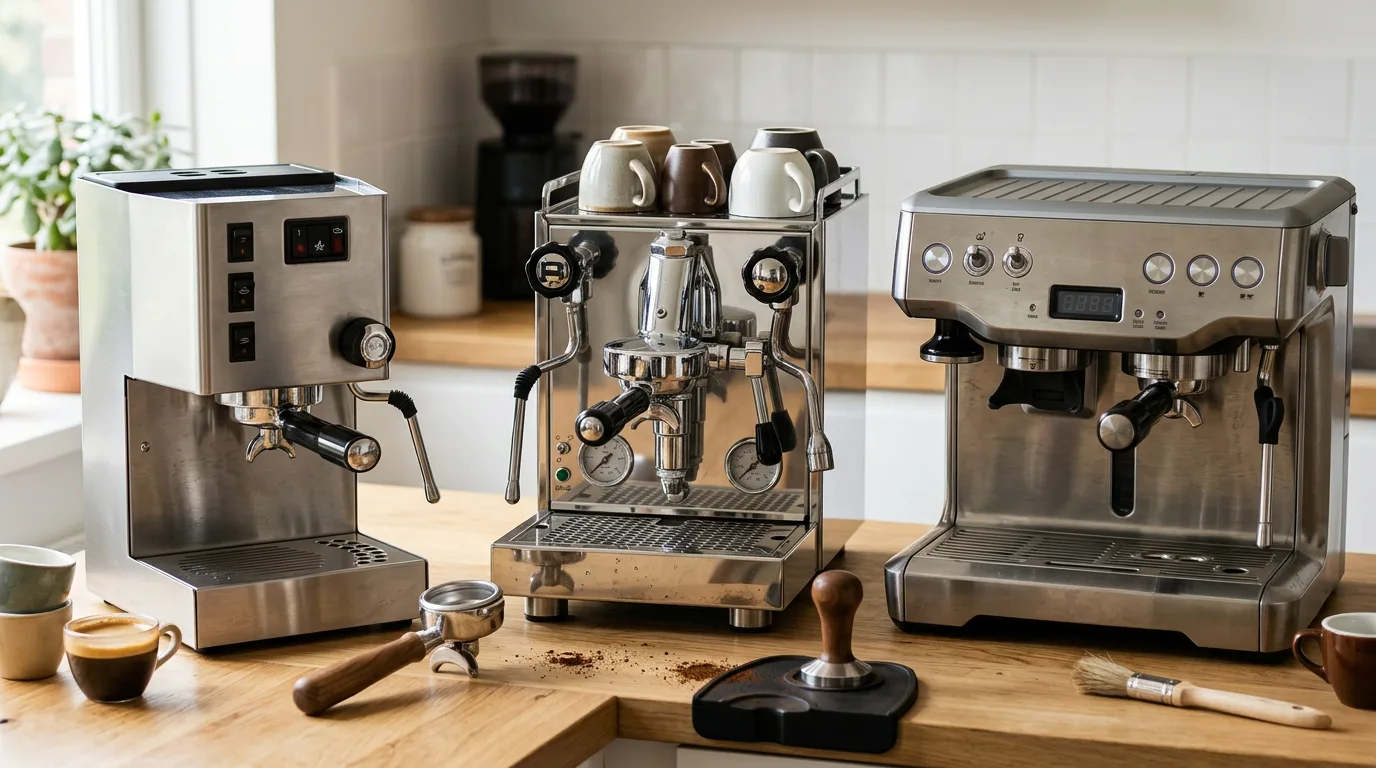
A single boiler is the simplest and most affordable, but you brew and steam one after the other. A heat exchanger (HX) lets you brew and steam at the same time from one big steam boiler. A dual boiler gives each job its own boiler, so you get simultaneous brewing and steaming plus the most precise brew temperature. If you mostly drink straight espresso, a single boiler is enough. If you make several milk drinks a day, look at an HX. If you want zero compromises, or love light roasts, a dual boiler is worth the extra size and cost.
Why the boiler matters most
Whether you're buying your first real espresso machine or your third upgrade, for a kitchen, an office or a small café, the single most important decision is the boiler system.
The boiler is a water vessel inside the machine that acts as its thermal engine. Every drop of brew water and every puff of steam comes from it.
Its design shapes almost everything you'll notice day to day: how fast you can make a cappuccino, how steady your shots taste, how much counter space the machine needs and how long it takes to warm up.
I started on a single boiler, moved to a heat exchanger when my household's latte habit grew, and now use a dual boiler. Each step solved a real problem, and each one came with trade-offs I'll be honest about.
Single boiler vs HX vs dual boiler at a glance
| Feature | Single boiler | Heat exchanger | Dual boiler |
|---|---|---|---|
| Boilers | 1 | 1 steam boiler + brew tube | 2 (brew + steam) |
| Brew and steam together | No | Yes | Yes |
| Brew temperature precision | Good (with PID) | Moderate | Excellent |
| Steam power | Modest, after a wait | Strong | Strong |
| Back-to-back milk drinks | Slow | Good | Effortless |
| Size and weight | Compact | Medium | Large, heavy |
| Power use | Lowest | Moderate | Highest |
| Relative cost | Lowest | Middle | Highest |
| Best for | Espresso drinkers, small kitchens | Daily milk drinks, households | Enthusiasts, high volume |
How an espresso machine boiler works
At its simplest, a boiler takes cold or room-temperature water and heats it to the precise temperatures that brewing and steaming need. The sequence is the same in every design:
- Water comes inWhen the machine is on, water is drawn from a removable reservoir holding dozens of ounces, or straight from a plumbed water line.
- The element heats itAn electric heating element inside the boiler transfers energy straight into the surrounding water.
- A controller holds the temperatureTraditionally a pressurestat switches the element on and off based on steam pressure. Most modern machines use a digital PID controller, which reads temperature directly and keeps it much steadier.
- Water or steam goes outHot water flows to the group head for brewing (about 1.5 to 2 ounces for a double shot), while steam goes to the steam wand.
The difference between the three types is really about how many vessels do this job and how the brew water and steam are separated.
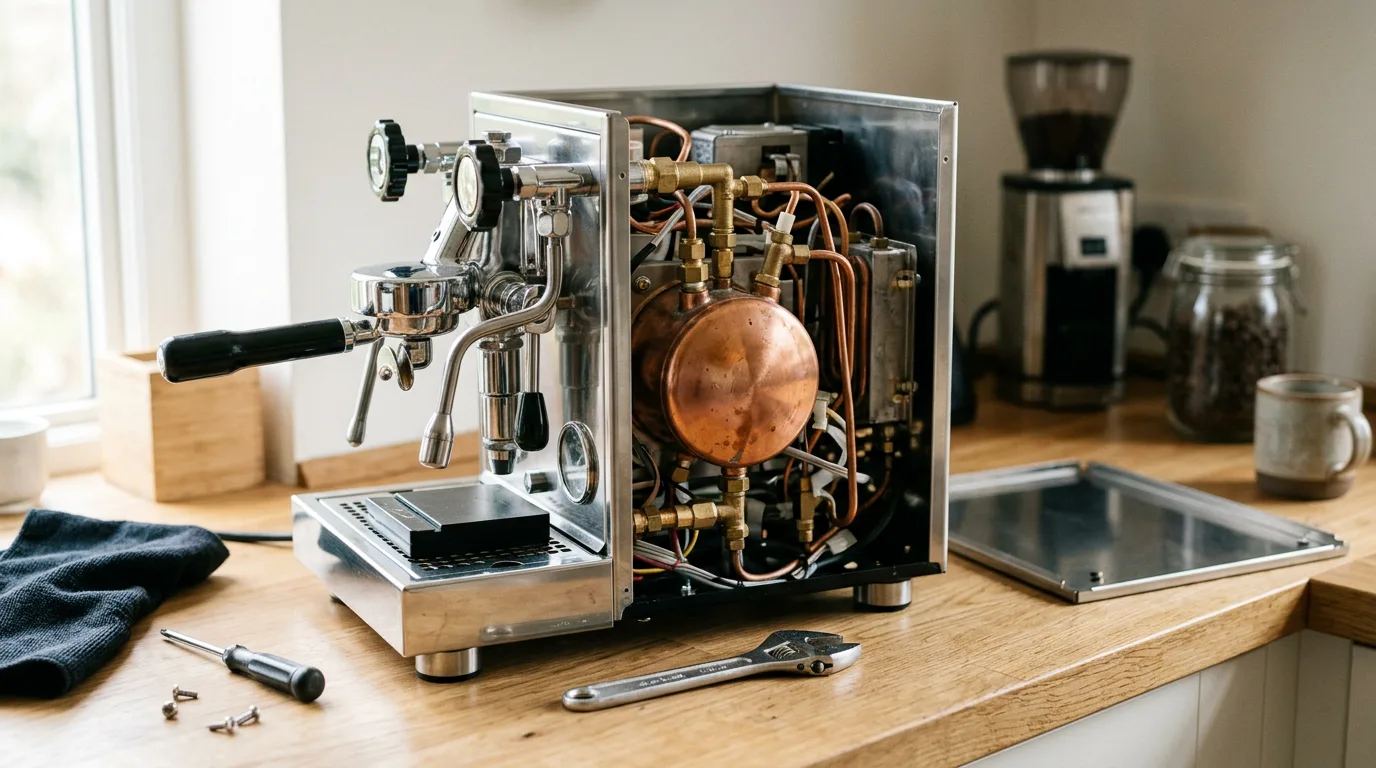
Boiler materials: brass, copper and stainless steel
Prosumer and commercial machines use a few specific metals for their boilers, sometimes combined in one vessel.
Brass
Common in more affordable, entry-level and compact machines. Brass holds heat well and is cost-effective to machine into complex shapes.
Copper
Found in many higher-end prosumer and commercial machines. Copper conducts heat exceptionally well, so it heats quickly and recovers fast after you pull water or steam.
Stainless steel
Widely used in modern commercial and high-end machines. It's durable, resists scale buildup and corrosion, and is easy to keep clean inside.
In practice, the material matters less than the boiler's size, its insulation and how well its temperature is controlled. I wouldn't choose a machine on boiler metal alone.
Our tip: Ask whether a boiler is insulated. An insulated boiler warms up faster, holds temperature better and wastes less energy, whatever metal it's made of.
Why brewing and steaming need different temperatures
This is the root of the whole boiler question. Espresso and steam need very different temperatures.
Espresso extracts best with water at roughly 194 to 201°F (90 to 94°C). Go much hotter and shots turn bitter and harsh. Go cooler and they taste sour and thin.
Steam that can texture milk needs water heated well above boiling under pressure, typically around 248°F (120°C) or more. Only then do you get dry, powerful steam.
Typical temperatures inside an espresso machine
One vessel can't sit at both temperatures at once. Each boiler design is a different answer to that problem.
Single boiler espresso machines
A single boiler machine has exactly one water vessel and one heating element. That one boiler handles both brewing and steaming.
Because the same water serves both jobs, the machine can't brew espresso and steam milk at the same time. It works in two separate modes.
Brew mode
The boiler holds water at espresso temperature, roughly 194 to 201°F. You lock in the portafilter and pull your shot.
Steam mode
You flip a switch and the element heats the whole boiler up to steam temperature, around 248°F. After a short wait, the steam wand is ready.
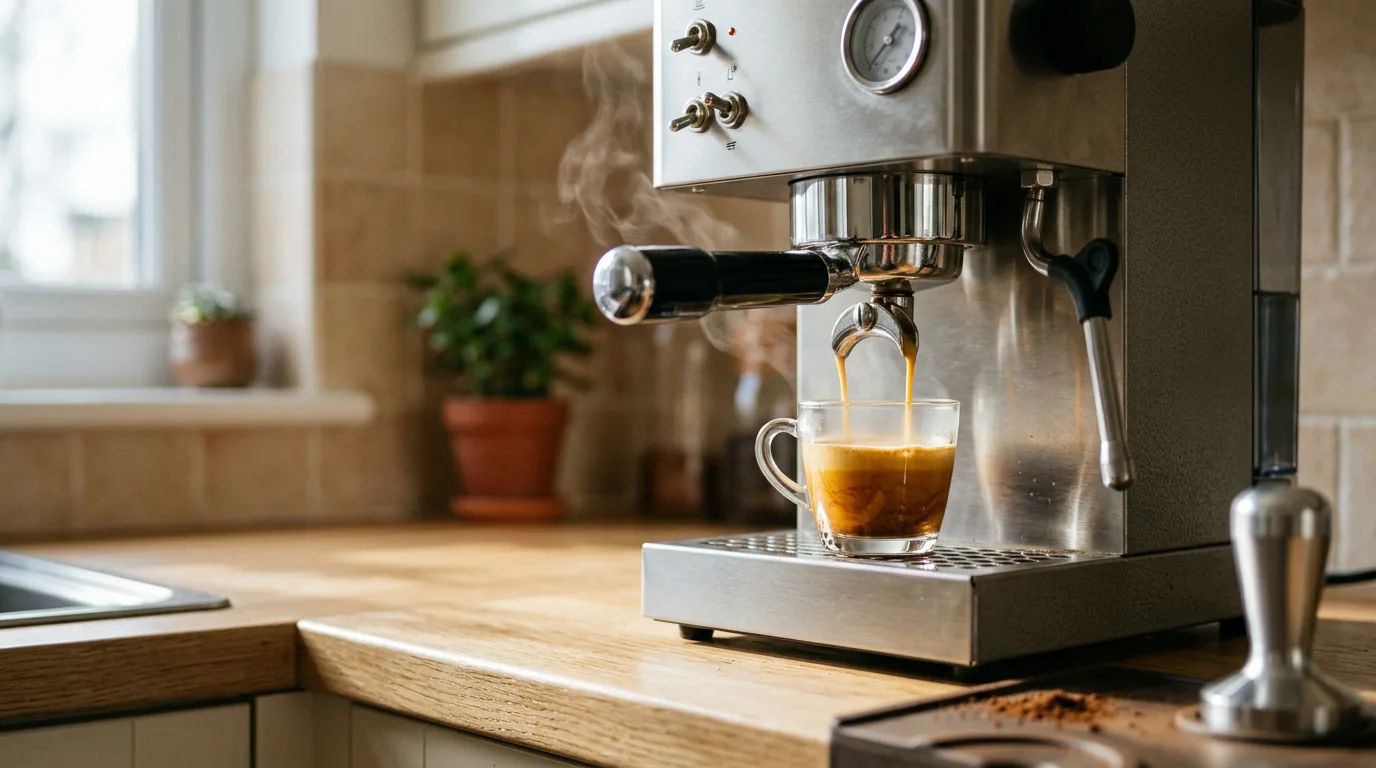
My first serious machine was a single boiler, and for straight espresso it was brilliant. Shots were consistent, the machine was small, and there was almost nothing to go wrong.
Advantages
- Compact footprint. With one boiler and simple plumbing, these machines are narrower and shallower, ideal for small kitchens.
- Simplicity. Fewer valves, sensors and tubes mean straightforward use and simpler long-term maintenance.
- Affordability. They cost far less than HX or dual boiler machines, making them an accessible entry into real espresso.
Limitations
- Sequential workflow. You can't brew and steam together, which slows down lattes and cappuccinos.
- Cooling flushes. Going from steam back to brewing means flushing water to cool the boiler, which makes back-to-back milk drinks tedious.
Well-known single boiler machines include the Rancilio Silvia, the ECM Classika and the Profitec Go.
A single boiler milk drink, step by step
Here's what making a cappuccino on a single boiler actually looks like:
- Pull the shot firstWith the boiler stable at brew temperature, lock in the portafilter and pull your double shot.
- Switch to steamPress the steam switch. The element raises the whole boiler to steam temperature, which takes a minute or so.
- Steam the milkOnce the steam light comes on, open the wand and texture 6 to 10 ounces of cold milk in a pitcher.
- Pour and enjoyCombine the milk with your espresso. The shot will have waited a little, which is the main compromise.
- Cool down before the next shotIf you want another espresso straight away, run water through the group until the boiler drops back to brewing temperature.
That last step is the one people underestimate. Brewing straight after steaming means using water that's around 248°F, which scorches the coffee and tastes harsh and burnt.
Our tip: On a single boiler, make all the espresso first, then steam all the milk. For two cappuccinos, pull both shots, then steam one larger pitcher.
Heat exchanger (HX) espresso machines
A heat exchanger machine sits between a single and a dual boiler. It delivers much of the simultaneous workflow of a dual boiler at a lower cost.
At first glance it has just one large boiler, often holding 50 to 70 ounces. The clever part is inside.
The steam boiler
The main boiler is kept at steam temperature all the time, around 248°F or more. It supplies steam to the wand whenever you need it.
The heat exchanger tube
Running through the middle of that hot boiler is a separate, sealed metal tube. Fresh water from the reservoir flows through this tube on its way to the group head.
As it passes through, the surrounding steam boiler heats it to brewing temperature. The brew water never mixes with the boiler water, so it's always fresh.
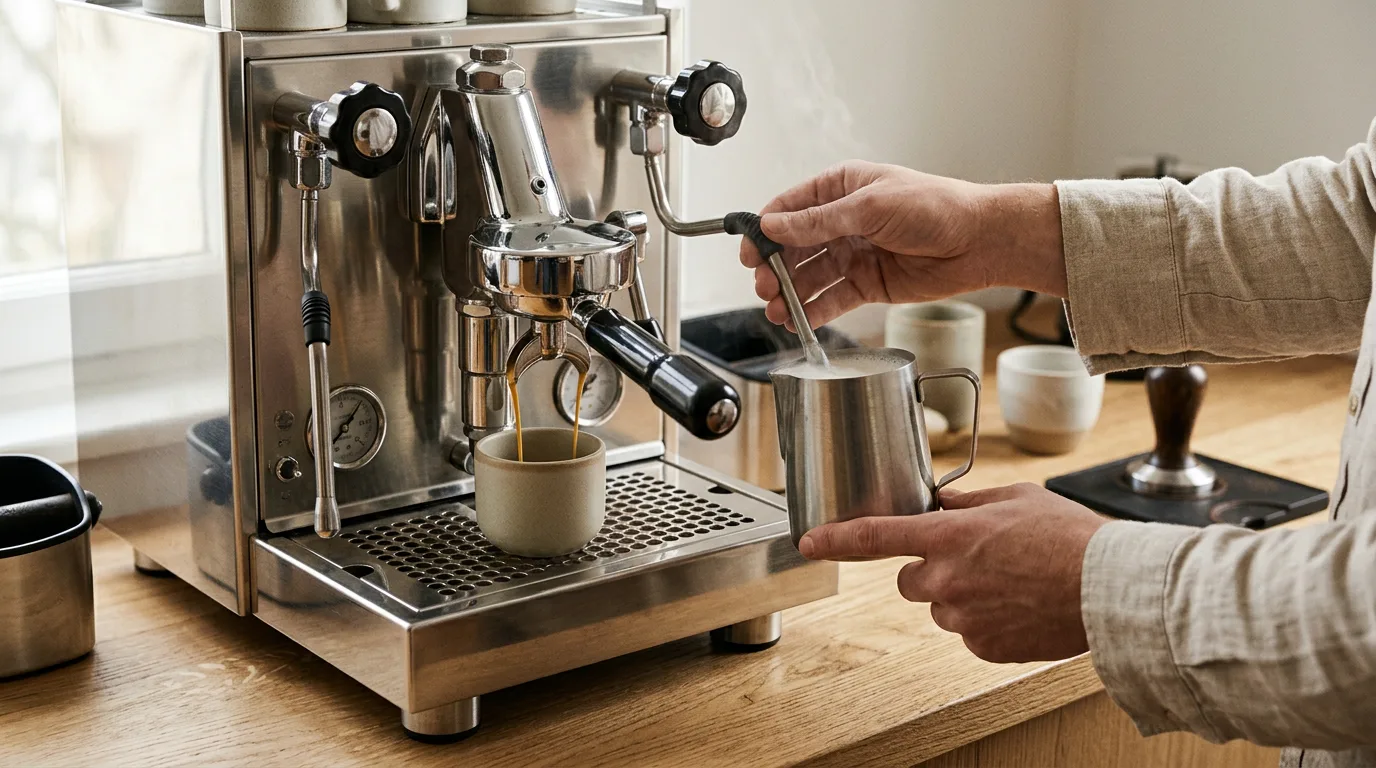
Because the steam and brew paths are independent, you can pull a shot and steam milk at the same time. When I moved to an HX, my morning routine for two cappuccinos dropped by several minutes.
Advantages
- Brew and steam together. A real time saver for lattes, cappuccinos and flat whites.
- Cost-effective. Dual-purpose capability for considerably less than a dual boiler.
- Energy efficient. One heating element for one main boiler draws less power than heating two.
- Strong steam. A large boiler dedicated mainly to steam gives brisk, powerful milk texturing.
- Back-to-back drinks. It handles several shots and pitchers in a row, fine for households and small gatherings.
Limitations
The weak point is brew temperature precision. The brew water is heated indirectly by a much hotter boiler, so its exact temperature depends on how long the machine has been idle.
Popular heat exchanger machines include the Rocket Appartamento, the ECM Mechanika and the Profitec Pro 400.
The HX cooling flush
When an HX machine sits idle, the water in the heat exchanger tube slowly creeps toward steam-boiler temperature. Pull a shot right away and the first water can be far too hot.
The fix is a cooling flush. Before brewing, you run a few seconds of water through the group head until the hissing and spitting stop and the flow settles. That clears the overheated water.
It sounds fiddly, and at first it is. After a week, it became automatic for me: flush, lock in, brew.
- After a long idle: flush until the sputtering stops, then a couple of seconds more.
- Between shots: a short flush is usually enough.
- For darker roasts: flush a little longer to bring the temperature down.
Many modern HX machines reduce the need for flushing with thermosyphon designs, flow restrictors or a PID on the steam boiler. They don't eliminate it entirely, but they make shots much more predictable.
Our tip: Watch the water during the flush rather than counting seconds. When it stops spitting and flows as a calm stream, you're close to brewing temperature.
Dual (double) boiler espresso machines
For absolute temperature precision, maximum steam power and effortless high-volume use, the dual boiler is the gold standard.
As the name says, it has two completely separate boilers, each with its own heating element and its own temperature control.
The brew boiler
Holds a smaller volume of water strictly at extraction temperature, usually 194 to 201°F, often adjustable over a wider range.
The steam boiler
Holds water continuously at steam temperature, 248°F and above, giving instant, steady steam pressure whenever you open the wand.
Since the boilers don't depend on each other, brew temperature stays rock steady even while you steam milk hard. There's no flushing and no waiting.
Advantages
- Unmatched thermal stability. Brew temperature doesn't drift during heavy steaming.
- Effortless volume. Pull shot after shot while steaming milk, with no recovery time.
- Independent PID control. Fine temperature adjustment for light, medium and dark roasts.
- Commercial-grade parts. Many include rotary pumps, plumb-in options and heavy-duty group heads.
Limitations
- Higher cost. Two boilers, two elements and more electronics raise the price significantly.
- Size and weight. A wider, deeper and much heavier chassis.
- More power. Heating two boilers uses more electricity and can mean longer warm-up times.
Well-known dual boiler machines include the La Marzocco Linea Micra, the Rocket R Cinquantotto and the ECM Synchronika.
PID control and matching temperature to the roast
Most dual boilers, and many modern single boilers, use a PID controller. It's a small computer that reads the boiler temperature constantly and pulses the heating element to hold it within about a degree.
That precision matters because different roasts want different temperatures:
- Dark roasts are more soluble and prone to bitterness when brewed too hot. They usually shine at lower temperatures, roughly 189 to 194°F.
- Medium roasts tend to sit comfortably in the middle, around 197 to 200°F.
- Light roasts are denser and harder to extract, often tasting sour if brewed too cool. They need more heat, around 200 to 203°F.
Being able to set the brew boiler to the exact degree made a dramatic difference for me with light roasts. A two-degree change turned a sharp, sour shot into a sweet, juicy one.
If you want to understand why temperature changes flavor so much, my guide to coffee extraction explains the chemistry.
Multi-boiler machines in cafés
Beyond dual boilers are multi-boiler machines. In commercial machines with two, three or four group heads, each group often gets its own brew boiler, plus one large shared steam boiler.
That lets a café run a different temperature on each group. A traditional dark house blend can run cooler on group one while a bright, floral single origin runs hotter on group two.
Both dual and multi-boiler designs are standard in busy cafés because they can turn out hundreds of drinks a day without the temperature drifting.
For home use, a multi-boiler is overkill. But it shows where the technology leads: one dedicated, precisely controlled boiler for every job.
What about thermoblock and thermocoil machines?
Many entry-level and compact machines don't use a classic boiler at all. They use a thermoblock or thermocoil, which heats water on demand as it flows through a heated metal channel.
These heat up in seconds and are very compact, which is why they're common in small home machines. Some even use two thermoblocks, one for brewing and one for steam.
The trade-off is thermal mass. With so little hot metal and water, temperature can wobble during a shot, and steam is usually weaker and wetter than from a real steam boiler.
They're a great way into espresso, but they're a different category from the single, HX and dual boiler machines in this guide.
Head-to-head: how the three compare in daily use
| Task | Single boiler | Heat exchanger | Dual boiler |
|---|---|---|---|
| One espresso | Excellent | Good, after a flush | Excellent |
| One cappuccino | Fine, with a wait | Fast | Fast |
| Four milk drinks | Slow and fiddly | Easy | Easiest |
| Light roast espresso | Good with PID | Harder to control | Best |
| Switching roasts | Easy with PID | Flush-dependent | Set and forget |
| Learning curve | Low to moderate | Moderate | Low |
My overall impressions after living with each
Warm-up time, power use and space
Boiler size affects more than drinks. It shapes your kitchen and your mornings too.
Warm-up time
Bigger boilers take longer to heat. A traditional HX or dual boiler with a heavy E61 group can need 20 to 30 minutes to be fully stable, while a small single boiler is ready sooner.
A simple smart plug or the machine's built-in timer solves this. Mine switches on half an hour before I get up.
Power use
A single boiler uses the least energy, an HX sits in the middle, and a dual boiler uses the most because it keeps two vessels hot. Insulated boilers and eco modes narrow the gap.
Space and weight
Measure before you buy. Dual boilers are noticeably wider, deeper and heavier, and you need room above for the water tank and cups.
Our tip: Leave a few inches of clearance at the back and sides. Espresso machines need air around them, and you'll need to reach the water tank easily every day.
Which boiler type suits you?
Three questions decide it: what you drink, how many drinks you make a day, and what coffee you buy.
The solo espresso or black coffee drinker: single boiler
If you mostly drink straight espresso, Americanos or long blacks, and only make an occasional cappuccino, a single boiler covers everything. You save money and counter space.
The daily milk-drink maker or host: heat exchanger
If you make several lattes, cappuccinos and cortados a day for yourself, family or guests, waiting between brewing and steaming gets old fast. An HX gives you fast, simultaneous drinks.
The enthusiast or high-volume home barista: dual boiler
If you want peak performance, zero workflow compromises and effortless back-to-back drinks, a dual boiler is the clear choice.
The black coffee exception
Many people assume that if you only drink black coffee, you'll never need more than a single boiler. Usually that's true. But there's an important exception.
If you drink specialty light roasts, or switch between several coffees during the week, precise temperature control becomes the priority. A dual boiler, or a single boiler with a good PID, lets you match the temperature to each coffee.
An HX is the weakest choice here. Its brew temperature depends on flushing technique, which makes fine-tuning light roasts frustrating.
My experience with all three
Theory is useful, but daily life is where the differences show. Here's how each machine actually felt over months of use in my kitchen.
Living with a single boiler
For the first year, I drank mostly straight espresso, and the single boiler was perfect. It warmed up quickly, the PID kept shots steady, and it took up very little space.
The cracks appeared when my partner started drinking flat whites every morning. Two milk drinks meant pulling two shots, switching to steam, waiting, steaming, and then flushing if anyone wanted a second round.
On weekends with guests, I spent more time waiting for the boiler than talking to people. That's when I started looking at heat exchangers.
Living with a heat exchanger
The HX changed my mornings overnight. I could steam milk while the shot was running, and the steam was much more powerful, so a pitcher of milk took half the time.
The flush took a week to learn. After that, I barely thought about it. For medium and darker roasts, the shots were excellent.
Where it struggled was light roasts. When I started buying bright single origins, small temperature swings made the difference between sweet and sour, and the HX made that hard to control consistently.
Living with a dual boiler
The dual boiler removed every compromise. I set the brew temperature for each coffee, steam whenever I like, and pull shot after shot without thinking about the machine at all.
The price of that freedom is size, weight, a longer warm-up and a higher purchase cost. For my household, which drinks a lot of coffee and loves light roasts, it was worth it. For many people, it wouldn't be.
Pressurestat vs PID: how temperature is controlled
How a boiler is controlled matters almost as much as how many boilers there are.
A pressurestat is a mechanical switch that reacts to steam pressure in the boiler. When pressure drops, it switches the element on; when pressure rises, it switches it off. It's simple and reliable, but it lets the temperature swing up and down in a fairly wide band.
A PID controller measures temperature directly with a sensor and pulses the element in small, calculated bursts. The result is a much tighter, steadier temperature, often within a degree.
| Feature | Pressurestat | PID |
|---|---|---|
| How it works | Mechanical, reacts to pressure | Electronic, reads temperature |
| Temperature swing | Wider | Within about a degree |
| Adjustable | With tools, roughly | From a display, precisely |
| Common in | Classic and older HX machines | Modern single and dual boilers |
If you're choosing between two otherwise similar machines, I'd take the one with a PID almost every time. It makes shots more repeatable and lets you adjust temperature for different coffees.
Getting the best from each boiler type
Single boiler tips
- Brew first, steam second. Pull all your shots before switching to steam.
- Use the hot water to your advantage. After steaming, the flush water is perfect for preheating cups.
- Keep milk cold. Cold milk gives you more time to texture with the gentler steam.
Heat exchanger tips
- Build a flushing routine. Same idle time, same flush, same result.
- Adjust flush length by roast. Longer for dark roasts, shorter for light ones.
- Use the steam power. Open the wand fully and keep the tip just under the surface for silky foam.
Dual boiler tips
- Change temperature with the coffee. Note what works for each bag.
- Use eco or timer modes. They cut energy use without affecting the shots.
- Descale or filter for both boilers. Scale can build up in two places.
Water tank, plumbing and noise
Boiler type often comes bundled with other features that change daily life, so it's worth knowing what to expect.
Reservoir or plumbed in
Most single boilers and many HX machines use a removable water tank. You refill it by hand, which is fine for a few drinks a day.
Many dual boilers, especially those with rotary pumps, can also be plumbed directly into a water line. That means no refilling and, with a good filter, consistent water quality. It's a big convenience if you make a lot of drinks.
Vibration or rotary pump
Vibration pumps are small, affordable and common in single boilers and many HX machines. They buzz noticeably while pulling a shot.
Rotary pumps, found mostly in higher-end HX and dual boiler machines, are much quieter, very durable and deliver steady pressure. In an open-plan kitchen early in the morning, the difference is easy to appreciate.
Steam wand behavior
Larger steam boilers keep their pressure while you steam, so foam is quicker and easier. On a small single boiler, steam pressure drops as you go, so it helps to start with very cold milk and a smaller pitcher.
Many machines also offer cool-touch steam wands, which stay comfortable to touch and keep milk from baking onto the outside. I wouldn't buy a machine without one now.
Our tip: If noise matters in your home, check the pump type before anything else. A rotary pump makes early-morning shots far less disruptive.
Questions to ask before you buy
- How many milk drinks do I make a day?One or none points to a single boiler; several points to an HX or dual boiler.
- What coffee do I buy?Light roasts and frequent switching favor precise PID control.
- How much space do I have?Measure the width, depth and height under your cabinets.
- How quickly do I need coffee in the morning?Check warm-up time and whether a timer is built in.
- What is my water like?Hard water means planning for filtration from day one.
- Have I budgeted for a grinder?The grinder matters as much as the machine.
Beyond the boiler: what else shapes your espresso
The boiler is the foundation, but it's not the whole story. Several other features affect shot quality just as much.
- Group head design. It decides how heat travels from the boiler to the coffee. Saturated groups are filled with boiler water and very stable; thermosyphon groups like the classic E61 circulate hot water through the group.
- Flow control. Paddles or valves let you adjust water flow and pressure during the shot, for gentle starts or tapering finishes.
- PID controllers. Electronic temperature control for repeatable shots within about a degree.
- Pre-infusion. Wetting the coffee at low pressure before full pressure kicks in, which reduces channeling and evens out extraction.
- Pump type. Vibration pumps are compact and affordable; rotary pumps are quieter, durable and allow plumbing in.
And don't forget the grinder. A great machine with a poor grinder makes worse espresso than an average machine with a great grinder. My guide to burr vs blade grinders covers the basics.
Our tip: Set aside a real part of your budget for the grinder. If you have to choose, a better grinder beats a fancier boiler.
Maintenance and scale
Every boiler shares one enemy: scale. Minerals in hard water deposit on the heating element and boiler walls, reducing efficiency and eventually causing failures.
The more boilers, the more there is to protect. A dual boiler has twice the surfaces to scale up, and descaling it can be more involved.
- Use the right water. Filtered or remineralized water with moderate hardness prevents most scale. My guide to water chemistry for coffee explains what to aim for.
- Follow the manual on descaling. Some machines shouldn't be descaled with harsh acids; check what the manufacturer recommends.
- Backflush the group. With a blind basket and cleaner, regularly, to remove coffee oils.
- Purge the steam wand. After every use, so milk doesn't get sucked back inside.
A well-maintained boiler machine can last for decades. Many of the classic designs are built to be repaired, not replaced.
Espresso machine glossary
Spec sheets are full of jargon. These are the terms that matter most when comparing boiler machines.
Once you know these, most espresso machine listings become much easier to read. The boiler type tells you the workflow; the controller and group head tell you how stable and precise the shots will be.
If a listing doesn't say how the brew temperature is controlled, assume it's a pressurestat and ask before buying. That one detail often separates a frustrating machine from a satisfying one.
The same goes for warm-up time and boiler sizes. Manufacturers usually publish them, and they tell you a lot about how the machine will fit into your morning.
Common buying mistakes
- Buying for the barista you imagine. If you drink one espresso a day, a dual boiler may be more machine than you'll use.
- Underestimating milk drinks. Households that drink lattes daily often outgrow a single boiler within months.
- Ignoring size. Large machines may not fit under kitchen cabinets.
- Forgetting warm-up time. Big boilers need time; plan for a timer.
- Skimping on the grinder. The machine can only work with what the grinder gives it.
- Not checking water hardness. Scale is the most common cause of boiler problems.
Myths about espresso machine boilers
"A dual boiler makes better espresso"
Not by itself. A well-controlled single boiler can pull shots just as good. A dual boiler's real advantage is doing everything at once, with stable temperature, without effort.
"HX machines can't make good espresso"
They can make excellent espresso. They just need a consistent flushing routine, or a modern design that reduces it.
"Bigger boilers always steam better"
Size helps, but steam pressure, tip design and boiler recovery matter just as much.
"Single boilers are only for beginners"
Plenty of experienced espresso drinkers use single boilers by choice because they only drink espresso and value simplicity.
The verdict
There's no best boiler, only the best one for how you drink coffee.
- Single boiler: one boiler, brew or steam. Compact, simple and affordable. Best for espresso drinkers and occasional milk drinks.
- Heat exchanger: one steam boiler with a brew tube. Brew and steam together, strong steam, moderate cost. Best for daily milk drinks.
- Dual boiler: two dedicated boilers with independent control. Simultaneous brewing and steaming with the best temperature precision. Best for enthusiasts and high volume.
- Multi-boiler: a brew boiler per group plus a steam boiler. Best for busy cafés serving several coffees.
Start with what you drink every day, then choose the simplest machine that does it without frustration.
If you are torn between two types, think about the next three years rather than the next three weeks. Habits grow: a single espresso drinker often becomes a flat white drinker once guests start asking for one, and a light roast habit can sneak up on anyone who discovers a good local roaster.
At the same time, there is no shame in buying the simpler machine and upgrading later. Good boiler machines hold their value well, and the skills you learn on a single boiler carry straight over to an HX or dual boiler.
Whatever you choose, pair it with a good grinder, fresh beans and decent water. Those three matter as much as any boiler, and they are what turn a good machine into a great cup.
Frequently asked questions
What is the difference between a single boiler and a dual boiler?
A single boiler uses one vessel for brewing and steaming, one after the other. A dual boiler has separate boilers, so you can brew and steam at the same time with stable temperature.
What does HX mean on an espresso machine?
HX means heat exchanger: one steam boiler with a separate tube inside that heats fresh brew water on its way to the group head.
Is a heat exchanger or dual boiler better?
A dual boiler offers more precise brew temperature and no flushing. A heat exchanger is simpler, uses less power and costs less.
Can you steam milk on a single boiler machine?
Yes, but not while brewing. You switch to steam mode, wait for it to heat up, then steam.
Why do I need to flush an HX machine?
Water in the heat exchanger tube overheats when idle. A short flush removes it so your shot isn't brewed too hot.
What brew temperature should I use?
Around 194 to 201°F in general: cooler for dark roasts, hotter for light roasts.
Do dual boiler machines use more electricity?
Yes. Heating two boilers uses more energy, though insulation and eco modes help.
Which boiler type is best for beginners?
A single boiler with a PID is a great start for espresso drinkers. If you make lots of milk drinks, an HX or dual boiler saves frustration.

- Michael Reynolds, years of home use with single boiler, heat exchanger and dual boiler machines
- Espresso machine, Wikipedia
- Heat exchanger, Wikipedia
- PID controller, Wikipedia
- Espresso, Wikipedia
Related guides
Espresso crema explained Ristretto vs espresso vs lungo Cappuccino vs latte vs flat whiteWritten by Michael Reynolds. Last updated November 20, 2026.