A Day in the Life of a Barista: From the 6 a.m. Opening to the Last Clean-Down
We usually see a barista for about a minute. To find out what really happens behind the bar, I followed the day of Arnaldo, a barista from Puerto Rico who has worked in New York specialty coffee for about ten years. Here's his shift hour by hour, from switching on the machine to dialing in, surviving the rush, pouring competition latte art and closing down.
We choose products independently. We may earn a commission through links on this page; your price stays the same. Affiliate policy
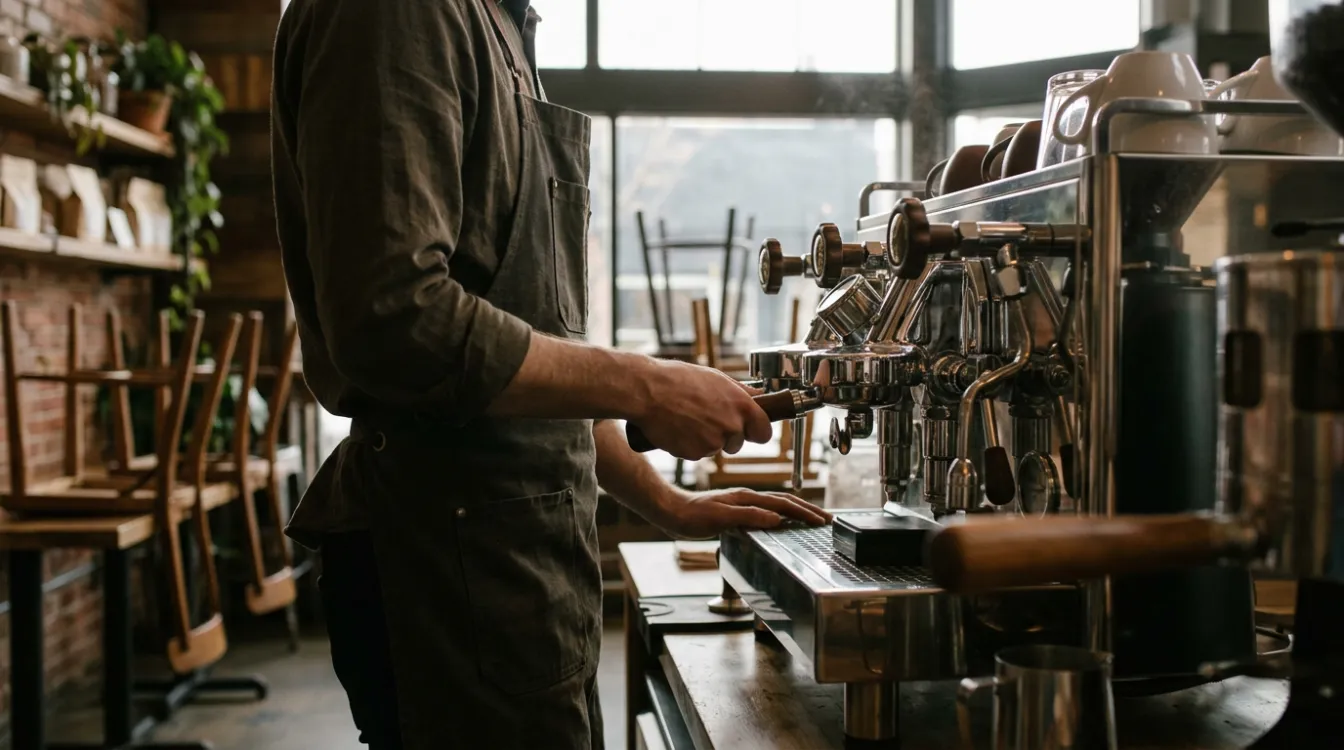
A barista's shift often starts just after 6 a.m. with switching on machines, checking stock and setting up the station. Before opening, baristas dial in the espresso, adjusting the grinder until dose, yield and time hit the target and the shot tastes right, often changing things by only a gram. The morning rush, often around 8 to 8:30, demands speed, consistency and constant communication. The rest of the day is restocking, cleaning, training, a lunch wave and a thorough close. Great baristas combine palate, technique, stamina and hospitality, and many build long careers in coffee.
What really happens behind the bar
Most of us see a barista for about a minute: the order, the hiss of the steam wand, a quick latte art pour and a smile as the cup slides across the counter. What we don't see is everything that happens before the doors open, between the rushes and after the last customer leaves.
To find out, I followed the story of Arnaldo, a barista originally from Puerto Rico who now works in a busy specialty café in New York. He has been making coffee professionally for about ten years, and he talked me through a typical shift from the first light switch to the final wipe-down.
This guide walks through his day hour by hour. Along the way it covers the skills baristas use, how they dial in espresso, how they cope with a rush, why latte art matters and what keeps people in a job that starts before sunrise.
A barista's day at a glance
| Time | What happens |
|---|---|
| Just after 6:00 | Arrive, switch on machines, check stock |
| 6:15 to 7:00 | Set up the bar, dial in espresso, taste |
| 7:00 | Doors open; first regulars arrive |
| 8:00 to 8:30 | Peak morning rush |
| 9:00 to 11:00 | Restock, clean, recalibrate, prep |
| 11:00 to 13:00 | Lunch wave |
| Afternoon | Quieter service, training, deep cleaning |
| End of shift | Hand over, clean machines, close down |
Shifts vary from café to café, but the rhythm is remarkably similar across specialty coffee: a quiet, focused start, an intense morning peak and a long tail of cleaning and preparation.
Meet Arnaldo
Arnaldo grew up in Puerto Rico, where coffee is part of daily life. As a young man he even spent time picking coffee on a farm in the island's mountains, an experience that changed how he sees every cup he makes today.
After moving to New York, he started working in cafés almost by accident. A friend needed help behind the bar; he discovered he loved the pace, the people and the craft. Ten years later, he trains new baristas, helps dial in the café's coffees and competes in latte art events.
"People think it's just pushing buttons," he said. "But every coffee is different, every day is different, and every customer is different. That's what keeps it interesting."
Just after 6 a.m.: opening the café
Arnaldo's alarm goes off early. He arrives at the café shortly after 6, when the street outside is still quiet and the city is only half awake.
Switching everything on
The first job is to switch on the espresso machine. Commercial machines take time to reach a stable temperature, so they must be turned on well before opening. The grinders, the batch brewer, the water filter system and the lights follow.
Checking stock
While the machine heats, Arnaldo checks the fridges and shelves:
- Is there enough milk and plant milk for the morning?
- Have the pastry and food deliveries arrived?
- Are there enough cups, lids and sleeves?
- Is there enough espresso and filter coffee in the hoppers and storage?
"If you run out of oat milk at 8:15, you have a problem," he laughed. "So you check everything before the doors open."
Setting up the station
A barista's station is like a cook's mise en place. Everything has a place, and everything must be within reach.
- Milk pitchers lined up by size.
- Clean cloths for the steam wand and the counter.
- Knock box emptied.
- Cups stacked and warming on top of the machine.
- Syrups and sauces filled.
- Scale, timer and tamper ready.
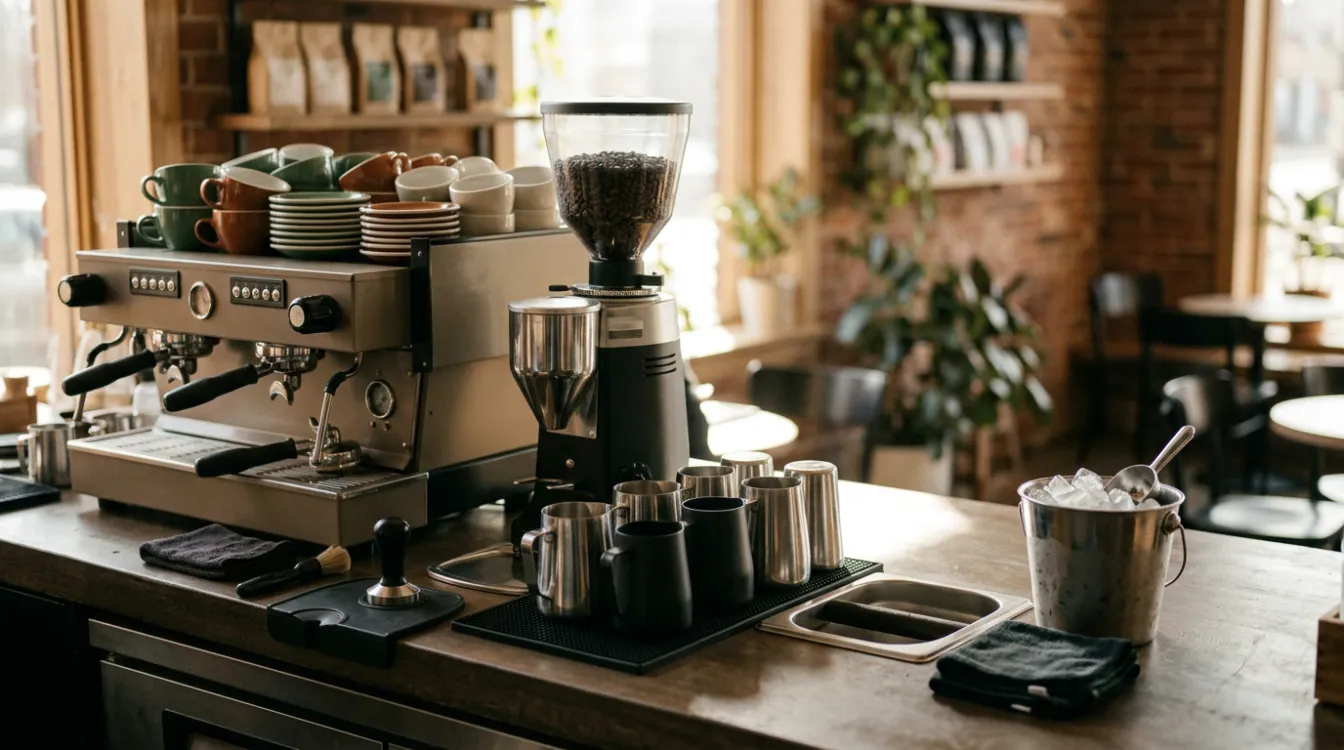
An organized station makes the difference between a calm rush and chaos. Arnaldo knows exactly where every tool is without looking.
6:15 to 7:00: dialing in the espresso
Once the machine is hot, the most important job of the morning begins: dialing in.
Dialing in means adjusting the grinder and recipe so the espresso tastes as good as possible that day. Coffee changes as it ages, and humidity, temperature and even the specific batch of beans can affect extraction. A recipe that worked perfectly yesterday might taste slightly off today.
The recipe
The café has a target recipe for its house espresso: a specific dose of ground coffee, a target yield of liquid espresso and a target time. On the morning I heard about, the target yield had recently changed from 39 grams to 38 grams to make the shot a little more concentrated.
- Weigh the doseArnaldo weighs the ground coffee in the portafilter on a scale, aiming for the exact target dose.
- Distribute and tampHe levels the coffee bed and tamps it firmly and evenly.
- Pull the shotHe starts the shot and the timer, with a cup on the scale.
- Stop at the target yieldHe stops the shot when the scale reaches the target weight.
- Check the timeHe notes how long it took.
- TasteHe tastes the espresso and decides what to change.
Small numbers, big differences
On his first shot that morning, the scale read 36.7 grams when the shot was stopped, a little short of the 38 gram target. The time was close, but the taste was slightly sharp.
He adjusted the grinder a fraction coarser, pulled another shot and tasted again. It took a few rounds before the shot hit its target and tasted sweet and balanced.
"A gram or two doesn't sound like much," he said. "But you taste it. A little more or less changes everything."
My guide to espresso brew time explains how time, dose and yield affect flavor, and my article on coffee grind size explains why tiny grinder adjustments matter so much.
Ergonomics: tamping without hurting yourself
Baristas tamp hundreds of shots every day, so technique matters for their bodies as well as the coffee. Arnaldo keeps his wrist straight and his elbow bent at about 90 degrees above the tamper, pressing down with his body weight rather than twisting his wrist.
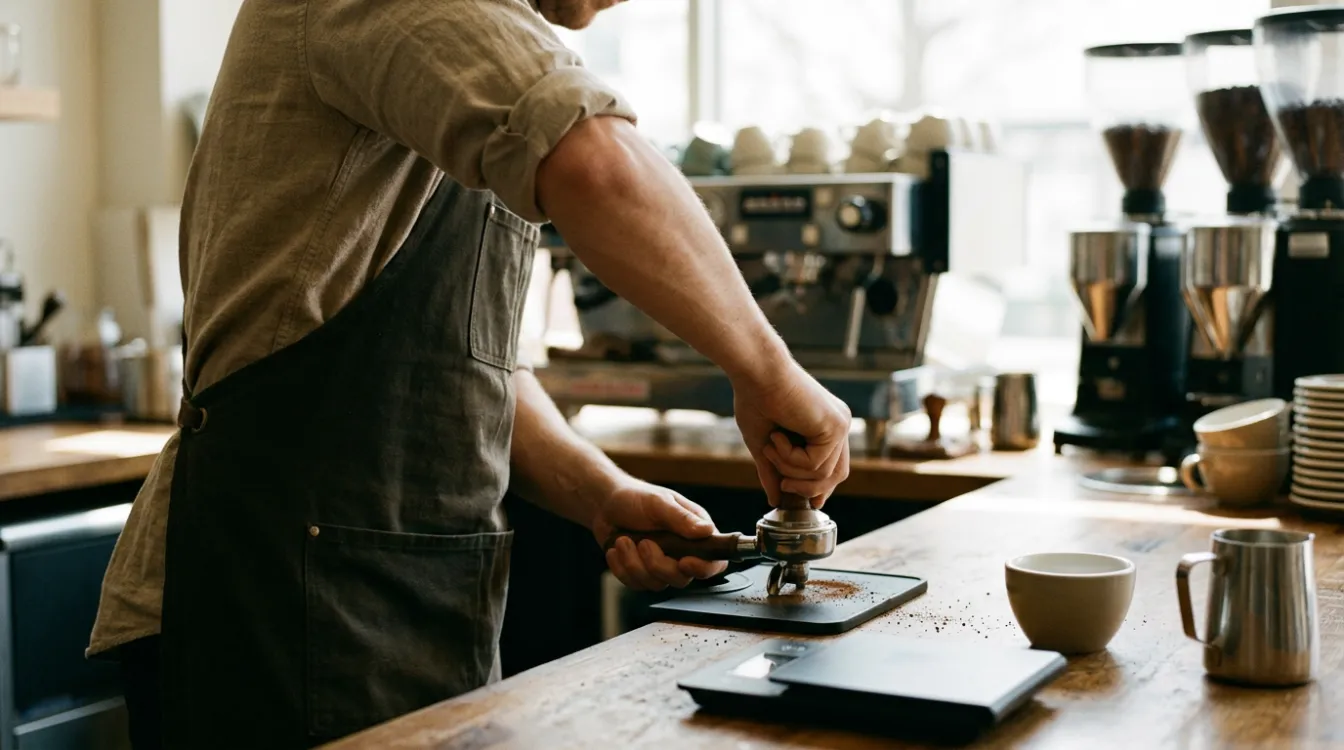
"When you're new, you tamp with your wrist, and after a week it hurts," he said. "You learn to use your shoulder and your body. Otherwise you can't do this for ten years."
Tasting everything
Before opening, Arnaldo tastes not just the espresso but also the filter coffee and the milk drinks. He tastes the espresso straight, then in a small milk drink, because a shot that tastes fine on its own can taste different with milk.
He also tastes the batch brew, using a spoon to sip from a cup, just like at a cupping. My guide to coffee cupping explains how professionals taste coffee.
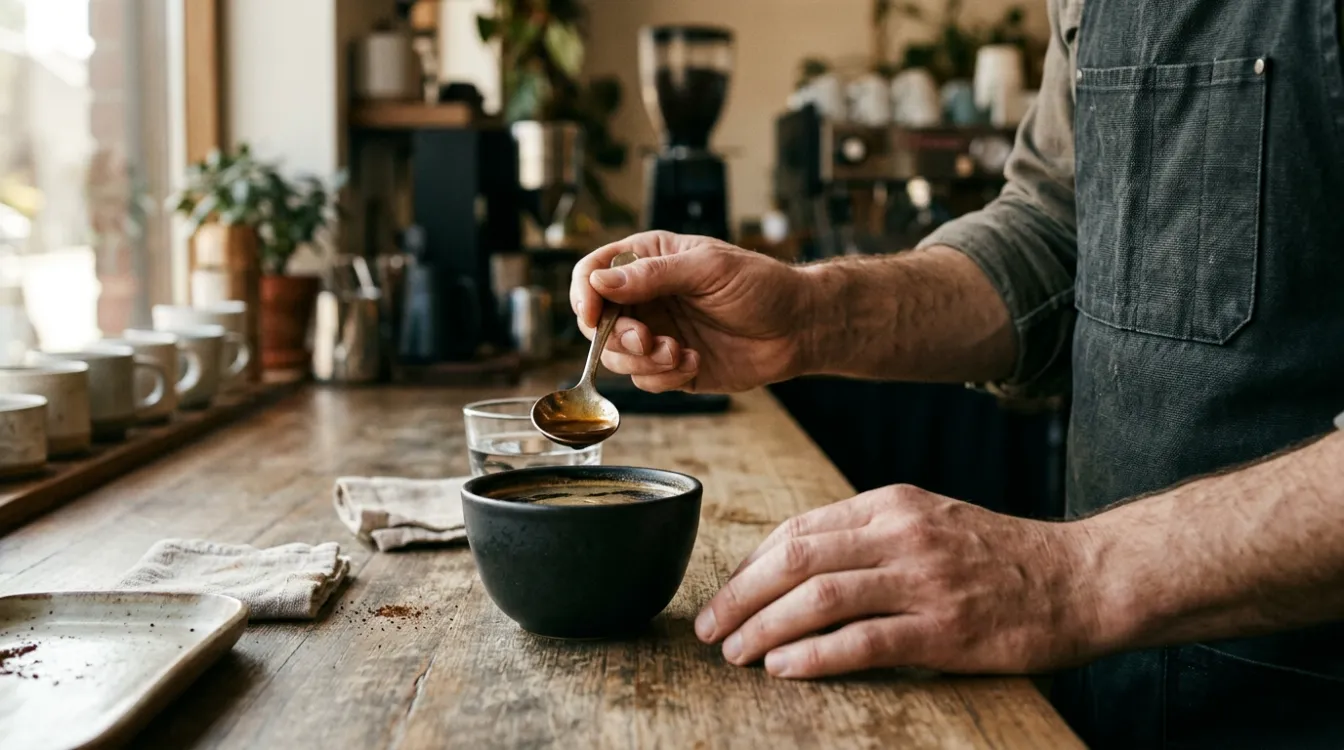
Tasting all day is part of the job. Arnaldo said he tastes dozens of small sips before noon, but he rarely drinks a full cup. "If I drank every coffee I tasted, I'd be shaking by 9," he joked.
7:00 a.m.: doors open
At 7, the doors open. The first customers are usually regulars: commuters on the way to work, people walking dogs, construction workers and nurses coming off night shifts.
Arnaldo knows many of them by name and by order. Before some regulars reach the counter, he's already grinding their shot.
"That's one of the best parts," he said. "You become part of somebody's morning. Some people, I see them every day for years. I know when they've had a baby, when they've changed jobs, when they're having a bad week."
The early hour is busy but manageable. It gives the team a chance to settle into their rhythm before the real rush arrives.
8:00 to 8:30 a.m.: the rush
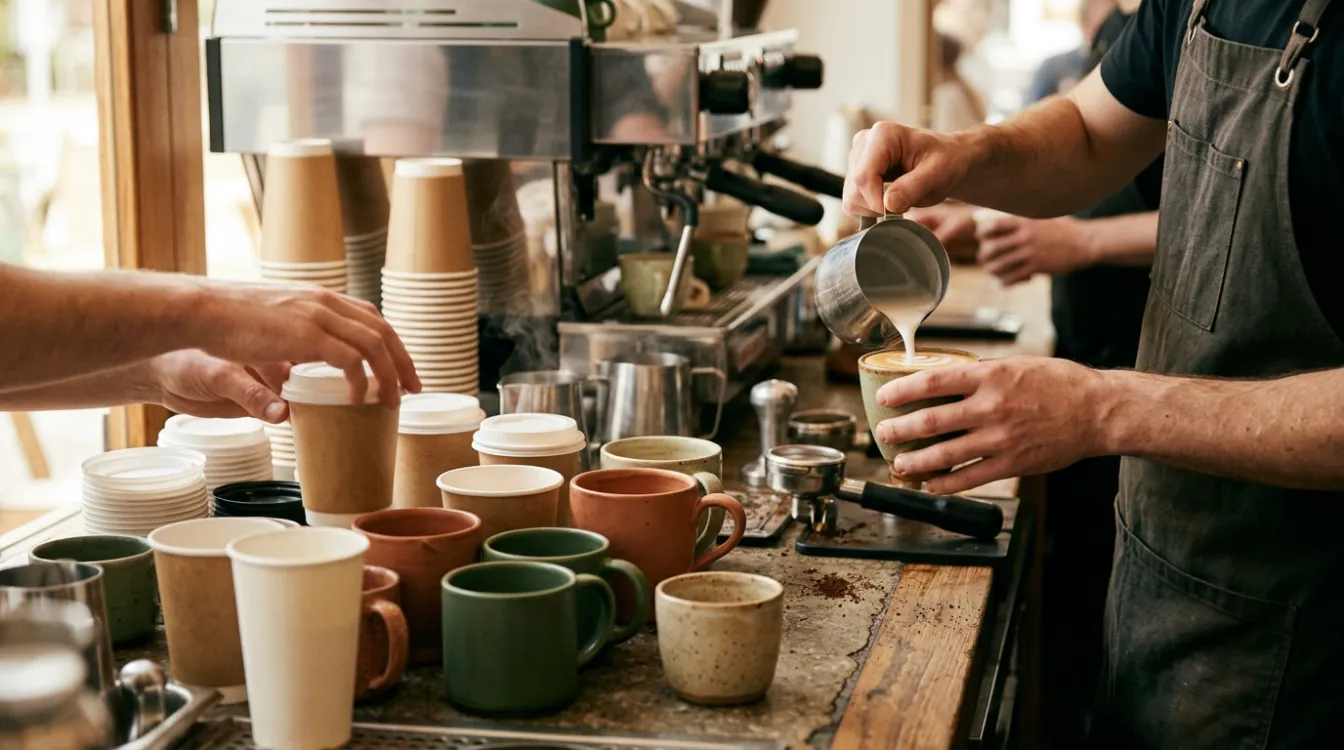
Between 8 and 8:30, the café hits its peak. The line reaches the door, mobile orders pile up on the screen and every seat fills.
How baristas handle a rush
During a rush, the team works like a small kitchen brigade. In Arnaldo's café, roles are usually divided:
- Register: takes orders, handles payments and calls out names.
- Bar: pulls shots and steams milk, often two or three drinks at once.
- Support: pours batch brew, plates pastries, restocks milk and cups, and clears tables.
Arnaldo usually works the bar. He keeps the grinder running, pulls a shot, starts steaming milk while the next shot runs, pours, and calls the drink, all in a steady loop.
- Read the ticketHe checks the size, milk and any special requests.
- Grind and tampHe doses and tamps the next shot while the previous one finishes.
- Pull and steam at the same timeThe shot runs while he steams milk for it.
- PourHe pours the milk, adding latte art.
- Call and hand offHe calls the drink and moves straight to the next ticket.
Staying consistent under pressure
The hardest part of a rush, Arnaldo said, isn't speed. It's staying consistent. Every drink should taste and look as good at 8:20 as at 7:05.
That means keeping an eye on the shot times, purging the steam wand, wiping the portafilter, and checking the grinder doesn't drift as it warms up. If shots start running fast or slow, he adjusts on the fly.
"When you're new, you only see the line," he said. "When you're experienced, you see the line, but you also watch your shots, your milk, your station. You're thinking two drinks ahead."
Communication
Constant communication keeps the bar running smoothly: "Two oat lattes behind you," "Out of large lids," "Shot's running fast." Good teams talk all the time, briefly and clearly.
Latte art: more than decoration
Every milk drink in Arnaldo's café gets latte art. It's become part of what customers expect from specialty coffee, but it also tells the barista something.
To pour good latte art, the milk must be steamed to a silky texture, with fine microfoam and the right temperature. The espresso must have good crema. If the pattern comes out messy, it often means the milk or the shot wasn't quite right. My guides to the science of steamed milk and espresso crema explain why.
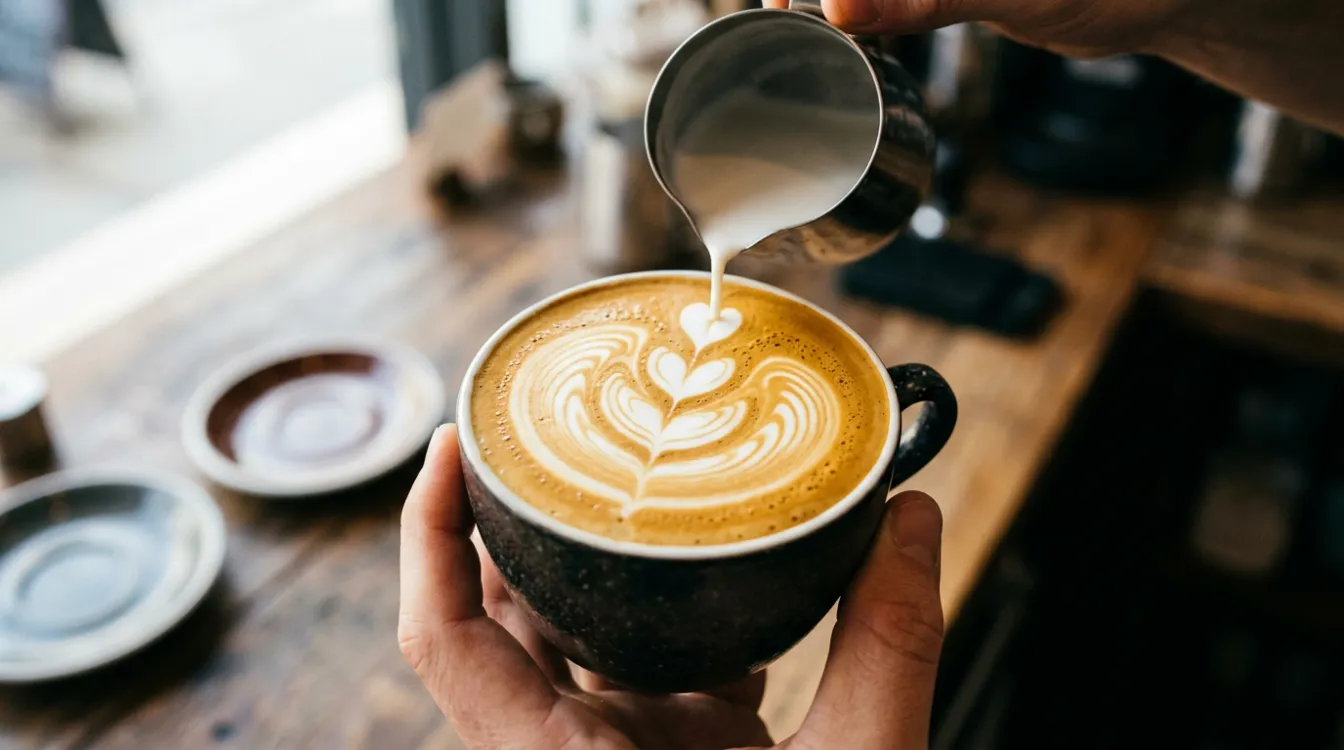
The basic patterns
- Heart: the first pattern most baristas learn.
- Tulip: stacked hearts, built one after another.
- Rosetta: a fern-like leaf made with a wiggling pour.
- Swan and other advanced designs: combinations of the above, often with more control and practice.
Competing
Arnaldo competes in latte art competitions. At one recent event he placed third with a design that combined two wings with three stacked hearts, poured freehand in a single cup.
Competitions test speed, symmetry, contrast and creativity. Baristas often practice dozens of pours in a row, refining a single design for weeks.
"In competition you have a few seconds and one cup," he said. "If your hand shakes, it's over. So you practice until your hands just know it."
My guide to the World Barista Championship explains how barista competitions work at the highest level.
9:00 to 11:00 a.m.: the reset
After the rush, the café gets quieter, but the work doesn't stop. This is when the team resets.
- Restock: refill milk fridges, cups, lids, sleeves, pastries and syrups.
- Clean: wipe counters, empty knock boxes, clean steam wands, sweep floors and clear tables.
- Check the espresso: re-taste and adjust the grinder. Coffee often needs small tweaks as the day goes on.
- Prep: brew more batch coffee, prepare cold brew, and prep for lunch.
- Breaks: staff take short breaks in turns.
Arnaldo also uses quieter moments to train newer baristas. He'll watch them steam milk or pour, give tips on their tamp or workflow, and let them practice latte art on slower orders.
11:00 a.m. to 1:00 p.m.: the lunch wave
Around lunchtime, a second wave arrives: office workers, students and people meeting friends. The orders shift toward iced drinks, cold brew, sandwiches and pastries.
This wave is usually more spread out than the morning rush, but it still demands focus. Iced drinks need different workflows, and food orders add extra steps.
The afternoon: slower service and deep cleaning
In the afternoon, the café settles into a slower pace. People work on laptops, read, meet for coffee and take calls.
This is the time for jobs that can't be done during busy hours:
- Backflushing the espresso machine to clean the group heads.
- Soaking portafilters and baskets in cleaning solution.
- Cleaning grinders and checking burrs.
- Wiping fridges and shelves.
- Ordering supplies for the next days.
- Updating menus and checking the next coffees to come in.
Some afternoons, the team tastes new coffees together, comparing them to choose the next guest espresso or filter coffee.
Closing down
At the end of the day, the café closes and the cleaning really begins. A thorough close makes the next morning's opening much easier.
- Clean the espresso machineBackflush with detergent, clean the group heads, scrub the steam wands and soak the parts.
- Empty and clean the grindersRemove leftover beans, brush out grounds and wipe everything down.
- Wash all equipmentPitchers, scales, tampers, milk jugs and serving ware.
- Clean the fridges and countersRemove old milk, wipe surfaces and check dates.
- Restock for the morningLeave the station ready for the opening barista.
- Count the register and lock upDo the paperwork and secure the café.
"A good closer is a gift to the opener," Arnaldo said. "If the close is bad, the next morning starts in a hole."
Picking coffee in Puerto Rico
Arnaldo's connection to coffee began long before New York. Growing up in Puerto Rico, he spent time on a farm in the island's mountainous coffee region, picking ripe cherries by hand.
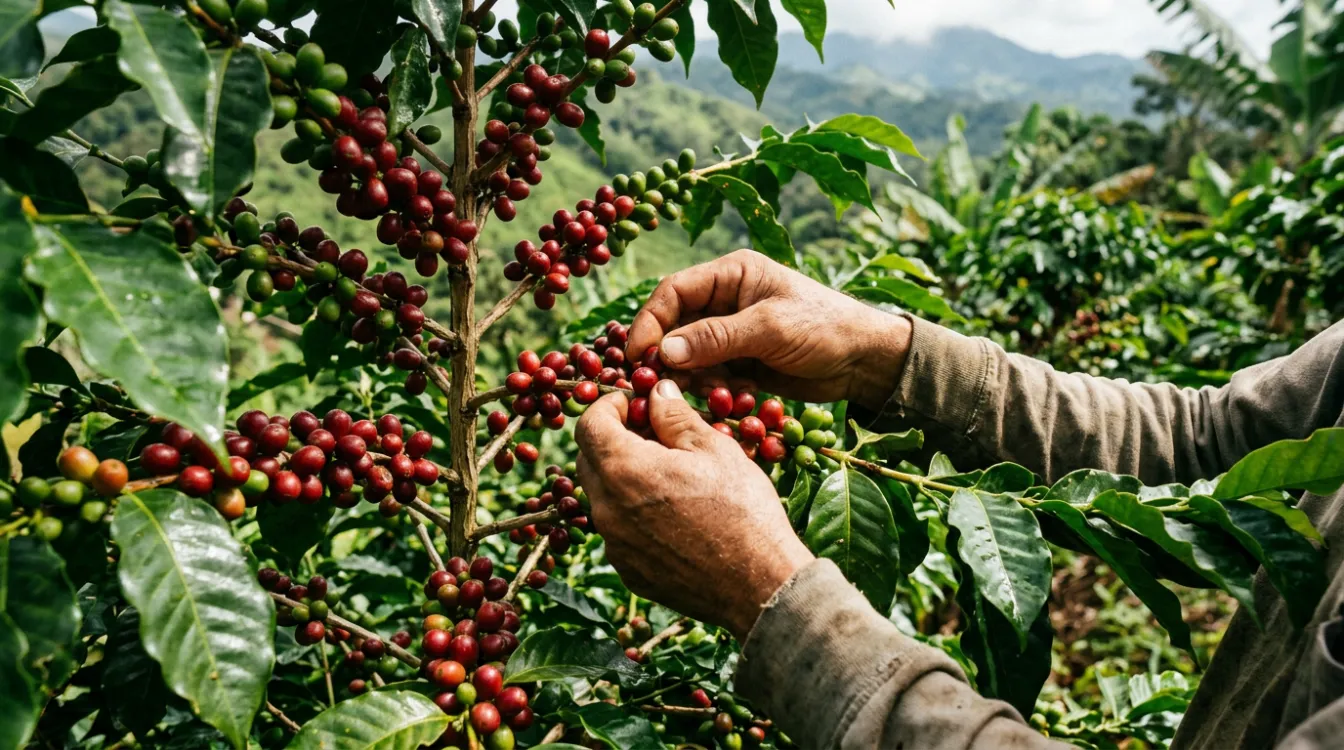
The work was hard. Coffee grows on steep slopes, and pickers walk up and down rows in heat and rain, selecting only the ripe cherries. Each tree has to be visited several times during the harvest because cherries ripen at different times.
"When you've picked coffee, you never waste a shot the same way again," he said. "You think about how many cherries are in that cup and who picked them."
That experience shapes how he works. He's careful with dialing in, he hates throwing away coffee, and he likes telling customers about the farms behind the beans. My guide to coffee processing methods explains what happens to coffee between picking and roasting, and my article on how altitude affects coffee flavor explains why mountain coffee often tastes so good.
A typical closing checklist
Arnaldo's café keeps a printed checklist by the machine so nothing is missed: group heads backflushed, steam wands soaked, grinders brushed, milk fridges checked, floors mopped, bins emptied, cold brew started for tomorrow and the station stocked for the opener. Ticking every box takes time at the end of a long day, but it means the next morning starts calmly instead of in a scramble, and the opening barista can focus on dialing in.
Regulars, loyalty and the human side
For many baristas, the people are the best part of the job. Arnaldo talks about his regulars with real affection.
- The early commuter who has the same cortado every day at 7:05.
- The nurse coming off a night shift who just needs something warm and kind words.
- The retired couple who share a pastry and two cappuccinos every Saturday.
- The student who orders iced coffee all year, even in winter.
Customer loyalty is built on these small, daily connections. People return not just for the coffee, but for the friendly face, the remembered order and the sense of belonging.
"You're not just making coffee," he said. "You're making somebody's day a bit better. If they leave happier than they came in, that's a good job."
Difficult moments
The job isn't always easy. Baristas deal with long lines, impatient customers, complicated orders and the occasional rude comment. Arnaldo's advice: stay calm, be kind, and don't take it personally. "Most people are just stressed. A smile helps them and helps you."
A barista's week, not just a day
A single shift doesn't tell the whole story. Over a week, a barista's job includes much more than service.
- Deliveries: coffee from the roaster, milk, pastries and supplies arrive on set days, and someone has to check and put everything away.
- Deep cleaning: once a week or so, the team takes apart grinders, descales or services equipment and cleans fridges thoroughly.
- Cupping sessions: many specialty cafés hold regular tastings to evaluate new coffees and train staff palates.
- Staff meetings: discussing menu changes, schedules and customer feedback.
- Weekend shifts: often the busiest days, with long lines of brunch customers and families.
- Events: latte art throwdowns, coffee tastings and community events in the evenings.
Arnaldo usually works five shifts a week, mostly openings. He likes the early starts because the afternoons are free for practice, rest and time with friends.
Why Arnaldo still loves the job
After ten years, I asked Arnaldo why he keeps doing it. His answer came quickly.
"Every day is different. The coffee changes, the weather changes, the customers change. I'm always learning. And at the end of the day, I made hundreds of people a little happier. Not many jobs give you that."
He also talked about the community of baristas: friends from other cafés he meets at competitions, people who share tips and help each other find jobs. For him, coffee isn't just work; it's a world he belongs to.
The tools a barista uses every day
| Tool | What it's for |
|---|---|
| Espresso machine | Pulling shots and steaming milk; the heart of the bar |
| Espresso grinders | Grinding fresh for each shot; often one for house, one for decaf or guest coffee |
| Scale and timer | Weighing dose and yield, timing every shot |
| Tamper and distribution tool | Leveling and compressing the coffee bed |
| Milk pitchers | Steaming and pouring, in several sizes |
| Thermometer | Checking milk temperature, especially for newer baristas |
| Batch brewer | Making filter coffee in large quantities |
| Pour-over gear | Kettles, drippers and filters for brewed-to-order coffee |
| Cleaning tools | Group head brushes, cloths, detergent and backflush discs |
| Knock box | Collecting used coffee pucks |
Arnaldo treats these tools with care. He wipes the portafilter before every shot, purges the group head and keeps his pitchers spotless. "Your tools are only as good as how you look after them," he said. My guide to espresso machine types explains the different kinds of machines cafés use.
How a new barista learns
Arnaldo now trains most new hires at his café. The first weeks follow a similar path.
- Week one: watching and supportNew baristas start on the register and support role, learning the menu, the customers and the flow of the café.
- Espresso basicsThey learn to dose, distribute, tamp and pull shots, and to taste the difference between sour, bitter and balanced espresso.
- Milk steamingThey practice steaming milk to the right texture and temperature, often using water and soap to practice without waste.
- Simple latte artHearts first, poured again and again on slower orders.
- Working the bar off-peakThey take over the bar during quiet hours, with a trainer nearby.
- The first rushOnly once they're confident do they work the bar during peak times.
"The biggest thing I teach is not technique," he said. "It's calm. If you panic, everything goes wrong. If you stay calm, you can fix anything."
Mistakes are part of learning. Every new barista over-extracts shots, scalds milk and pours lopsided hearts. What matters is tasting, noticing and improving.
Iced drinks and cold brew behind the bar
Iced drinks have become a big part of café menus, even in winter, and they bring their own workflow.
- Cold brew is made in batches, steeped for many hours and filtered ahead of time.
- Iced lattes use fresh espresso poured over cold milk and ice.
- Iced pour-over brews hot coffee directly onto ice, locking in aroma.
- Nitro cold brew is poured from a tap, without ice.
Prepping cold brew is usually an afternoon or closing job, so it's ready for the next day. My guide to the science of cold brew explains how it's made.
The sounds and rhythms of a shift
Arnaldo says he can tell how the bar is running just by listening. The grinder's whir, the hiss and gurgle of the steam wand, the knock of a portafilter against the knock box and the clink of cups all form a rhythm.
- A steady rhythm means the workflow is smooth and the team is in sync.
- A screeching steam wand means the milk isn't being textured properly.
- A long silence from the grinder during a rush means someone is stuck.
- Lots of talking between team members is a good sign; it means everyone knows what's coming.
"After a while, you don't need to look," he said. "You hear when something's wrong."
The skills a great barista needs
After ten years, Arnaldo sees barista work as a blend of craft, science and hospitality.
| Skill | Why it matters |
|---|---|
| Palate | Tasting espresso and filter coffee and knowing what to adjust |
| Technical knowledge | Understanding grind, dose, yield, time and temperature |
| Milk technique | Steaming silky microfoam and pouring latte art |
| Speed and multitasking | Handling several drinks at once during a rush |
| Consistency | Making the same drink just as well all day |
| Cleanliness | Keeping equipment and the station spotless |
| Communication | Working smoothly with the team |
| Hospitality | Making customers feel welcome |
| Physical stamina | Standing, lifting and moving for hours |
| Calm under pressure | Staying focused when the line reaches the door |
"Coffee knowledge you can learn from books," he said. "Hospitality and calm, you learn from doing it every day."
The physical side of the job
Being a barista is physically demanding. A typical shift involves standing for hours, repetitive motions, lifting milk crates and bags of beans, and working near hot water and steam.
- Wrists and shoulders: repetitive tamping, steaming and pouring can strain joints, which is why good technique matters.
- Feet and back: long hours standing on hard floors take a toll. Many baristas invest in good shoes and anti-fatigue mats.
- Burns: steam wands and hot water can cause burns, so careful habits are essential.
- Caffeine: constant tasting can add up, so experienced baristas often spit or take only tiny sips.
Arnaldo stretches before and after shifts and swears by comfortable shoes. "Your feet are your career," he said.
Where a barista career can lead
Many people think of barista work as a short-term job, but for many it becomes a career.
- Head barista or trainer: leading the bar and training new staff.
- Café manager: running operations, staff and finances.
- Quality control and roasting: cupping, profiling and roasting coffee.
- Green coffee buying: sourcing coffees from farms and importers.
- Competition and education: competing, judging and teaching courses.
- Café ownership: opening a café of their own.
- Equipment and service: working for machine makers or technicians.
Arnaldo is thinking about roasting next. "I want to understand the coffee before it gets to me," he said. "From the cherry to the cup."
Organizations such as the Specialty Coffee Association offer courses and certifications in barista skills, brewing, roasting and sensory skills, which many baristas use to develop their careers.
The reality: pay, hours and burnout
Barista work can be rewarding, but it's not always easy financially. Pay varies widely by country, city and café, and in some places tips make up an important part of income.
Early starts, weekend work and busy holidays are part of the job. Burnout is a real risk, especially in busy cafés with short staffing.
Good cafés invest in their baristas with fair pay, training, reasonable schedules and opportunities to grow. That investment often shows up in the coffee: experienced, happy baristas make better drinks and keep customers coming back. My article on why café coffee is so expensive explains how labor costs fit into the price of every cup.
How to be a barista's favorite customer
I asked Arnaldo what customers can do to make a barista's day easier. His answers were simple:
- Know your order when you reach the counter, especially during the rush.
- Be clear about modifications, such as milk type, size and temperature.
- Say hello and thank you. It sounds obvious, but it makes a difference.
- Be patient during the rush. Good coffee takes a few minutes.
- Ask questions when it's quiet. Baristas love talking about coffee when they have time.
- Tell them if something's wrong. A good barista would rather remake a drink than have you leave unhappy.
- Tip if it's customary where you live.
- Clear your table if the café expects it.
What ten years behind the bar taught Arnaldo
I asked Arnaldo what he wishes he'd known when he started. His answers were practical.
- Learn to taste early. Taste every shot you pull, even when you're new.
- Look after your body. Good shoes, stretching and proper tamping technique protect your career.
- Stay curious. Visit other cafés, read, watch competitions and ask questions.
- Be kind to new baristas. Everyone was slow and messy once.
- Remember the farmers. Every cup carries the work of people you'll probably never meet.
What home brewers can learn from baristas
Following a barista's day taught me several lessons I now use at home.
- Weigh everything. Baristas weigh dose and yield for every shot. A scale at home makes your coffee more consistent.
- Taste and adjust. If your coffee tastes sour, grind finer or extract longer. If it tastes bitter, grind coarser or extract less.
- Keep your equipment clean. Old coffee oils taste stale and bitter.
- Purge and wipe your steam wand. It keeps milk tasting fresh and protects your machine.
- Set up your station. Keep your tools within reach, and your morning coffee becomes faster and calmer.
- Practice latte art with patience. Hearts first, then tulips and rosettas.
- Use fresh beans. Baristas taste the difference daily. My guide on how to store coffee beans helps keep them fresh.
Our tip: Write down your recipe (dose, yield and time) on a sticky note near your machine. When something tastes great, you'll know exactly how to repeat it.
Even after a decade, Arnaldo still learns something new almost every week, whether it's a new coffee, a better workflow or a regular with an unusual order.
Myths about baristas
"It's just pressing a button"
Specialty espresso requires dialing in, tasting, milk technique and constant adjustments throughout the day.
"Baristas drink coffee all day"
They taste constantly, but most take small sips rather than drinking full cups.
"Latte art is just for show"
It's also a sign that the milk and espresso were prepared well.
"It's not a real career"
Many baristas build long careers in coffee, moving into training, roasting, buying, management or ownership.
"Anyone can do it on day one"
Basic drinks can be learned quickly, but consistent excellence takes months or years of practice.
What a day behind the bar really involves
A barista's day starts before sunrise and ends long after the last coffee is served. In between, it's a mix of science, craft, physical work and hospitality: dialing in espresso to a fraction of a gram, steaming milk to silky perfection, pouring latte art under pressure, keeping the station spotless and making customers feel at home.
For Arnaldo, who once picked coffee in the mountains of Puerto Rico, every cup is the last step in a long journey. "When you hand someone a coffee," he said, "you're finishing the work of a lot of people. I want to do that well."
Next time you order, take a second to watch what happens behind the bar. There's a lot more going on than you might think.
Frequently asked questions
What time do baristas start work?
Opening baristas often start around 6 a.m., an hour or more before the café opens.
What does dialing in mean?
Adjusting the grinder and recipe so the espresso hits its target and tastes balanced that day.
When is the busiest time in a café?
Usually the morning commute, often around 8 to 8:30 a.m.
Do baristas drink a lot of coffee?
They taste a lot, but mostly in small sips rather than full cups.
Is being a barista hard?
It's physically and mentally demanding, with early starts, rushes and constant multitasking.
Why do baristas pour latte art?
It looks good and shows the milk and espresso were prepared well.
Can being a barista be a career?
Yes. Many move into training, roasting, buying, management or ownership.
How can customers help baristas?
Know your order, be patient in the rush and say hello and thank you.

- Michael Reynolds, interviews with barista Arnaldo
- Barista, Wikipedia
- Latte art, Wikipedia
- Coffee production in Puerto Rico, Wikipedia
- Specialty Coffee Association, Specialty Coffee Association
Related guides
World Barista Championship The science of steamed milk Espresso brew time explainedWritten by Michael Reynolds. Last updated November 20, 2026.