Gaggia Classic Pro E24 vs Breville Barista Express
The Gaggia Classic Pro E24 and the Breville Barista Express are two of the most popular first “serious” espresso machines, and they take opposite routes. The Gaggia is a simple, rugged, commercial-style machine with a 58 mm group and a powerful steam wand, but no grinder and no temperature control. The Barista Express packs a grinder, PID temperature control and a pressure gauge into one box. I used each as my daily machine for four weeks to see which one makes better coffee for you.
We choose products independently. We may earn a commission when you buy through our links. Affiliate policy
Jargon helpNew to espresso? Tap any dotted term to see what it means.
In this comparison
For most people starting from scratch, buy the Barista Express. The built-in grinder, PID and one-minute heat-up make good espresso easier every single morning. Buy the Gaggia Classic Pro E24 if you already own a good espresso grinder, or plan to buy one, and want the better espresso and stronger steam of a commercial-style 58 mm machine that can be repaired for decades.
The two machines
Specs checked November 24, 2026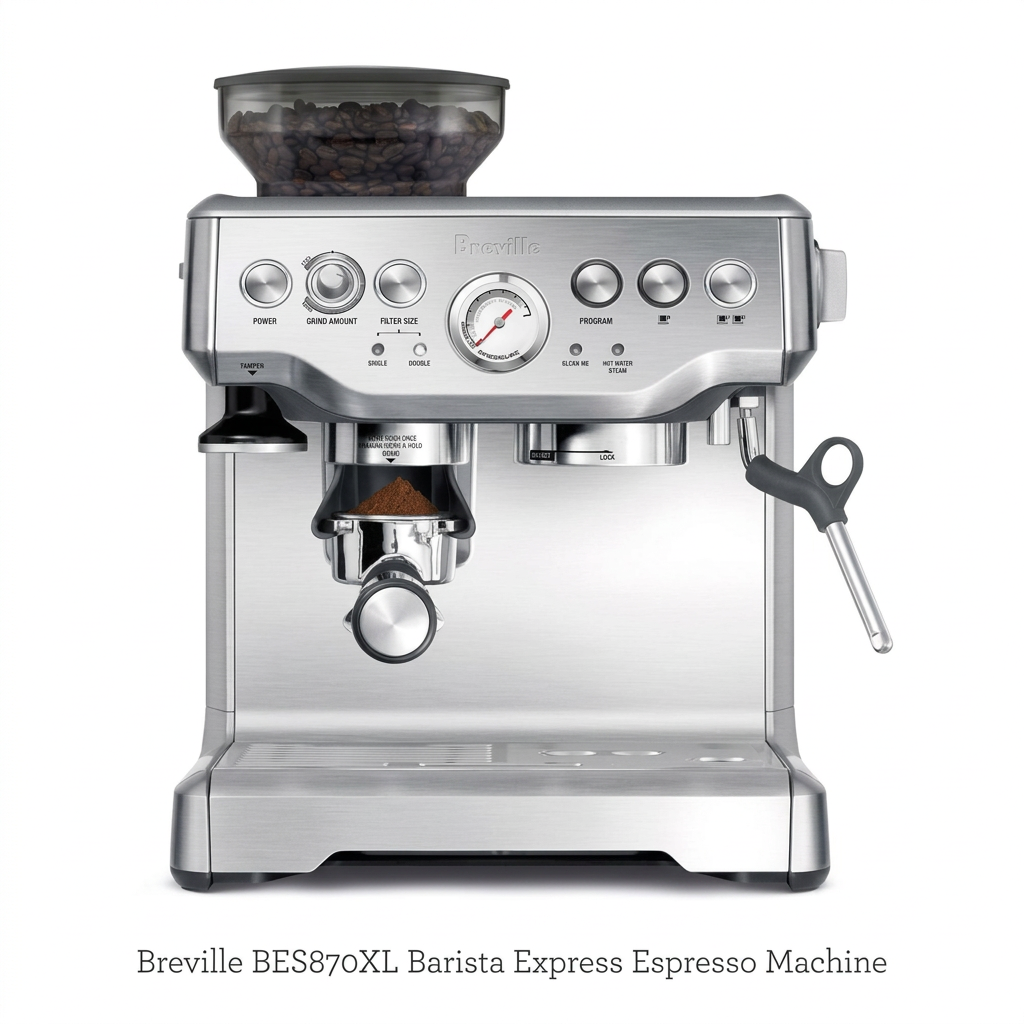
Built-in conical burr grinder, PID temperature control, pressure gauge and a one-minute heat-up.
Check price on Amazon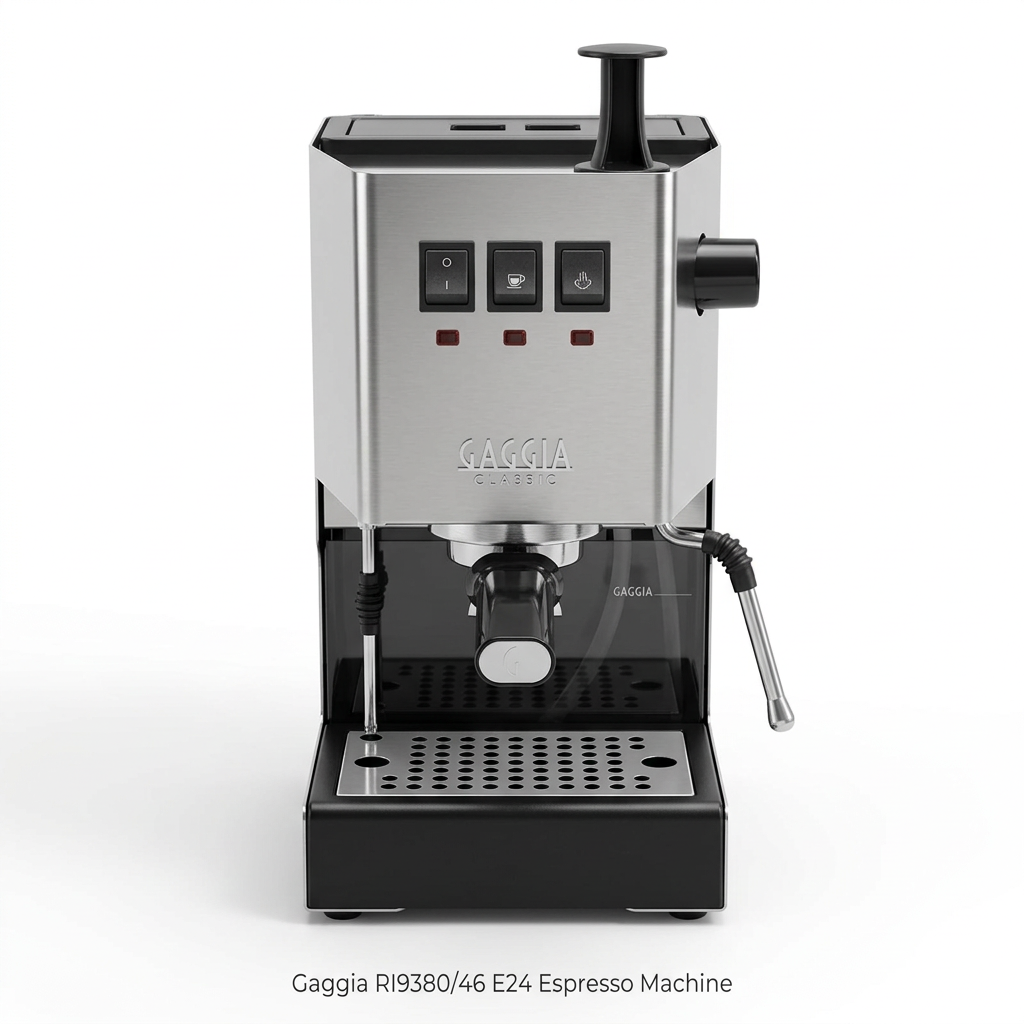
Commercial-style 58 mm group, 9-bar valve, brass boiler and a powerful steam wand. Grinder sold separately.
See Today’s PriceGaggia E24 vs Barista Express at a glance
- Both make real 9-bar espresso with proper crema.
- The Barista Express is the easier all-in-one package with stable temperature.
- The Gaggia made slightly better espresso and much stronger steam, but needs a grinder and patience.
- The Gaggia is built to be repaired; the Express is more convenient.
Head to head
The best result in each row is marked, based on my four weeks with each machine and the manufacturer specs.
This is a close fight between convenience and capability, and the rows split almost evenly.
| Spec | Gaggia E24 | Barista Express |
|---|---|---|
| Espressowith a good grinder | Richer, fuller body ✓ Best | Very good, consistent |
| Milk steaming | Very powerful ✓ Best | Good, slower |
| Grinder | Not included | Built in, 16 settings ✓ Best |
| Temperature control | None, surf it | PID ✓ Best |
| Heat-up | About 10 minutes | About 1 minute ✓ Best |
| Portafilter | 58 mm, commercial ✓ Best | 54 mm |
| Pressure gauge | No | Yes ✓ Best |
| Water tank | 72 oz ✓ Best | 67 oz |
| Cup clearance | Low | More room ✓ Best |
| Repairability | Excellent, made in Italy ✓ Best | Good |
| Rows won | 5 | 5 |
Five rows each. The Gaggia wins on the coffee and the hardware; the Barista Express wins on everything that makes mornings easier.
Is It On Sale? Check NowGaggia E24 vs Barista Express pros and cons
Gaggia Classic Pro E24
- Rich, full-bodied espresso with a good grinder
- Very powerful steam wand for silky milk
- Rugged, repairable, commercial 58 mm group
- No grinder; you must buy one
- No PID, so you temperature surf
- About 10 minutes to heat up
Breville Barista Express
- Built-in grinder saves money and space
- PID keeps brew temperature stable
- Ready in about a minute, with a gauge
- Grinder range is narrower than a good standalone
- Steam is slower than the Gaggia
- No low-water warning
Who should buy which machine?
- First-time espresso makers
- One box on the counter
- Fast weekday mornings
- Owners of a good grinder
- Milk-drink lovers who want power
- Tinkerers who want a lifelong machine
Two different approaches
These machines are often compared because they land in a similar part of the market, but they are built on different ideas.
The Gaggia Classic Pro E24 is a classic single-boiler machine with a brass boiler, a commercial-size 58 mm group✕58 mm groupThe standard portafilter size in commercial espresso machines, with the widest choice of baskets, tampers and accessories., a 9-bar OPV✕Over-pressure valve (OPV)A valve that caps the pump pressure at the coffee, here set to about 9 bar, the classic espresso pressure. and a three-way valve✕Three-way solenoid valveA valve that releases pressure from the coffee puck after the shot, so the puck comes out dry and you can knock it out straight away.. It has no electronics to manage the temperature, so you learn its rhythm.
The Breville Barista Express is an all-in-one machine: a conical burr grinder, a PID✕PID controllerAn electronic controller that holds brew water at a steady, set temperature, removing the need for temperature surfing. controlled thermocoil, a pressure gauge and a 54 mm portafilter. It takes much of the guesswork away.
So the real question is not which machine is better in isolation, but whether you would rather spend money and effort on a separate grinder and technique, or on convenience.
| Approach | Gaggia E24 | Barista Express |
|---|---|---|
| Philosophy | Simple, rugged, commercial-style | Integrated, guided |
| What you add | A good grinder, a better tamper | Nothing to start |
| Learning curve | Steeper | Gentler |
| Ceiling | Higher with upgrades | Good, but limited by the grinder |
Our tip: Budget for a good espresso grinder before choosing the Gaggia; without one, it cannot show what it can do.
Design, size and build
The Gaggia is a compact steel box with three rocker switches, for power, brew and steam, and a steam knob on the side. There is no screen and no gauge, and it looks almost the same as it did decades ago. It is narrow and fits under most cabinets, but the space under the group is low, so tall mugs do not fit and I brewed into small cups or a shot glass.
The Barista Express is much bigger at about 12.5 x 13.8 x 15.9 inches and 22 to 23 pounds, because the grinder and bean hopper sit on top. It has a pressure gauge in the middle, a grind-size dial on the side and buttons for one or two cups. It needs about 18 inches of height under your cabinets to fill the hopper comfortably.
Both feel solid. The Gaggia feels more like a tool; the Express feels like a well-designed appliance.
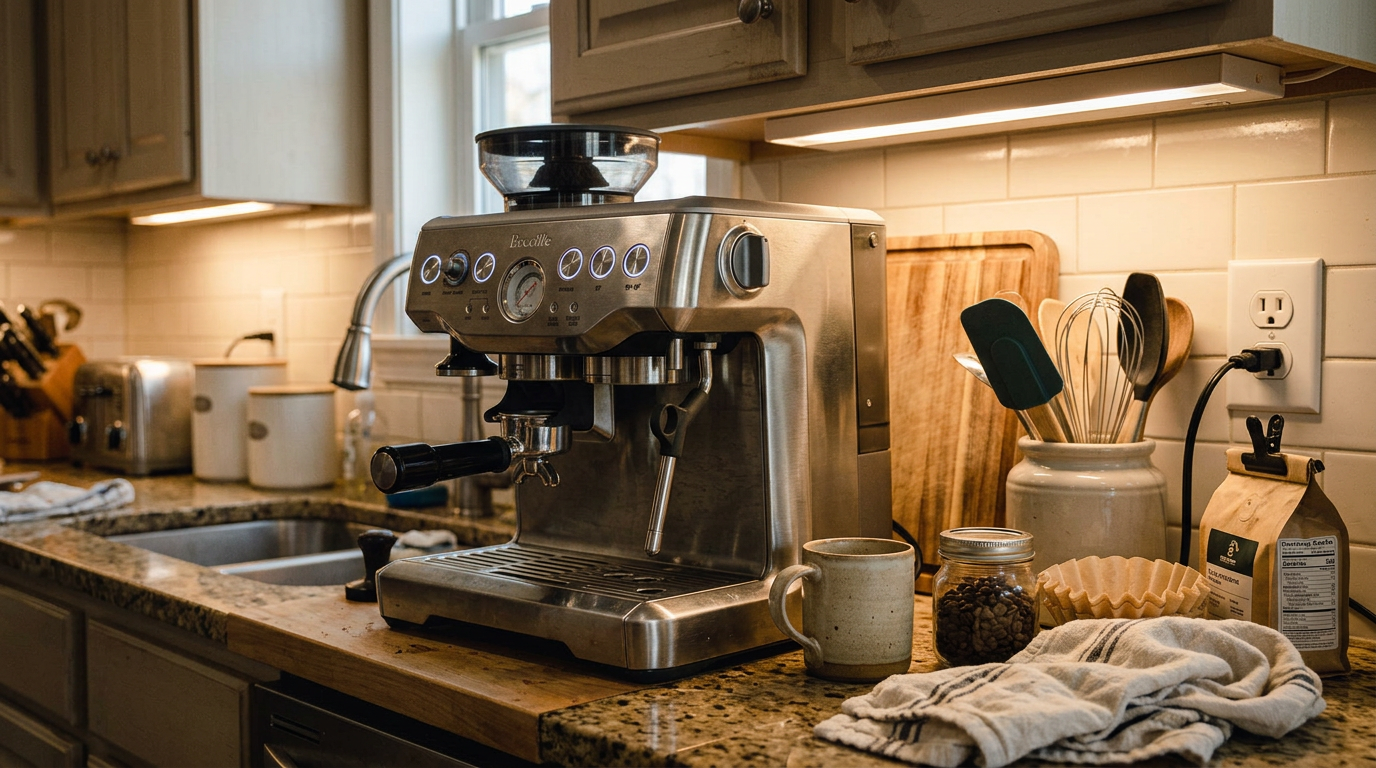
The Barista Express puts the grinder, gauge and steam wand in one box.
Once you add a grinder next to the Gaggia, the two setups take up similar counter space. The Express is one tidy unit; the Gaggia and grinder are two.
One practical detail: the Gaggia’s water tank fills from the top, and I needed to slide the machine forward to reach it under my cabinets. The Barista Express’s tank lifts out from the back, which was easier to refill at the sink. Both drip trays held a morning’s worth of flushes without overflowing.
Setup and first shot
The Barista Express took about 15 minutes to unbox, rinse and set up. I filled the beans, chose a grind setting of 5 as a starting point, flushed water through the group and pulled my first drinkable shot within half an hour of opening the box. Dialling it in properly took me about a day of shots.
The Gaggia took longer. I primed the pump through the steam wand as the manual describes, waited for the boiler to heat fully, and then needed my separate grinder dialled in too. My first good shot came on the second morning. The included plastic tamper was the weakest part of the box, and I replaced it with a proper 58 mm tamper in week one.
| Setup step | Gaggia E24 | Barista Express |
|---|---|---|
| Unbox to first shot | About 30 min plus heat-up | About 15 min |
| Extra gear needed | Grinder, better tamper | None |
| Dialling in | A couple of days | About a day |
| Trickiest part | Priming and temperature | Finding the grind setting |
The grinder question
This is the biggest difference, and it decides the choice for most people.
The Barista Express’s conical burr grinder has 16 external settings and an inner burr you can adjust, which I moved from the factory 6 down to 2 to go finer with lighter roasts. It doses straight into the portafilter. My usual dose was about 15.4 g in the double basket.
It is a good built-in grinder, but its range is narrower than a dedicated espresso grinder, and fine adjustments between steps are not possible on the outer dial.
The Gaggia has no grinder at all. Paired with a capable espresso grinder, it gave me finer control and better shots than the Express. Paired with a cheap blade grinder, it would make poor coffee, especially with its single-wall baskets.
| Grinder | Gaggia E24 | Barista Express |
|---|---|---|
| Included | No | Yes, conical burr |
| Settings | Depends on your grinder | 16 plus inner burr |
| Fine control | Best with a good grinder | Steps only |
| Counter space | Extra unit | Built in |
My guides to grind size and burr vs blade grinders explain why the grinder matters so much for espresso.
If you buy the Gaggia, think of the grinder as half of the machine. A capable espresso grinder lets you make tiny adjustments between shots, which is what turns a good espresso into a great one. If you buy the Express, you are getting a grinder that is well matched to the machine and good enough for medium and dark roasts, with the convenience of grinding directly into the portafilter at the push of the portafilter against the cradle.
Heat-up and temperature
The Barista Express was ready to brew in about a minute, and its PID held a steady brew temperature from shot to shot. Switching from brewing to steaming took about 15 seconds.
The Gaggia needs about 10 minutes for the brass boiler and group to heat properly; I used a smart plug to switch it on before I got up. It has no PID, so the boiler swings between its thermostat limits, and I used temperature surfing✕Temperature surfingFlushing a little water or timing the shot to the heating light, so the brew water lands at a more consistent temperature on a machine without a PID.: a short flush, then brewing as the heating light switched off.
Once I had the routine, the Gaggia’s shots were consistent, but it is one more thing to manage.
Ready to brew from cold
My timings from switch-on to first shot.
| Temperature | Gaggia E24 | Barista Express |
|---|---|---|
| Control | Thermostat, surf it | PID |
| Brew to steam | Wait for boiler to heat | About 15 s |
| Shot-to-shot consistency | Good with routine | Very good |
Our tip: Put the Gaggia on a smart plug so it is fully heated by the time you reach the kitchen.
The practical effect is simple: if you make coffee at unpredictable times, the Express’s one-minute start is a big advantage. If you make coffee at the same time every morning, a smart plug makes the Gaggia’s warm-up invisible, and the heavy brass boiler and group then give you very stable heat for back-to-back shots.
Espresso quality
Both make proper 9-bar espresso with real crema, and both are a big step up from pressurized-basket machines.
With a good grinder, the Gaggia’s shots were richer and fuller-bodied. The 58 mm basket gave a flatter, more even puck, and the heavy brass group held its heat well. Medium-dark roasts tasted chocolatey and syrupy, and lighter roasts had more clarity than on the Express.
The Barista Express was very good and more consistent day to day, thanks to the PID. Its shots were balanced and sweet with medium and dark roasts, and the gauge helped me see when the grind was off. With lighter roasts, I hit the limits of its grinder sooner.
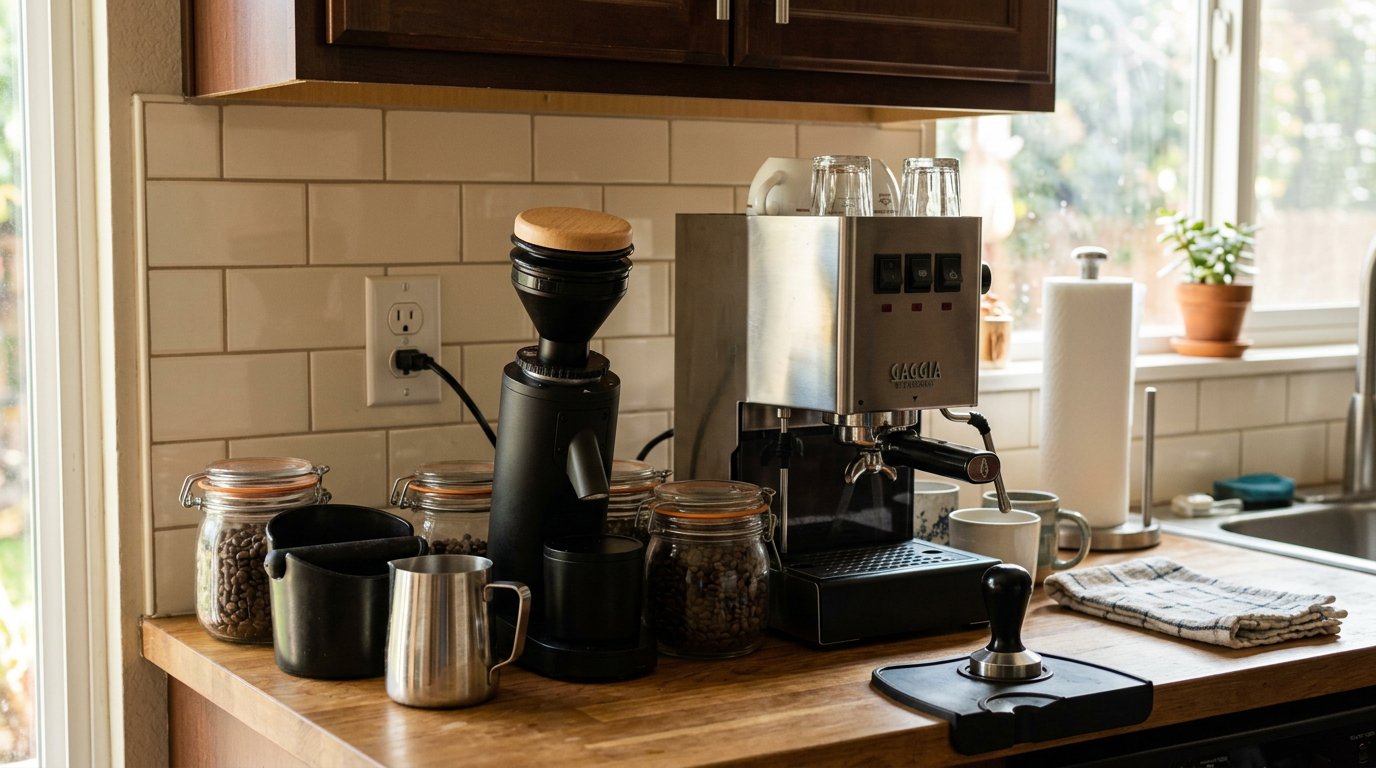
The Gaggia’s 58 mm group gave the fullest-bodied shots of the two.
My espresso ratings
Ratings out of 10 from my single reviews; the Gaggia used a separate espresso grinder.
| What you taste | Likely cause | Fix |
|---|---|---|
| Sour, thin | Grind too coarse or too cool | Finer grind; surf the Gaggia hotter |
| Bitter, harsh | Grind too fine or shot too long | Coarser grind, shorter shot |
| Uneven, spurting | Poor distribution or tamping | Distribute, then tamp level |
My guide to espresso pressure explains why 9 bar is the sweet spot both machines aim for.
Reveal Today’s DealTo compare fairly, I ran the same medium-dark blend on both for a full week, at the same 1:2 ratio, and tasted them side by side each morning. The Gaggia’s shots had more texture and a longer, sweeter finish; the Express’s were cleaner and very slightly brighter. Under milk, the difference narrowed a lot, and in a flat white most people I served could not reliably tell them apart. As straight espresso, the Gaggia was the one I reached for.
Baskets and portafilters
The Gaggia comes with three baskets: two single-wall baskets✕Single-wall basketA traditional basket with many small holes, where the grind and tamp alone create the resistance. It rewards a good grinder with better espresso., single and double, and one pressurized basket for pre-ground coffee. The 58 mm portafilter is heavy chrome-plated brass, and every commercial accessory fits it.
The Barista Express comes with single-wall and dual-wall baskets in single and double sizes, a 54 mm portafilter, a metal tamper that clips into the machine and a milk jug.
I used the single-wall double basket on both almost all the time.
| In the box | Gaggia E24 | Barista Express |
|---|---|---|
| Portafilter | 58 mm, chrome-plated brass | 54 mm |
| Single-wall baskets | Single and double | Single and double |
| Pressurized baskets | One | Single and double |
| Tamper | Plastic | Metal, magnetic dock |
| Milk jug | No | Yes |
Our tip: Use the single-wall double basket on either machine once your grind is right; it gives the best espresso.
Milk and steaming
The Gaggia’s steam wand is the stronger of the two by a wide margin. The E24 version has a heavier upper boiler, about 59% heavier than before, with 26% more water and 27% more stored heat, which the maker says gives 25% faster steam. In my tests, it took 5 oz of milk from 42°F to 142°F in about 24 seconds, with the commercial-style wand making silky microfoam✕MicrofoamSteamed milk with tiny, even bubbles and a glossy, paint-like texture, used for latte art. good enough for latte art.
The Barista Express’s wand was slower and gentler. It still made good microfoam once I learned to keep the tip just under the surface, and the gentler pace is more forgiving for beginners. Steaming a full jug for two lattes took noticeably longer.
On the Gaggia, you wait for the boiler to reach steam temperature after the shot, and refill the boiler afterwards by running water through the wand. On the Express, the switch to steam took about 15 seconds.
Milk ratings
My single-review milk scores out of 10.
| Milk | Gaggia E24 | Barista Express |
|---|---|---|
| Power | Very strong | Moderate |
| 5 oz to 142°F | About 24 s | Slower |
| Latte art | Easy once learned | Possible |
| Beginner-friendly | Less forgiving | More forgiving |
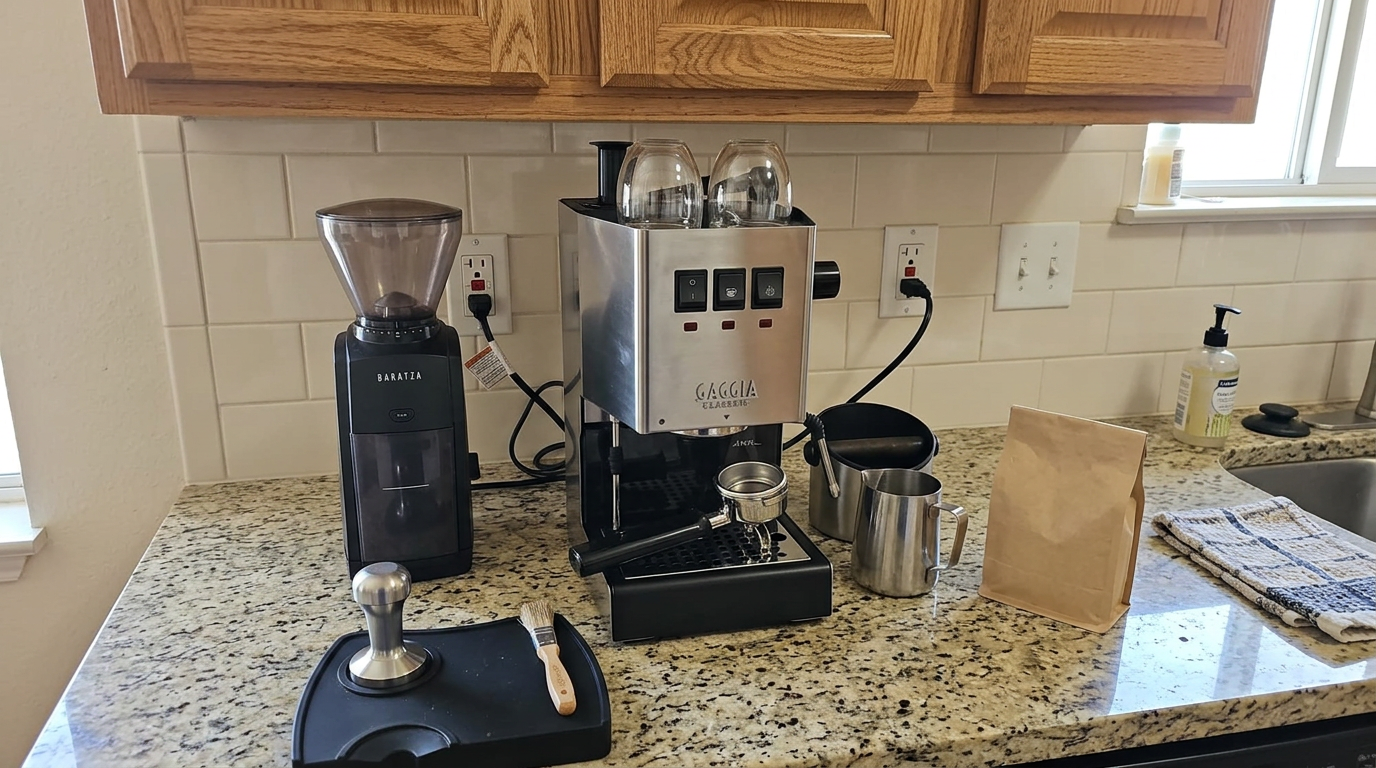
The Gaggia’s commercial-style wand made silky microfoam quickly.
My guide to the science of steamed milk explains how to get glossy microfoam on either machine.
See How Much You’ll SaveMilk type mattered on both. Cold whole milk gave the thickest, sweetest foam. Barista oat milk was the best non-dairy choice on both; almond milk made bigger bubbles that collapsed faster. On the Gaggia, the power meant I had to be quicker to stop at the right temperature; on the Express, I had more time to adjust the jug angle and build a smooth vortex.
Workflow and speed
For one latte, the Barista Express was quicker from switch-on: about a minute to heat, grind straight into the portafilter, tamp with the docked tamper, pull the shot, then steam. My whole routine took about five minutes.
The Gaggia took about the same hands-on time once hot, but the 10-minute heat-up and the wait for steam temperature made it slower overall unless I planned ahead with a smart plug.
For several milk drinks in a row, the Gaggia’s stronger steam caught up. Brewing all the shots first, then steaming one large jug, worked well on both.
Two lattes, start to finish from cold
Including heat-up; the Gaggia is faster once already hot.
| Step | Gaggia E24 | Barista Express |
|---|---|---|
| Heat-up | About 10 min | About 1 min |
| Grinding | Separate grinder | Built in |
| Tamping | Separate tamper | Docked tamper |
| Brew to steam | Wait for boiler | About 15 s |
Noise
Both use vibratory pumps, so both buzz while brewing. The Gaggia’s pump was a little louder and rattlier, and its steam wand roared more because of its power. The three-way valve also gives a short hiss as it releases pressure after each shot.
The Barista Express adds the noise of its grinder, which is loud for the few seconds it runs. Overall, the two felt similar in a quiet morning kitchen; the Gaggia’s noise comes from steaming, the Express’s from grinding.
| Sound | Gaggia E24 | Barista Express |
|---|---|---|
| Pump | Buzzy, a little louder | Buzzy |
| Grinding | Your separate grinder | Loud, a few seconds |
| Steaming | Strong roar | Gentler hiss |
| After the shot | Short valve hiss | Quiet |
Cleaning and upkeep
Both are easy to keep clean day to day: knock out the puck, rinse the basket, flush the group and wipe and purge the wand after every milk drink.
The Gaggia’s three-way valve leaves a dry puck that knocks out cleanly. I backflushed it with water weekly using a blind basket and descaled it regularly, as the manual describes.
The Barista Express has a clean-me light, a cleaning disc and tablets for its cleaning cycle, and a descale routine. The grinder also needs brushing every few weeks to clear old grounds. Its 67 oz tank has no low-water warning, so I checked it each morning; the Gaggia’s 72 oz tank needs watching too.
| When | Gaggia E24 | Barista Express |
|---|---|---|
| After each shot | Knock out, rinse, flush | Knock out, rinse, flush |
| After milk | Wipe and purge | Wipe and purge |
| Weekly | Backflush with water | Wipe hopper and grinder area |
| Regularly | Descale | Cleaning cycle, descale, brush burrs |
Cleaning ratings
My single-review scores out of 10.
Beans, water and dialling in
Both machines rewarded fresh beans, roasted within the last few weeks. Medium and medium-dark roasts were the easiest to dial in on both; light roasts were where the Gaggia and a good grinder pulled ahead.
I started both with a 1:2 ratio: about 15 to 16 g of coffee in, about 30 to 36 g of espresso out, in roughly 25 to 30 seconds. On the Barista Express, the gauge needle sitting in the middle of the espresso range told me I was close. On the Gaggia, which has no gauge, I went by time, weight and taste.
I used filtered water in both. Very soft water can taste flat and very hard water scales the boiler quickly, so filtered tap water was a good middle ground.
| Starting recipe | Gaggia E24 | Barista Express |
|---|---|---|
| Dose | 15 to 18 g | About 15.4 g |
| Yield | About 1:2 | About 1:2 |
| Time | 25 to 30 s | 25 to 30 s |
| Guide | Time, weight, taste | Gauge, time, taste |
My guides to water chemistry for coffee and coffee roast levels go deeper on both.
Our tip: Weigh both your dose and your espresso with a small scale; it makes dialling in either machine much faster.
Repairs and lifespan
This is where the Gaggia stands apart. It is a simple machine made in Italy, with standard parts and a huge owner community. Gaskets, the shower screen, the pump and the valves can all be replaced at home with basic tools, and spare parts are easy to find. Many owners keep these machines running for well over a decade.
The Barista Express is well built and widely serviced, but with a grinder, electronics and more integrated parts, it is more of an appliance. If the grinder wears out, the whole unit is out of action unless it is repaired.
Our tip: Replace the group gasket on either machine as soon as the portafilter starts locking past its usual position.
In my four weeks, neither machine had a single fault. The Express’s grinder ran smoothly throughout, and the Gaggia’s switches and steam knob felt exactly as solid at the end as on day one.
Serving guests
For two or three drinks, both machines were easy. For four or more milk drinks, the Gaggia’s stronger steam made it the better host machine once hot: I pulled all the shots, then steamed one big jug and split it.
The Barista Express handled four lattes well too, but steaming took longer, and I refilled the tank partway through. Its built-in grinder kept the counter tidier with guests around.
Four lattes, machine already hot
My timings, steaming one shared jug.
Our tip: When serving several milk drinks, pull all the shots first, then steam one large jug and pour from it.
Upgrades
The Gaggia is one of the most upgradeable machines at home. Its 58 mm group takes any commercial basket, a bottomless portafilter, a precision tamper and a distribution tool. Owners also change the pressure valve spring and add PID kits, though I tested it in stock form.
The Barista Express also takes a 54 mm bottomless portafilter, a better tamper and a dosing funnel, which helped my workflow, but there is less to change inside.
| Upgrade | Gaggia E24 | Barista Express |
|---|---|---|
| Bottomless portafilter | 58 mm, wide choice | 54 mm |
| Precision baskets | Wide choice | Some |
| Better tamper | Yes, recommended | Optional |
| Dosing funnel | Yes | Yes |
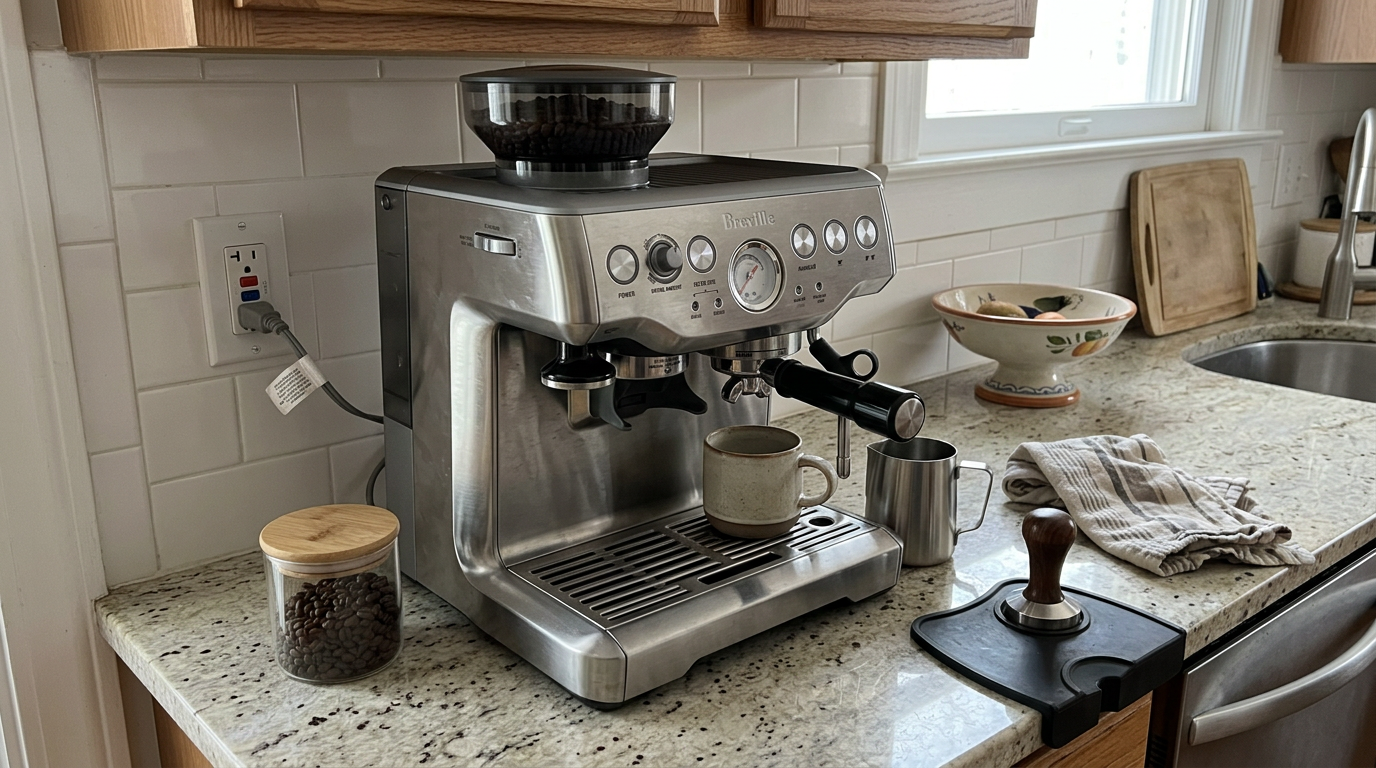
The Express grinds straight into the portafilter, which keeps the counter tidy.
My advice is to use either machine in its stock form for a month before buying anything. On the Gaggia, the first two upgrades that made a real difference for me were a proper 58 mm tamper and a bottomless portafilter, which showed me exactly where my puck preparation was going wrong. On the Express, a dosing funnel stopped grounds from spilling around the portafilter, and that was all I needed.
Mistakes to avoid
Buying the Gaggia without a proper grinder. Pre-ground or blade-ground coffee will hold it back.
Brewing on the Gaggia straight after switch-on. Give it the full 10 minutes.
Running the Express tank dry. It has no low-water warning.
Ignoring the Express inner burr. It is the fix for light roasts running fast.
Using tall mugs under the Gaggia. Brew into a small cup and pour.
| Problem | Fix |
|---|---|
| Gaggia shots taste sour | Longer warm-up, surf hotter, finer grind |
| Express shots run fast | Finer setting or inner burr |
| Gaggia steam runs out | Wait for the steam light, refill the boiler after |
| Express gauge stays low | Finer grind, firmer tamp, check dose |
Which makes the better first machine?
For most first-timers, the Barista Express. It removes the two hardest early hurdles, choosing a grinder and managing temperature, and its gauge teaches you what a good shot looks like.
The Gaggia can be a great first machine for the right person: someone who enjoys learning, already has a good grinder, or wants to build a setup piece by piece. It has a steeper start, but there is more room to grow.
| Coming from | Better pick | Why |
|---|---|---|
| Pods or capsules | Barista Express | Everything included |
| A pressurized-basket machine | Either | Both are a real step up |
| Already own a good grinder | Gaggia E24 | Best espresso and steam |
| Love to tinker | Gaggia E24 | Endless upgrades |
Our tip: If you choose the Barista Express, spend your first week only changing the grind setting; leave the dose and inner burr alone.
A typical morning on each
My weekday drink was a flat white and an espresso.
On the Barista Express, I switched it on, ground 15.4 g into the portafilter, tamped with the docked tamper, pulled the espresso, then another shot for the flat white, and steamed about 5 oz of milk. Total time was about seven minutes from a cold machine.
On the Gaggia, the smart plug had already warmed it. I weighed and ground the beans on my grinder, distributed and tamped, flushed briefly, pulled both shots, flipped the steam switch, waited for the light and steamed. Hands-on time was about the same, but the Gaggia’s milk was ready faster and silkier.
| Step | Gaggia E24 | Barista Express |
|---|---|---|
| Heat-up | Smart plug, 10 min | About 1 min |
| Grind and dose | Separate grinder | Built in |
| Shots | Two | Two |
| Milk | Faster, silkier | Slower, gentler |
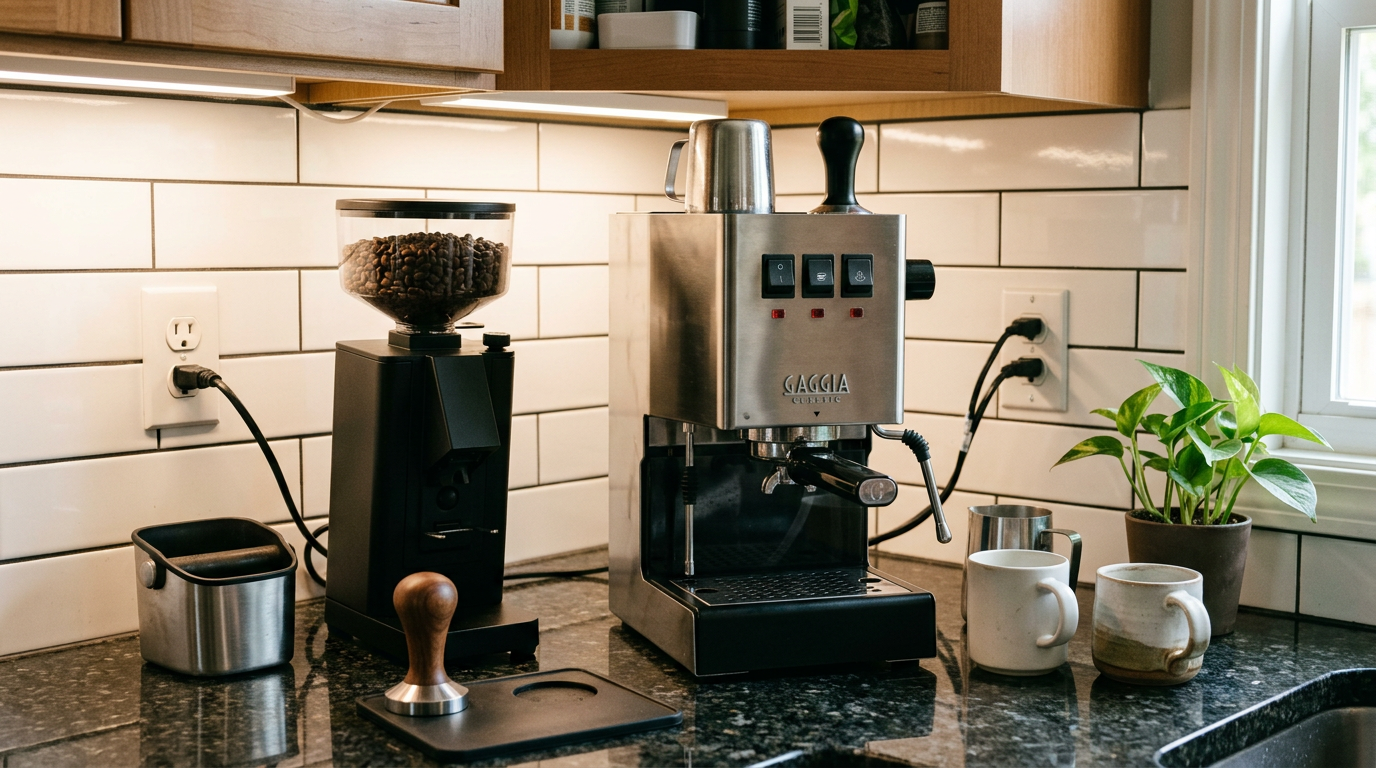
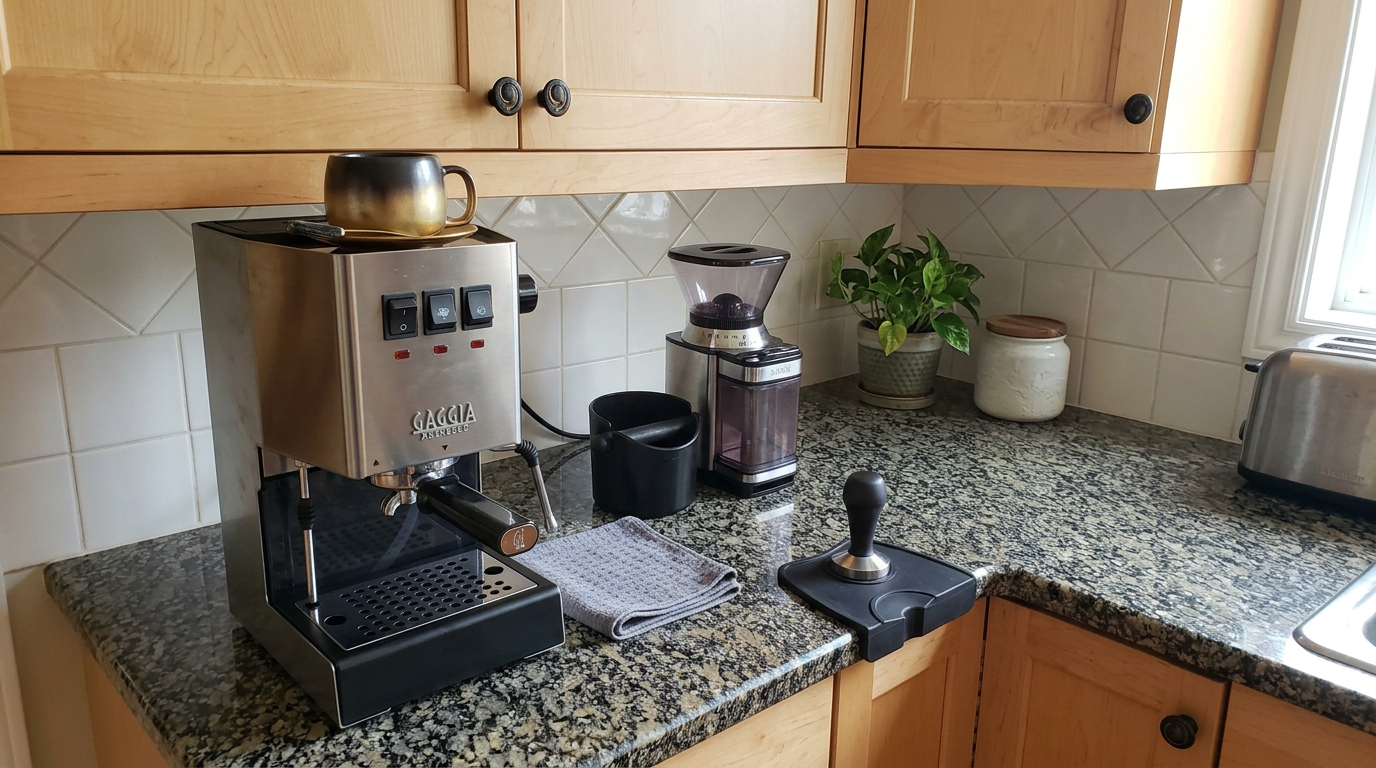
The Gaggia in my kitchen, where it lived for four weeks.
On weekends I had more time, and that is where the Gaggia became the more enjoyable machine: weighing, grinding, tasting and adjusting felt like a small ritual. On rushed weekdays, the Express’s all-in-one workflow was simply less to think about, and I never skipped coffee because the machine was not ready.
Four weeks with each: my diary notes
These are the notes I kept as each machine settled into my routine.
Gaggia Classic Pro E24
Week 1: Primed the pump, replaced the plastic tamper, first good shot on day two.
Week 2: Temperature surfing became routine; shots got consistent.
Week 3: The steam wand made latte art easy.
Week 4: Rich, syrupy espresso was the best I made in the test.
Breville Barista Express
Week 1: Dialled in within a day at grind 5.
Week 2: Moved the inner burr from 6 to 2 for a lighter roast.
Week 3: Ran the tank dry once; started checking it daily.
Week 4: The fastest, easiest routine of the two.
Real-life scenarios
These are the situations where one machine fit better in my four weeks.
Grinder and PID included.
Best espresso and steam.
Ready in a minute.
Much stronger steam.
Compact and short.
Repairable, standard parts.
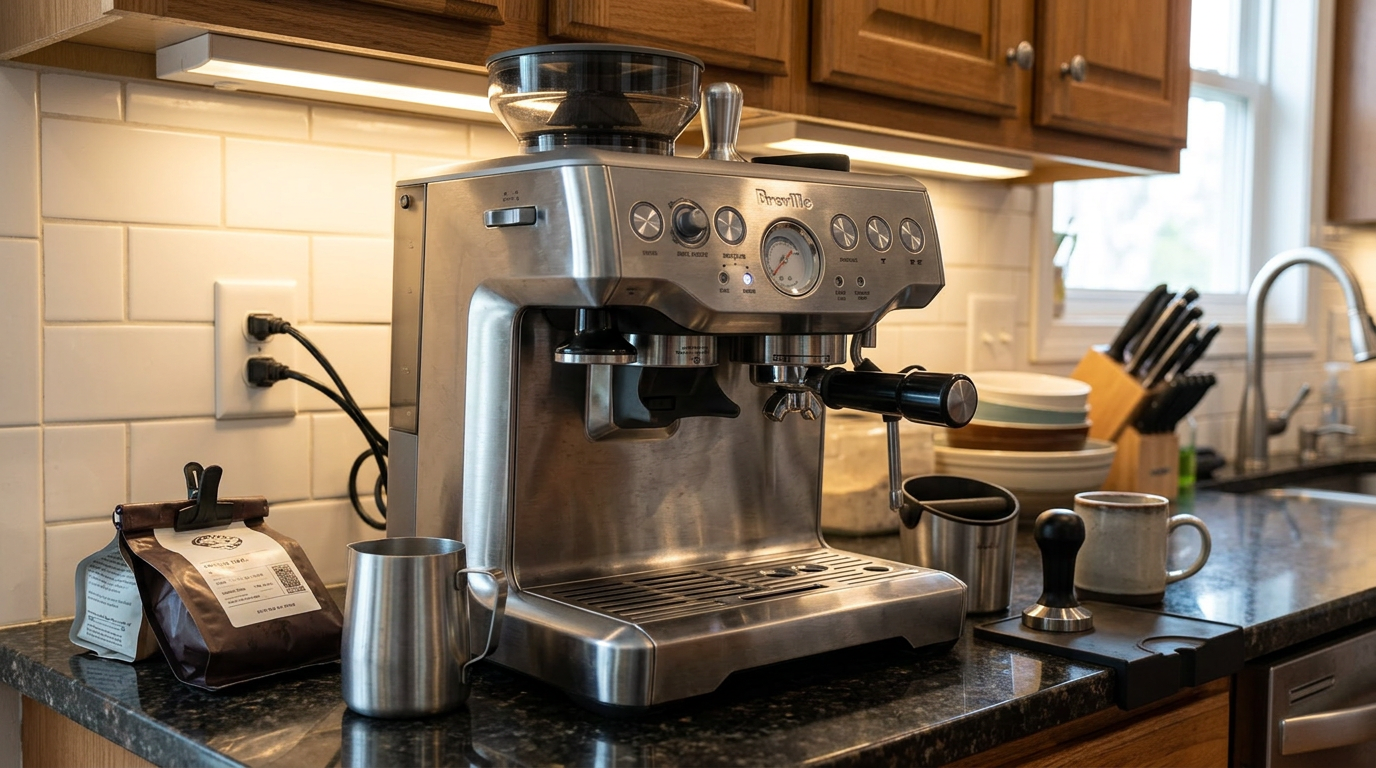
The Barista Express handled every busy weekday without fuss.
My scorecard
These are my scores out of 10 from my single reviews.
Gaggia Classic Pro E24
Breville Barista Express
Overall, I rate the Gaggia 8.2 and the Barista Express 8.0. The Gaggia scores higher as a machine, but that score assumes you pair it with a good grinder; the Express includes one.
Find Out the Price TodayWhich one is right for you?
4 quick questionsWhich one should you buy?
For most people starting out, the Barista Express. It includes the grinder, holds the temperature for you and is ready in a minute.
If you already have a good grinder, or want the best espresso and steam with room to grow, the Gaggia Classic Pro E24. For the full detail, read my reviews of the Gaggia Classic Pro E24 and the Barista Express.
- You want one box with a grinder
- You want it ready in a minute
- You are new to espresso
- You want the strongest steam
- You want to upgrade endlessly
- You own a good grinder
- You love milk drinks
- You want a repairable machine
- You want it ready instantly
- You use tall mugs
My pick for most people is the Breville Barista Express. With its built-in grinder, PID and one-minute heat-up, it makes very good espresso the easiest way.
Choose the Gaggia Classic Pro E24 if you have a good grinder and want richer espresso, much stronger steam and a machine you can repair for years.
Whichever you choose, use fresh beans, the single-wall double basket and a steady tamp.
Gaggia E24 vs Barista Express specifications
From manufacturer specifications and my own testing.
| Gaggia Classic Pro E24 | Breville Barista Express | |
|---|---|---|
| Type | Single boiler, manual | All-in-one with grinder |
| Boiler or heater | Brass boiler | Thermocoil with PID |
| Pressure | 9-bar OPV | 15-bar pump, gauge |
| Portafilter | 58 mm | 54 mm |
| Grinder | None | Conical burr, 16 settings |
| Heat-up | About 10 min | About 1 min |
| Water tank | 72 oz | 67 oz |
| Size | Compact | 12.5 x 13.8 x 15.9 in |
How I tested and compared them
Michael Reynolds here. I used each machine as my everyday espresso machine for four weeks, with the same medium-dark and light-roast beans and cold whole milk, and kept detailed notes throughout.
I paired the Gaggia with a dedicated espresso grinder and used the Barista Express’s built-in grinder. I timed heat-up, shots and steaming, weighed doses and yields, and ran side-by-side tastings.
I steamed whole, 2%, barista oat and almond milk on both, and followed each manual’s cleaning routine.
- Espresso: body, crema, flavor and consistency.
- Milk: foam texture and learning curve.
- Workflow: heat-up, prep and daily routine.
- Ownership: cleaning, noise, water and footprint.
Gaggia E24 vs Barista Express FAQ
What is the difference between the Gaggia Classic Pro E24 and Barista Express?
The Gaggia is a commercial-style 58 mm machine with a brass boiler and strong steam, but no grinder or PID. The Barista Express is an all-in-one with a built-in grinder, PID temperature control and a gauge.
Which makes better espresso?
With a good grinder, the Gaggia made richer, fuller-bodied espresso. The Express was more consistent day to day.
Which is better for milk drinks?
The Gaggia. Its steam wand took 5 oz of milk to 142°F in about 24 seconds.
Does the Gaggia E24 have a grinder?
No. You need a separate espresso grinder.
Does the Gaggia have a PID?
No. You use temperature surfing for consistent shots.
How long does each take to heat up?
About 10 minutes for the Gaggia and about 1 minute for the Barista Express.
What portafilter size do they use?
58 mm on the Gaggia and 54 mm on the Barista Express.
Which is better for beginners?
The Barista Express, because the grinder and PID are included.
Which lasts longer?
The Gaggia is simpler and easy to repair with standard parts.
Do tall mugs fit under the Gaggia?
No, cup clearance is low; brew into a small cup.