Zojirushi NS-TSC10 review
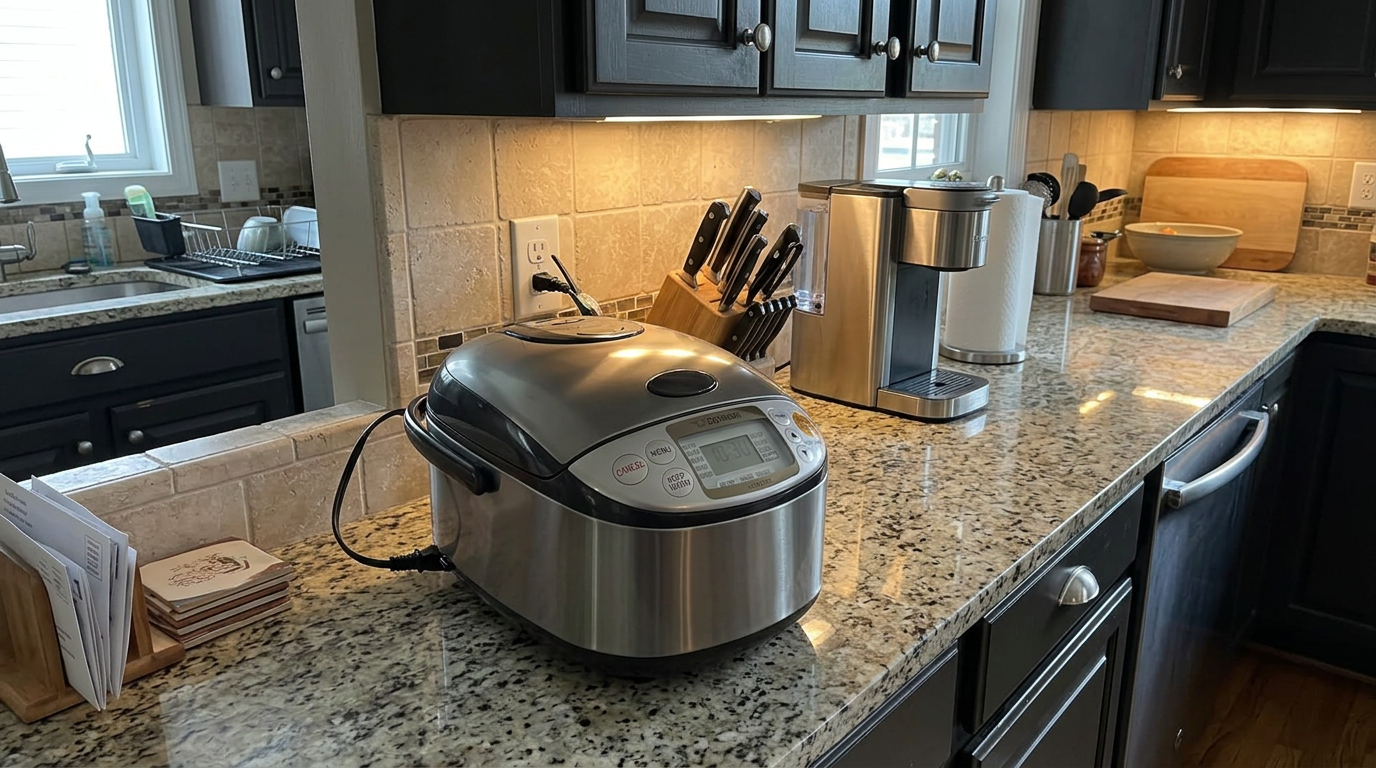
The Zojirushi NS-TSC10 5.5-Cup Micom Rice Cooker and Warmer is a compact, computer-controlled rice cooker with eight menu settings, a delay timer, automatic keep warm, a steam tray and a retractable cord. I used it for three weeks for long-grain white rice, brown rice, sticky sweet rice, porridge, mixed rice, steamed vegetables and even a cheesecake. White rice came out fluffy and evenly cooked every single time, the timer had rice ready exactly when dinner was and cleanup was easy. The regular white rice cycle takes about an hour and the extras are basic, but for consistently excellent rice, it is hard to beat.

Emily Carter
Hands-on review
Hands-on testing, research, specs
3 weeks
26 minutes
Jargon helpNew to rice cookers? Tap any dotted term to see what it means.
In this review
Yes, if you eat rice several times a week and want it right every time. The Zojirushi NS-TSC10 made fluffy, evenly cooked white rice with no scorching, handled brown rice, sticky sweet rice and porridge with ease and kept everything warm without drying it out for hours. The delay timer let me set it in the morning and come home to fresh rice. The handle and retractable cord make it easy to store. The main trade-off is time: regular white rice takes about an hour. If you value perfect rice over speed, it is an excellent choice.
Zojirushi NS-TSC10 at a glance
Zojirushi NS-TSC10 pros and cons
- Fluffy, evenly cooked rice every time
- Delay timer and gentle keep warm
- Compact with handle and retractable cord
- Regular white rice takes about an hour
- Removable parts are hand wash only
- Steaming and cake settings are basic
Who should buy the Zojirushi NS-TSC10?
- Families who eat rice most days
- Cooks who want set-and-forget rice
- Small kitchens that need easy storage
- People who need rice in under 30 minutes
- Large gatherings every week
- Anyone wanting a full multi-cooker
First impressions of the Zojirushi NS-TSC10
The NS-TSC10 is compact and tidy, with a brushed stainless exterior, a carrying handle and a clear LCD panel.
It measures about 10 by 14 by 8.5 inches, small enough for a corner of the counter or a pantry shelf.
At around 7 pounds, it is easy to lift.
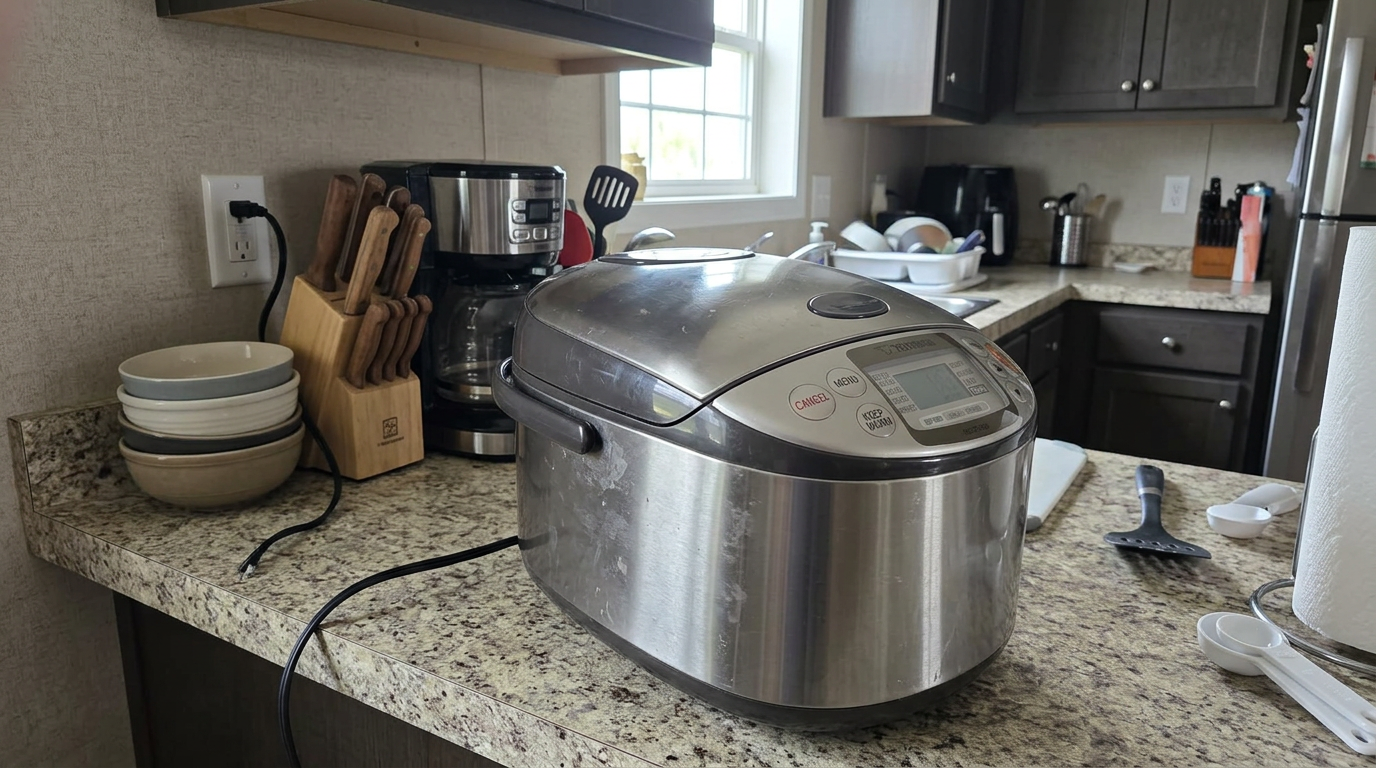
The nonstick inner pan, detachable inner lid and control panel.
Inside sits a nonstick inner cooking pan with clear water-level markings for each rice type.
The inner lid detaches for washing, and a steam vent cap sits on top.
In the box, I found a steaming tray, a rice measuring cup and a serving spatula.
The retractable cord was a small detail I came to love.
Pull it out when you need it, press a button and it disappears.
Our tip: Keep the supplied measuring cup with the cooker at all times, because it holds about 180 ml, less than a standard US cup, and every water marking in the pan is based on it.
What “Micom” means
Micom is short for microcomputer.
The cooker uses a small computer chip and fuzzy logic✕Fuzzy logicA control method that lets the rice cooker adjust heat and timing on its own based on temperature readings, instead of following one fixed program. to adjust heat and timing during the cycle.
Instead of simply boiling until the water is gone, it soaks, heats, steams and rests the rice in stages.
In practice, that means you do not need to think about any of it.
You add rice and water, choose a menu and press start.
The cooker takes care of the rest, adjusting as it goes.
The rough stages of a Micom white rice cycle.
Our tip: Resist opening the lid during the cycle, because the cooker relies on trapped steam and temperature readings to finish the rice and lifting the lid can leave it undercooked or uneven.
Long-grain white rice test
For my main test, I measured two cups of long-grain white rice with the supplied cup.
I rinsed it in a bowl, swirling with my hand and draining the cloudy water until it ran almost clear.
Then I put it in the pan and filled water to the “2” line for white rice, using the water-level markings✕Water-level markingsLines printed inside the rice cooker pan that show how much water to add for a given number of rice cups and type of rice. inside the pan.
I selected White and pressed Start.
The cycle took about an hour, then the cooker beeped and switched to Keep Warm.
When I opened the lid, the rice looked moist and evenly cooked from top to bottom.
After a gentle fluff with the spatula, the grains were light and mostly separate, with no hard bits or scorched layer.
It was better than my stovetop rice on its best day.
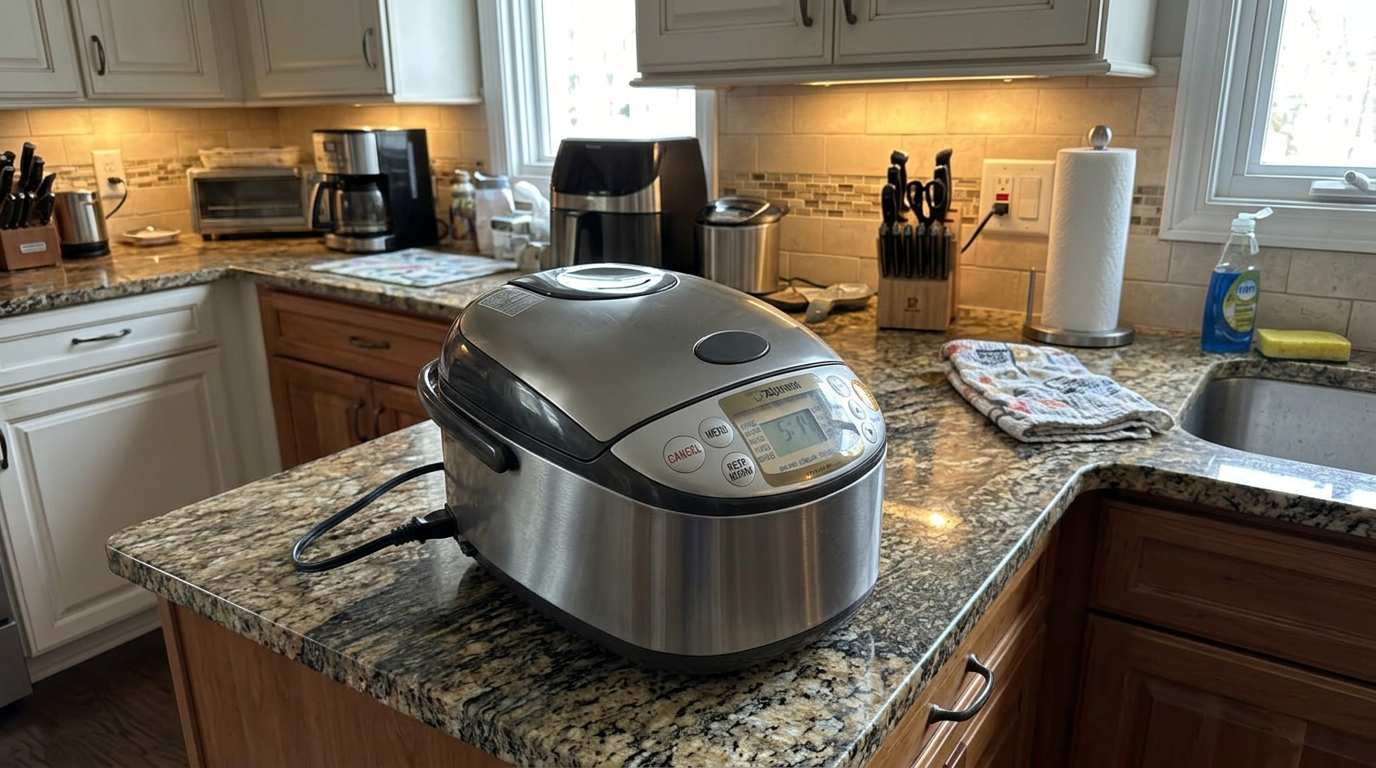
Evenly cooked white rice, fluffed with the included spatula.
Our tip: Fluff the rice gently with the spatula as soon as the cycle ends, because turning it releases excess steam, stops the bottom layer from compacting and keeps the grains light while it sits on Keep Warm.
Measuring rice and water correctly
Good rice starts with good measuring.
The supplied cup holds about 180 ml, not a standard US cup, so I always used it.
The pan has separate markings for white, brown, sweet and porridge, which takes out all the guesswork.
When I added slightly too much water, the rice came out softer.
Too little made it firm.
Keeping to the line, and adjusting only a few millimeters for preference, gave me consistent results.
| Rice amount | Water level | Result |
|---|---|---|
| 1 cup white | Line 1 for white | Fluffy, small batch |
| 2 cups white | Line 2 for white | Fluffy, family side |
| 3 cups white | Line 3 for white | Fluffy, plenty for leftovers |
| 2 cups brown | Line 2 for brown | Tender, slight chew |
Our tip: Check the water level with the pan sitting flat on the counter, because tilting it even slightly makes the line hard to read and can throw off the texture of the finished rice.
Quick rice for busy nights
The regular white cycle takes about an hour, so the Quick setting is useful on busy nights.
It skips some of the soaking and finishes faster.
Quick rice was good, though slightly firmer and less fluffy than the regular White setting.
For a weeknight stir-fry, it was perfectly fine.
For a dinner where rice is the star, I used the full White cycle.
Relative cycle times from my testing.
Our tip: Soak rice for 20 minutes before using the Quick setting, because pre-soaking makes up for the shorter cycle and gives you softer, more even grains in less time.
Brown rice
Brown rice is where a good rice cooker really earns its keep.
The bran layer needs a longer, gentler cook, and the Brown setting handles it automatically.
My brown rice came out tender with a pleasant chew, and the grains did not split open or turn mushy.
It took longer than white rice, so I started it earlier or used the timer.
Our tip: Use the brown rice water markings, not the white ones, because brown rice needs more water and using the white line leaves the grains hard in the center.
Sticky sweet rice
Sweet rice, also called glutinous or sticky rice, behaves differently from long-grain rice.
It is meant to be cohesive and chewy rather than fluffy and separate.
On the Sweet setting, I got glossy, sticky rice that held together perfectly for a mango sticky rice dessert.
It was the easiest sticky rice I have ever made at home.
Our tip: Soak sweet rice for at least an hour before cooking, because the extra soak helps the grains cook evenly and gives you the glossy, chewy texture that sticky rice dishes need.
Rice porridge
The Porridge setting makes soft, creamy rice porridge, often called congee✕CongeeA soft, comforting rice porridge cooked with plenty of water until the grains break down. It is often eaten for breakfast with savory toppings..
I used the porridge water line, added a little ginger and let the cooker do its thing.
The result was smooth and comforting, with the grains broken down just enough.
I topped it with scallions, a soft egg and a drizzle of sesame oil for a warming breakfast.
Our tip: Set porridge on the timer before bed so it is ready at breakfast, because the long, gentle cycle is perfect overnight and you wake up to a hot, ready meal.
Mixed rice with vegetables
The Mixed setting is for rice cooked with other ingredients.
I made a simple chicken stock rice with peas, carrots and a little soy sauce.
The rice absorbed the stock evenly, the vegetables were tender and nothing stuck to the pan.
It made a quick, flavorful side dish with almost no effort.
Our tip: Add seasonings and stock to the water before you check the level, because the total liquid is what matters and adding sauces after measuring makes the rice softer than you expect.
The delay timer
The delay timer was one of my favorite features.
You set the time you want the rice finished, not when it should start.
The cooker works out the start time based on the menu.
To set it, press Timer, use the arrows to choose the finish time and press Start.
The display may use a 24-hour clock, so 17:00 means 5:00 p.m.
There are two timer memory settings, which I used for breakfast and dinner.
On busy days, I loaded the rice and water in the morning, set the timer for 6:00 p.m. and came home to freshly cooked rice.
It took one more thing off my evening list.
| Step | What to do |
|---|---|
| 1 | Add rinsed rice and water to the line |
| 2 | Press Timer |
| 3 | Set the finish time with the arrows |
| 4 | Check the time on the display |
| 5 | Press Start |
Our tip: Use the timer only with plain rice and water for long delays, because ingredients like stock, milk or meat should not sit at room temperature for hours before cooking.
Keep warm without drying out
When cooking ends, the cooker switches to Keep Warm and the display counts the hours since.
The rice stayed moist and pleasant for several hours, which was helpful when dinner ran late.
After many hours, the bottom layer started to firm up slightly.
For the best texture, I served within a few hours and refrigerated leftovers promptly.
Our tip: Cool leftover rice quickly and refrigerate it within two hours, because cooked rice left warm for too long can grow harmful bacteria and is best reheated until steaming hot.
Leftover rice and fried rice
A rice cooker that makes great rice also makes great leftovers.
I chilled rice from dinner in a covered container and used it the next day for fried rice.
Chilled rice is firmer and drier than fresh, which helps it stir-fry without turning mushy.
With eggs, vegetables and a little soy sauce, it made one of the quickest lunches of the week.
For food safety, I refrigerated the rice within two hours, kept it cold and reheated it until steaming hot throughout.
Our tip: Break up chilled rice with your hands before frying, because separated grains heat evenly and crisp up in the pan instead of forming dense clumps.
Steaming with the tray
The steam tray sits above the inner pan and turns the cooker into a basic steamer.
I steamed broccoli, carrots and frozen dumplings with water in the pan below.
It worked well for small portions.
The tray is not large, so it is best for side dishes rather than a full steamed meal.
If your tray ever goes missing, the rice settings still work normally.
Replacement trays are available for this model.
Our tip: Cut vegetables into even pieces for the steam tray, because the small space and gentle steam cook everything at the same pace and uneven pieces finish at different times.
The cake setting
The cake setting was a fun extra.
I made a simple cheesecake batter, poured it into the greased pan and ran the cake program.
It came out moist and evenly cooked, with a pale top rather than a browned one.
It is not an oven replacement, but for an easy, small cake or cheesecake, it works.
Our tip: Line the bottom of the pan with a circle of parchment when baking a cake, because it helps the cake release cleanly and protects the nonstick coating from knives and scraping.
Design, handle and retractable cord
The NS-TSC10 is built for easy living.
The fold-down carrying handle let me move it from the counter to the pantry with one hand.
The retractable cord keeps the counter tidy and makes storage simple.
The control panel is clear and logical, with Menu, Timer, Start and Cancel buttons.
You can choose between a melody and a simple beep for the end-of-cycle signal.
| Detail | What I found |
|---|---|
| Size | About 10 x 14 x 8.5 in |
| Weight | About 7 lb |
| Capacity | 5.5 cups uncooked, about 10 cups cooked |
| Power | 610 watts |
| Handle | Fold-down carrying handle |
| Cord | Retractable |
Our tip: Retract the cord fully before carrying the cooker by its handle, because a loose cord is easy to catch on cabinet doors and could pull the cooker out of your hand.
Cleaning and care
Cleaning takes a couple of minutes.
The nonstick inner pan washes easily with a soft sponge and warm soapy water.
The inner lid detaches, and I hand washed it after every few uses.
Zojirushi recommends hand washing removable parts, so I avoided the dishwasher.
After washing, I let the inner lid dry completely before clicking it back into place.
- Wash the inner pan after every use with a soft sponge.
- Remove and hand wash the inner lid regularly.
- Dry the outside and bottom of the pan before putting it back.
- Wipe the exterior with a damp cloth.
- Never use metal utensils or abrasive pads in the pan.
Our tip: Always dry the outside and bottom of the inner pan before placing it in the cooker, because water on the heating plate can affect the sensors and leave marks on the base.
Capacity: how much rice it makes
The NS-TSC10 is a 5.5-cup cooker, measured in its own rice cup.
That means up to 5.5 cups of uncooked rice, which makes roughly 10 cups of cooked rice.
For my family of four, two to three cups uncooked was plenty for dinner and leftovers.
It also cooked a single cup perfectly, so it works for small households too.
| Uncooked rice | Cooked yield (approx.) | Feeds |
|---|---|---|
| 1 cup | About 2 cups | 1 to 2 |
| 2 cups | About 4 cups | 3 to 4 |
| 3 cups | About 6 cups | 4 to 6 |
| 5.5 cups | About 10 cups | A gathering |
Our tip: Cook a little extra rice on purpose, because leftover rice from this cooker makes excellent fried rice the next day and saves you a whole cooking cycle.
A typical week with the NS-TSC10
By the second week, the cooker ran almost daily.
White rice with curries and stir-fries, brown rice for grain bowls, porridge for two breakfasts and sticky rice for a weekend dessert.
The timer changed my routine most.
Loading rice and water in the morning meant one less job in the evening rush.
| Day | Rice | Setting | Used with |
|---|---|---|---|
| Monday | Long-grain white | White | Chicken curry |
| Tuesday | Brown | Brown | Grain bowls |
| Wednesday | Porridge | Porridge | Breakfast |
| Thursday | White | Quick | Stir-fry |
| Saturday | Sweet | Sweet | Mango sticky rice |
Our tip: Rinse and measure rice the night before and leave it covered in the fridge, because it makes timer cooking even easier and the short soak improves the final texture.
Short-grain and sushi rice
The White setting doubles as a sushi rice setting, and short-grain rice is where Zojirushi cookers shine.
I rinsed short-grain rice well, let it soak for 30 minutes and cooked it to the white line.
The rice came out glossy, tender and slightly sticky, exactly right for sushi.
I folded in seasoned rice vinegar while it was still warm and fanned it to cool.
The grains stayed whole and held together beautifully in rolls.
Short-grain rice is stickier because it has more amylopectin✕AmylopectinA type of starch in rice that makes grains sticky and tender. Short-grain and sweet rice have more of it, long-grain rice has less and cooks up more separate., a starch that makes grains cling together.
Long-grain rice has less, which is why it cooks up more separate.
Our tip: Let short-grain rice rest for ten minutes on Keep Warm before seasoning it, because the short rest firms up the surface of the grains so they absorb the vinegar without breaking.
Jasmine and basmati rice
I also tested aromatic long-grain rice.
Jasmine rice on the White setting came out soft, fragrant and lightly clingy, which is exactly how it should be.
Basmati needed a little adjustment.
Using slightly less water than the white line and rinsing thoroughly gave me long, separate grains with a lovely fragrance.
| Rice | Setting | Water | Result |
|---|---|---|---|
| Jasmine | White | To the white line | Soft, fragrant |
| Basmati | White | Slightly below the line | Long, separate grains |
| Short-grain | White/sushi | To the white line | Glossy, tender |
| Long-grain American | White | To the white line | Fluffy, separate |
Our tip: Reduce the water a few millimeters for basmati, because its long, slender grains need less water than other white rice to stay separate and fluffy.
Signals, noise and everyday living
The NS-TSC10 is almost silent while cooking, with only a gentle hiss of steam from the vent.
At the end, it plays a short melody, or a simple beep if you switch the signal setting.
I liked the melody at first, then switched to the beep for early mornings.
Either way, it is easy to hear from the next room.
Our tip: Keep the steam vent clear of wall cabinets and curtains, because the steady steam during cooking can leave moisture marks on surfaces directly above the cooker.
A good fit for small households
The 5.5-cup size is ideal for couples and small families.
It cooked one cup of rice as well as three, which is not true of every cooker.
Because it is compact and light, it also suits small kitchens and apartments.
The handle and retractable cord make it easy to put away between meals.
For larger families or frequent entertaining, the bigger 10-cup version of this model may be worth a look.
Our tip: Cook at least one full cup at a time, because very small amounts below the lowest line can cook unevenly, while one cup and up gives you reliably fluffy results.
What long-term ownership looks like
Three weeks of daily use showed no wear at all.
The nonstick pan was unmarked because I only used the supplied spatula and a soft sponge.
The markings inside the pan were still crisp and clear.
Replacement parts, including the inner pan, inner lid and steam tray, are available for this model, which suggests it is built to last.
With gentle care, I would expect many years of reliable use.
Our tip: Use only the plastic spatula in the inner pan, because metal spoons scratch the nonstick coating and the pan is the part that most affects how evenly your rice cooks.
Rice for meal prep
On Sundays, I cooked a full batch of brown rice and a batch of white rice back to back.
I cooled them quickly, portioned them into containers and refrigerated them for weekday lunches.
Reheated with a splash of water and covered, the rice came back soft and fluffy.
It made grain bowls, fried rice and quick sides easy all week.
Our tip: Spread freshly cooked rice on a tray to cool before refrigerating, because a thin layer cools fast, which keeps it safe and stops it clumping in the container.
Why I stopped cooking rice on the stove
Before this test, I cooked most of my rice in a saucepan.
It worked, but it needed attention: watching for boil-overs, turning the heat down at the right moment and hoping the bottom did not scorch.
With the NS-TSC10, all of that disappeared.
I measured, rinsed, added water to the line and walked away.
The rice was better and more consistent than my stovetop rice, and the stove was free for the rest of dinner.
| Task | Stovetop pot | Zojirushi NS-TSC10 |
|---|---|---|
| Watching the pot | Yes, for boil-overs | No |
| Adjusting heat | Yes | Automatic |
| Scorched bottom | Sometimes | Never in my tests |
| Ready on schedule | No | Delay timer |
| Keeping warm | Cools quickly | Automatic keep warm |
Our tip: Free up the stove by starting rice in the cooker first, because once it is running you have every burner available for the main dish and sides.
Reheating rice
The cooker keeps rice warm well, but sometimes I needed to reheat leftovers from the fridge.
I found the best method was a splash of water, a cover and a short reheat in the microwave or a covered pan, stirring halfway.
Rice from this cooker reheated better than my old stovetop rice because the grains were cooked evenly to begin with.
For food safety, I always reheated it until steaming hot all the way through and only reheated it once.
Our tip: Add about a tablespoon of water per cup of cold rice before reheating, because the extra moisture turns to steam and brings the grains back to a soft, fluffy texture.
My three weeks with the NS-TSC10
In week one, I focused on white rice, testing different amounts, rinsing methods and water levels.
Once I had my routine, the results were excellent and very consistent.
In week two, I tried every menu: brown, sweet, porridge, mixed, quick, cake and steam.
Each one did what it promised, with brown and sweet rice the standouts.
In week three, I used the timer daily and paid attention to keep warm, cleaning and storage.
The pan showed no wear, and the cooker looked as good as new.
| Week | Focus | Main finding |
|---|---|---|
| 1 | White rice | Consistently fluffy and even |
| 2 | All menu settings | Excellent brown and sweet rice |
| 3 | Timer, keep warm, care | Convenient, easy to clean, no wear |
Our tip: Experiment with water a few millimeters above or below the line in your first week, because small adjustments let you dial in exactly the texture your family prefers.
Troubleshooting what I ran into
A few small issues came up, all easy to solve.
| Problem | Cause | Fix |
|---|---|---|
| Slightly sticky rice | Rinsed only once | Rinse until water is nearly clear |
| Rice a bit soft | Water above the line | Measure with the pan flat |
| Firm rice | Used a standard US cup | Use the supplied rice cup |
| Rice ready too late | Forgot the hour-long cycle | Use the timer or Quick |
| Bottom slightly firm | Hours on Keep Warm | Serve sooner, refrigerate leftovers |
Our tip: Use the cooker’s own rice cup and markings every time, because nearly every texture problem I saw came from mixing standard measuring cups with the cooker’s water lines.
Who it suits in real life
The NS-TSC10 suits anyone who eats rice often and wants it perfect with no effort.
It is ideal for families, rice lovers and anyone tired of scorched or gummy stovetop rice.
It is less ideal if speed matters most, since white rice takes about an hour.
If you want one appliance for pressure cooking, slow cooking and rice, a multi-cooker is a better fit.
For pure rice quality and reliability, though, it is one of the easiest kitchen upgrades I can recommend.
Our tip: Think about how often you eat rice each week before buying, because a dedicated rice cooker pays off most in homes where rice is on the table three or more times a week.
Is the Zojirushi NS-TSC10 worth the money?
Yes, if rice is a regular part of your meals.
It makes consistently fluffy, evenly cooked rice, handles brown, sweet and porridge beautifully and adds a useful timer and keep warm.
The trade-offs are the hour-long white rice cycle, hand-wash-only parts and basic steaming and cake functions.
If you value perfect rice over speed, those are easy to live with.
My category scores after three weeks.
How it compares with other ways to cook rice
| Feature | Zojirushi NS-TSC10 | Basic on/off rice cooker | Stovetop pot | Multi-cooker |
|---|---|---|---|---|
| Rice consistency | Excellent | Good | Variable | Good |
| Brown and sweet rice | Dedicated settings | Usually no | Possible with care | Some programs |
| Delay timer | Yes, 2 settings | Usually no | No | Often |
| Keep warm | Gentle, long | Basic | No | Yes |
| Speed | About 60 minutes for white | About 30 minutes | About 25 minutes | Fast |
| Hands-on attention | None | None | Some | None |
| Your priority | Fit | Why |
|---|---|---|
| Perfect everyday rice | Excellent | Micom control and clear markings |
| Brown, sweet and porridge | Excellent | Dedicated menu settings |
| Rice ready on schedule | Excellent | Delay timer |
| Fast weeknight rice | Fair | About an hour for regular white |
| One appliance for everything | Fair | Rice-focused |
Which one is right for you: is the Zojirushi NS-TSC10 your match?
4 quick questionsZojirushi NS-TSC10 specifications
From manufacturer data, retailer listings and my own testing.
How I tested and scored the Zojirushi NS-TSC10
For three weeks, the Zojirushi NS-TSC10 was my only way of cooking rice.
I tested long-grain and short-grain white rice in different amounts, then brown, sweet, mixed, porridge and quick rice, plus the cake and steam settings.
I timed cycles, used the delay timer and keep warm daily and cleaned the pan and inner lid after use.
- Rice quality (9.3): fluffy, even and consistent across settings.
- Ease of use (9.0): clear markings, simple menus, timer, handle and retractable cord.
- Versatility (8.2): eight settings, with basic steam and cake functions.
- Speed (6.8): regular white rice takes about an hour.
My test scores were: long-grain white rice 9.4, brown rice 9.2, sweet rice 9.2, porridge 9.0, mixed rice 8.8, quick rice 8.2 and cake 7.8. The overall score of 8.7 is an editorial rating that reflects those results and three weeks of daily use.
Zojirushi NS-TSC10 FAQ
Is the Zojirushi NS-TSC10 worth it?
Yes, if you eat rice often. It makes consistently fluffy, evenly cooked rice and adds a delay timer, gentle keep warm and eight menu settings.
How much rice does it make?
Up to 5.5 cups of uncooked rice, measured in the supplied cup, which makes roughly 10 cups of cooked rice.
How long does white rice take?
About an hour on the regular White setting. The Quick setting is faster, with slightly firmer rice.
What menu settings does it have?
White/sushi, quick, mixed, porridge, sweet, brown, cake and steam.
What does Micom mean?
Microcomputer. The cooker uses fuzzy logic to adjust heat and timing through soaking, cooking and resting.
How does the delay timer work?
You set the time you want the rice finished, not when it starts. There are two timer memory settings.
Should I rinse the rice?
Yes, for fluffy long-grain rice. Rinse until the water runs nearly clear, then drain and add water to the line.
Can I use a normal measuring cup?
Use the supplied rice cup. It holds about 180 ml, and the water markings are based on it.
How long can rice stay on keep warm?
Several hours with good texture. For the best results, serve within a few hours and refrigerate leftovers promptly.
Can it steam vegetables?
Yes, with the included steam tray, best for small portions.
Is it dishwasher safe?
Hand wash the inner pan and inner lid. Zojirushi recommends hand washing removable parts.
Does it have a retractable cord?
Yes, plus a fold-down carrying handle, which makes storage easy.
Senior home appliance tester
Emily has tested home appliances for a living since 2016, first as a test coordinator at a national consumer advocacy group and, since 2021, at HouseholdMe. She has a degree in industrial design from Ohio State, so she looks at how a product is built, not just how it performs. She used the Zojirushi NS-TSC10 as her only rice cooker for three weeks for this review.
- Three weeks of hands-on testing of the Zojirushi NS-TSC10
- Zojirushi product information and instruction manual