Martha Stewart Stand Mixer review
The Martha Stewart 5.3QT Tilt Head Stand Mixer is a home baking mixer with a 660-watt motor, 12 speeds, a 5.3-quart stainless-steel bowl, a silicone edge beater that scrapes the sides as it mixes, a tilt head and suction feet for stability. I tested it for three weeks with cakes, cookies, bread, whipped cream and frosting. It mixed evenly, whipped cream fast, stayed steady and was quieter than expected. It works hard on stiff bread dough, the build feels average and the range of optional attachments is limited.

Emily Carter
Hands-on review
Hands-on testing, research, specs
3 weeks
26 minutes
Jargon helpNew to this kind of product? Tap any dotted term to see what it means.
In this review
Yes, if you bake cakes, cookies and frosting at home and want a roomy bowl without a premium machine. The Martha Stewart Stand Mixer creamed butter and sugar to a fluffy finish, whipped cream to stiff peaks in about three minutes and handled double batches of cookie dough in its 5.3-quart bowl. The silicone edge beater cut bowl scraping to about once per recipe, and the suction feet kept it steady. It works hard on long bread kneads, the head rocks with very stiff dough and the build feels average, but for everyday home baking, it is a capable, easy mixer.
Martha Stewart Stand Mixer at a glance
Martha Stewart Stand Mixer pros and cons
- Roomy 5.3-quart stainless-steel bowl
- Silicone edge beater cuts scraping
- Quiet and steady on its suction feet
- Works hard on stiff bread dough
- Build feels average
- Limited optional attachments
Who should buy the Martha Stewart Stand Mixer?
- Everyday home bakers
- Families who bake big batches
- Holiday bakers
- Daily bread bakers
- People who want many add-on attachments
- Very small-batch bakers
First impressions of the Martha Stewart Stand Mixer
The Martha Stewart 5.3-quart stand mixer is a tilt-head mixer aimed at home bakers who want a roomy bowl and plenty of speed control.
It has a 660-watt motor, 12 speeds, a stainless-steel bowl and a silicone edge beater that scrapes the sides as it mixes.
Out of the box, it looks clean and modern.
The classic stand mixer shape has a smooth finish, a speed dial on the side and a lever to tilt the head back.
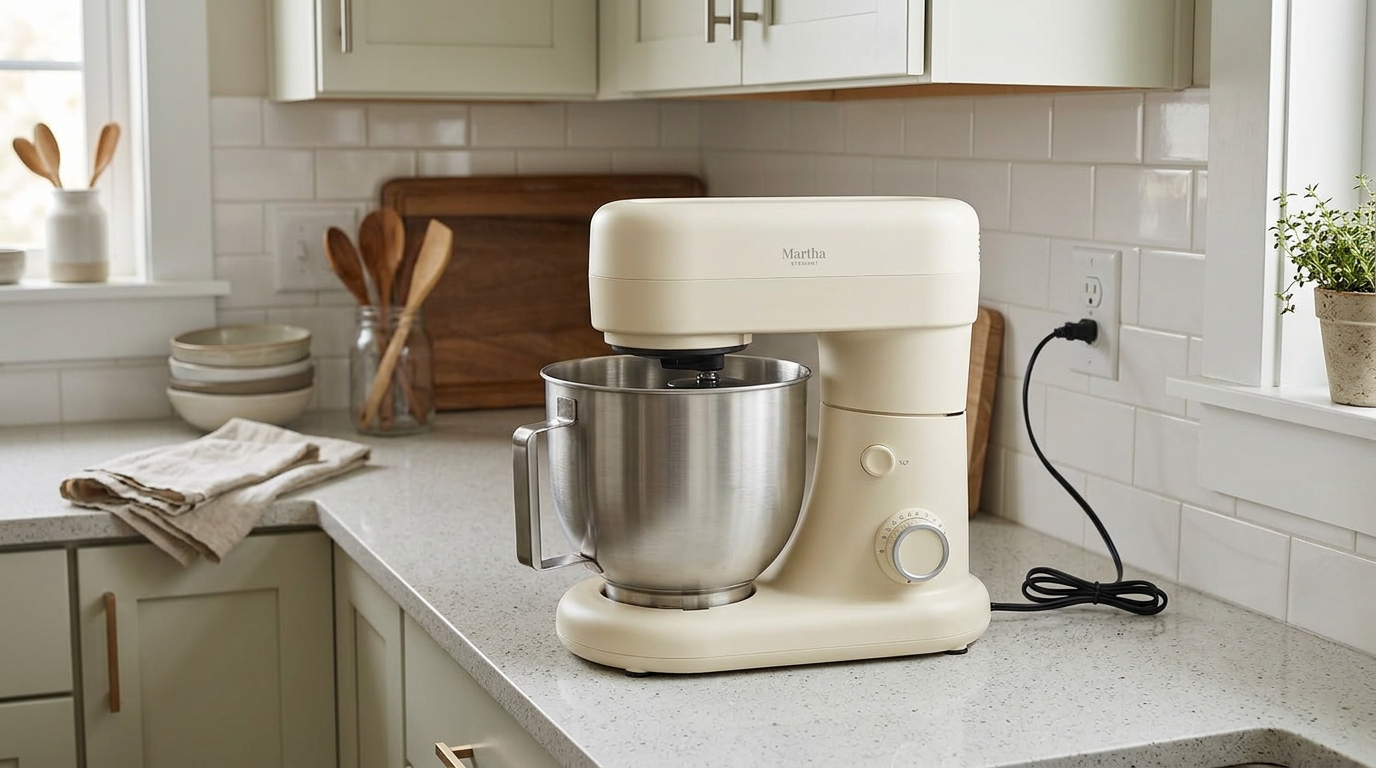
The Martha Stewart stand mixer on my kitchen counter.
I tested it for three weeks, baking cakes, cookies, muffins, bread, pizza dough, frosting and whipped cream for my family.
I paid close attention to mixing results, speed control, stability, noise and how it handled dense doughs.
Our tip: Wash the bowl and attachments before your first bake, because a quick wash removes any manufacturing residue and gets you familiar with how the parts fit together.
Setup and first use
Setup took about five minutes.
I washed the bowl and attachments, set the mixer on a clean counter and pressed it down so the suction feet gripped.
Fitting the bowl and attachments was simple.
I tilted the head back, twisted the bowl into place and pushed an attachment onto the shaft with a quarter turn.
My first test was a simple vanilla buttercream.
It came together smoothly in about four minutes.
| Setup step | Time | Notes |
|---|---|---|
| Wash bowl and attachments | About 3 minutes | Warm soapy water |
| Place on counter | A few seconds | Press down for suction |
| Lock bowl | A few seconds | Twist to lock |
| Fit attachment | A few seconds | Push and turn |
| First recipe | About 4 minutes | Smooth buttercream |
The power cord was long enough to reach my outlet without stretching across the counter.
Our tip: Wipe the counter clean and dry before placing the mixer, because the suction feet grip best on a smooth, clean surface and hold the mixer steadier during heavy mixing.
Design and build quality
The mixer has an attractive, contemporary look that suited my kitchen.
The stainless-steel bowl felt sturdy and resisted stains and smells.
After three weeks of butter, eggs and chocolate, it still looked new.
The body is not as heavy as some premium mixers.
It feels solid enough for home baking, but not built like a tank.
Some buyers describe the build as average rather than premium, and I understand why.
The plastic parts and controls feel fine but not luxurious.
In daily use, nothing creaked or loosened.
It simply worked.
Our tip: Keep the mixer on the counter rather than lifting it in and out of a cupboard, because frequent lifting adds wear and makes you less likely to use it.
The tilt-head design
The tilt-head design lifts the top of the mixer back, giving open access to the bowl.
That made several tasks easier: adding ingredients, scraping the bowl, swapping attachments and lifting out the finished mixture.
When a recipe called for adding eggs one at a time or flour in batches, I could tilt the head and add them without fighting around the beater.
The head locked firmly in the down position during mixing.
It never lifted or wobbled, even with stiff dough.
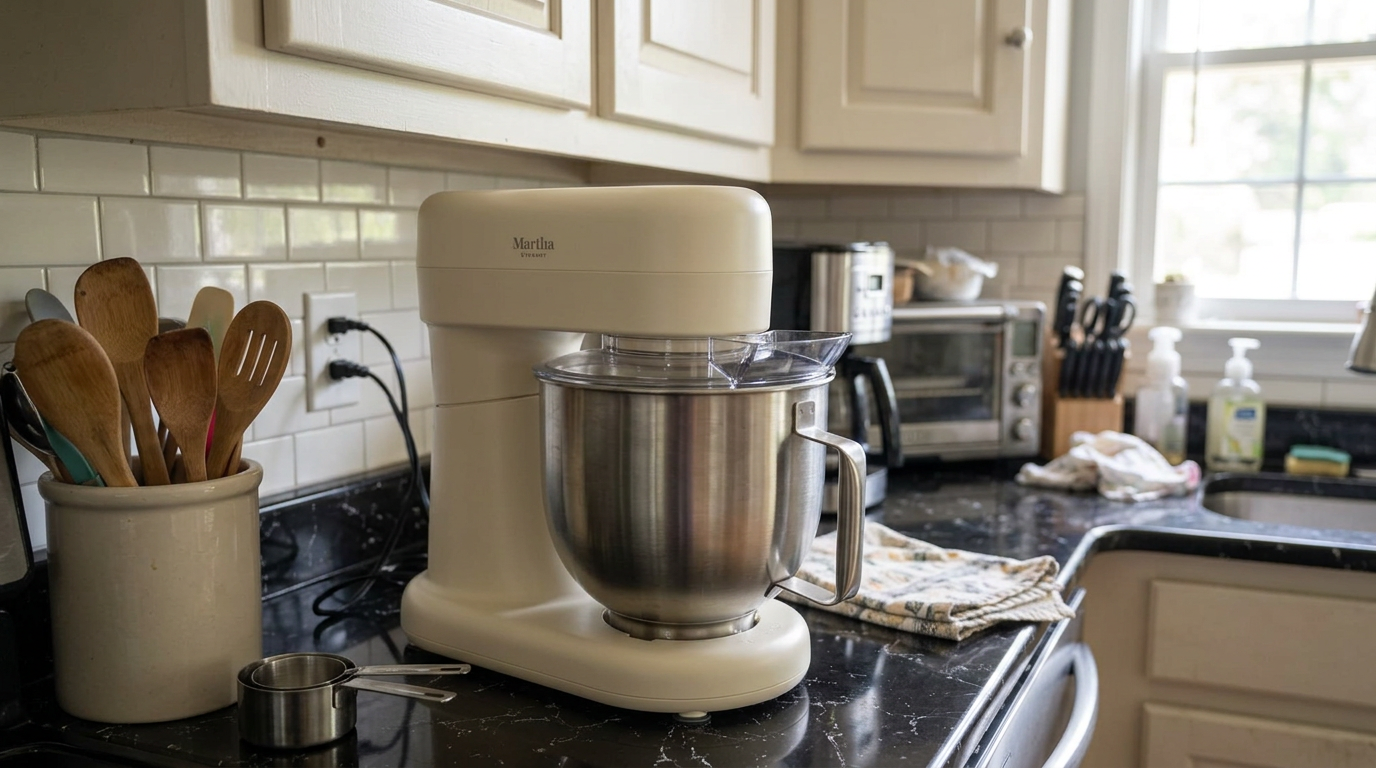
The head tilts back for easy access to the bowl and attachments.
Our tip: Lock the tilt head down before turning on the mixer, because an unlocked head can rise during heavy mixing and splash batter across the counter.
The 660-watt motor
The 660-watt motor had enough power for everything I made at home.
Light mixtures like whipped cream and cake batter were easy.
The motor barely sounded strained.
Thicker mixtures were a better test.
A double batch of chocolate chip cookie dough came together well on medium speed, though the motor worked noticeably harder.
Watts are not the whole story.
Gear construction, attachment shape and bowl design also affect how well a mixer handles heavy dough.
How easily the motor handled each mixture in my tests.
Our tip: Mix heavy cookie and bread doughs on low to medium speeds, because higher speeds put more strain on the motor without making the dough mix any faster.
Using the 12 speeds
The 12-speed dial gave me fine control over mixing.
| Speeds | Best for | Why |
|---|---|---|
| 1 to 2 | Adding flour and dry ingredients | Keeps flour from flying |
| 3 to 4 | Kneading dough, folding in chips | Gentle and steady |
| 5 to 7 | Cake batter, cookie dough | Even mixing |
| 8 to 10 | Creaming butter and sugar | Adds air |
| 11 to 12 | Whipping cream and egg whites | Fast and airy |
Starting slowly made a big difference.
On my first cake, I started on speed 6 with flour in the bowl and covered the counter in a fine dust.
After that, I always started on speed 1 or 2 and increased gradually.
The mixing was cleaner and more even.
Our tip: Increase the speed gradually rather than jumping to high, because starting slow prevents splashing and gives ingredients time to combine evenly.
The 5.3-quart stainless-steel bowl
The 5.3-quart bowl is one of the mixer's best features.
It held a double batch of cookie dough, a three-layer cake batter and enough bread dough for two loaves.
Depending on the recipe, the bowl can handle up to about nine dozen cookies' worth of dough.
My biggest batch was six dozen, and there was still room.
| Recipe | Batch size | Fit in 5.3 quarts |
|---|---|---|
| Chocolate chip cookies | 6 dozen | Comfortable |
| Layer cake | Three 9-inch layers | Comfortable |
| Sandwich bread | Two loaves | Fits well |
| Whipped cream | 1 quart cream | Plenty of room |
| Buttercream | Enough for a layer cake | Comfortable |
For very small amounts, like a single egg white, the bowl is almost too big.
The whisk could not reach enough of the mixture.
Our tip: Avoid filling the bowl right to the top, because ingredients need room to move for even mixing and an overfilled bowl puts extra strain on the motor.
The silicone edge beater
The silicone edge beater✕Edge beaterA flat mixing attachment with flexible silicone edges that wipe the sides of the bowl as it turns, reducing the need to stop and scrape. was my favorite accessory.
Its flexible edges wiped the sides of the bowl as it turned.
Butter and sugar that would normally cling to the sides got pulled back into the mix.
With a standard flat beater, I usually stop to scrape the bowl two or three times per recipe.
With this one, I stopped once at most.
How often I stopped to scrape the bowl during cake and cookie recipes.
The bottom of the bowl still needed one quick scrape for cake batter, because the beater does not reach the very center.
Our tip: Give the bottom of the bowl one scrape near the end of mixing, because even an edge beater can leave a little unmixed butter or flour at the very base.
Test one: layer cakes and cupcakes
I baked a vanilla layer cake and two dozen chocolate cupcakes.
Creaming butter and sugar on speed 8 for three minutes made a pale, fluffy mixture.
The edge beater kept it even across the bowl.
Adding eggs one at a time was easy with the tilt head.
The final batter was smooth, with no streaks of flour.
The cakes rose evenly and had a fine, tender crumb.
My results for vanilla cake.
Our tip: Let butter and eggs come to room temperature before creaming, because softened butter traps more air and gives cakes a lighter, more even crumb.
Test three: bread and pizza dough
Bread dough is the hardest test for any home mixer.
I kneaded a sandwich bread dough with the dough hook on speed 2 for eight minutes.
It developed good gluten✕GlutenA network of proteins formed when flour is mixed with water and kneaded. Strong gluten gives bread its stretch and chewy structure. and passed the windowpane test.
The motor housing got warm during the long knead, and the mixer worked harder than with cookie dough.
Pizza dough was easier, with a shorter five-minute knead.
For a double batch of very stiff bagel dough, the mixer struggled.
I split it into two batches, and each one kneaded well.
| Dough | Knead time | Result |
|---|---|---|
| Sandwich bread | 8 minutes, speed 2 | Good gluten, warm motor |
| Pizza dough | 5 minutes, speed 2 | Smooth and stretchy |
| Bagel dough, double | Struggled | Split into two batches |
| Bagel dough, single | 8 minutes | Kneaded well |
Our tip: Knead bread dough on a low speed and split very stiff doughs into smaller batches, because long, heavy kneads are the biggest strain on any home stand mixer.
Test four: whipped cream and meringue
The whisk and high speeds were excellent for whipped cream.
A pint of cold heavy cream reached soft peaks in about two minutes on speed 12 and stiff peaks in about three.
Egg whites for meringue whipped to glossy stiff peaks in about four minutes.
The large bowl gave the whisk plenty of room, and nothing splattered.
Whipping times on the highest speeds.
Our tip: Chill the bowl and whisk in the freezer for 10 minutes before whipping cream, because cold equipment helps cream whip faster and hold its shape longer.
Test five: frosting and buttercream
Buttercream was a strong result.
I beat softened butter for three minutes, then added powdered sugar on speed 1 to avoid a sugar cloud.
Once the sugar was in, I raised the speed to 8 for two minutes.
The frosting turned light and smooth.
The edge beater was ideal here, because buttercream clings to the sides of the bowl.
Our tip: Add powdered sugar on the lowest speed and drape a clean towel over the mixer for the first few seconds, because powdered sugar puffs up easily and coats the counter.
Stability and the suction base
The suction cup feet kept the mixer steady on my quartz counter.
On high speeds with whipped cream, it did not move at all.
With stiff cookie and bread dough, the head rocked slightly, but the base stayed put.
On my wooden butcher-block section, the suction was weaker, so I moved it back to the smooth quartz.
Our tip: Release the suction feet by lifting gently from the side before moving the mixer, because pulling straight up can strain the feet and make them grip less over time.
Noise levels
The mixer was quieter than I expected.
On low and medium speeds, it made a gentle hum.
I could talk in the kitchen without raising my voice.
On the highest speeds, it was louder, as all mixers are, but not harsh.
How loud the mixer sounded at each speed range.
Early-morning baking did not wake anyone in my house.
Our tip: Plan noisy steps like whipping cream for later in the morning if you bake early, because the high speeds are the loudest part of using any stand mixer.
Cleaning and care
Cleanup was easy.
The stainless-steel bowl and attachments are dishwasher-safe.
I hand-washed the silicone edge beater most days to keep the silicone in good condition, and put it in the dishwasher occasionally.
The body needed only a wipe with a damp cloth after each use.
I never put the motor housing under water and kept moisture away from the controls.
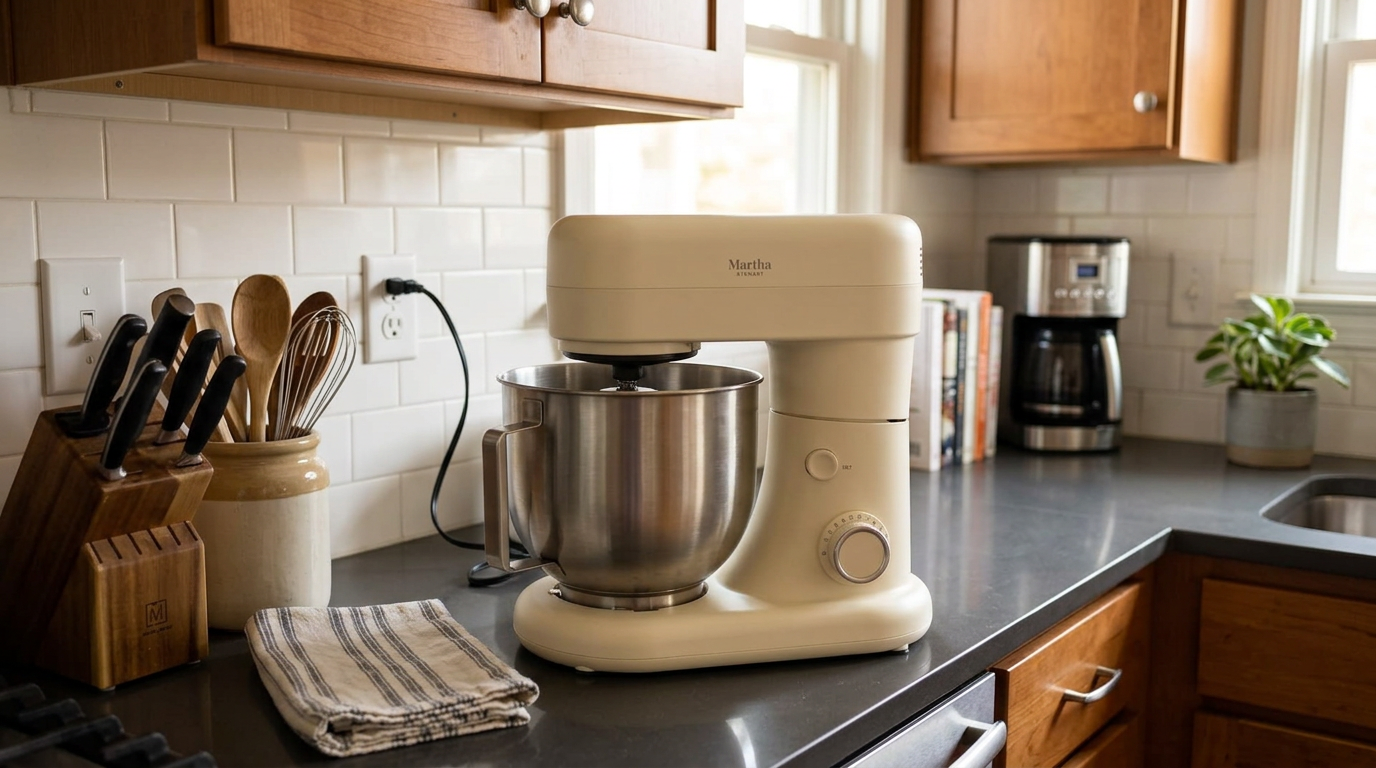
The stainless-steel bowl and attachments are dishwasher-safe.
| Part | How to clean | How often |
|---|---|---|
| Bowl | Dishwasher or hand wash | After each use |
| Dough hook and whisk | Dishwasher or hand wash | After each use |
| Silicone edge beater | Hand wash mostly | After each use |
| Body | Damp cloth | After each use |
| Suction feet | Damp cloth | Weekly |
Our tip: Hand-wash the silicone edge beater most of the time, because gentle washing keeps the silicone flexible and helps it keep scraping the bowl well for longer.
Attachments and versatility
The mixer comes with the essentials for baking: the silicone edge beater, dough hook and whisk.
Those covered everything I made in three weeks.
The range of optional extras is limited compared with some long-established mixer brands, which offer add-ons for other kitchen jobs.
If you mainly want a mixer for baking, that hardly matters.
If you hope to turn it into a multi-purpose kitchen machine, it may not suit you.
Our tip: Decide whether you want a baking mixer or a multi-purpose kitchen machine before buying, because the range of optional attachments matters only if you plan to expand beyond baking.
Durability and long-term use
Three weeks is too short to judge long-term reliability, but I can share what I saw.
After about 30 recipes, the mixer ran just as smoothly as on day one.
Nothing loosened or rattled.
The brand does not have a decades-long stand mixer track record, which makes long-term durability harder to predict.
Replacement parts and service may also be harder to find than with older, more established mixer makers.
For regular home baking, it felt dependable.
For heavy daily bread baking, I would want a heavier-duty machine.
Our tip: Keep your receipt and register the mixer with the manufacturer, because it makes warranty claims and finding replacement parts easier if you need them later.
Energy use
The 660-watt motor only runs for a few minutes per recipe.
Most of my bakes involved three to ten minutes of mixing.
Even long bread kneads were under ten minutes.
That means electricity use is small compared with an oven or dishwasher.
Running the mixer correctly matters far more than energy use: start slowly, avoid overloading the bowl and give the motor a rest during long kneads.
Our tip: Let the mixer rest for a few minutes between long kneads or back-to-back heavy batches, because a short break keeps the motor from running too hot.
A day of holiday-style baking
In week three, I simulated a busy holiday baking day.
I made six dozen sugar cookies, a batch of gingerbread, a layer cake and a bowl of buttercream in one afternoon.
The large bowl meant fewer batches, and the dishwasher-safe bowl made switching recipes quick.
The mixer stayed steady and handled the workload, though I gave it a short rest between the stiff gingerbread and the cake.
It was a genuinely helpful partner for a long baking session.
Our tip: Plan big baking days from lightest to heaviest mixtures, like whipped cream before bread dough, because it saves washing the bowl between each recipe.
What I would change
This is a capable baking mixer, but it has some limits.
- Build feels average rather than premium
- Head rocks slightly with very stiff dough
- Limited range of optional attachments
- No long track record for long-term reliability
- The large bowl is less suited to very small batches
None of these stopped me from baking well with it.
If you bake bread every day or want a mixer that can grow into a multi-purpose machine, a heavier-duty option may suit you better.
Our tip: Match the mixer to your baking habits rather than the biggest possible spec, because a reliable mid-range mixer often suits weekly home baking better than a heavy commercial-style one.
Why creaming matters
Many cake and cookie recipes start with creaming✕CreamingBeating butter and sugar together until pale and fluffy. Sugar crystals cut tiny air pockets into the butter, which help baked goods rise. butter and sugar.
It is the step where a stand mixer earns its place.
By hand, it takes several minutes of hard work, and it is easy to stop too soon.
On speed 8, the mixer turned butter and sugar pale and fluffy in about three minutes.
The edge beater kept the whole bowl evenly creamed.
I compared cookies made with one minute of creaming and three minutes of creaming.
The longer-creamed batch spread less and had a softer, more even texture.
How creaming time changed my chocolate chip cookies.
Our tip: Cream butter and sugar until the mixture turns noticeably paler and fluffier, because that color change is the easiest sign that enough air has been beaten in.
Checking bread dough with the windowpane test
To tell when bread dough was kneaded enough, I used the windowpane test✕Windowpane testA check for bread dough: stretch a small piece thin. If it forms a translucent sheet without tearing, the gluten is well developed..
After eight minutes with the dough hook, I pinched off a small piece and stretched it between my fingers.
It stretched thin enough to let light through without tearing, which meant it was ready to rise.
At six minutes, it tore easily, so the extra two minutes made a real difference.
The test saved me from guessing and from over-kneading, which can make bread tough.
Our tip: Let flour and water rest for 20 minutes before kneading bread dough, because the flour absorbs water and starts forming gluten on its own, which shortens the knead.
Muffins and quick breads
Muffins and quick breads need gentle mixing, and the low speeds were ideal.
For blueberry muffins, I mixed the wet ingredients on speed 4, then added the dry ingredients on speed 1 for just 20 seconds.
The batter was lumpy, which is right for muffins, and they baked up tall and tender.
Banana bread was just as easy.
I mashed the bananas right in the bowl with the edge beater on speed 2.
Overmixing is the main risk with these recipes, so the slow speeds and the easy tilt head for quick checks were very helpful.
Our tip: Stop mixing muffin and quick-bread batter as soon as the flour disappears, because overmixing makes them tough and full of tunnels.
Baking with children
My two young children love to help in the kitchen, and the mixer made that easier.
The tilt head let them tip ingredients into the bowl safely while the mixer was switched off.
The low speeds were slow enough that nothing splashed when they added chocolate chips.
I always kept the mixer switched off and the head tilted back before small hands went near the bowl.
The stable base gave me confidence the mixer would not slide or tip during their enthusiastic help.
Our tip: Switch the mixer off before little helpers add ingredients, because tilting the head back with the motor off keeps fingers well away from moving beaters.
Counter space and storage
The mixer has a fairly compact footprint for a 5.3-quart model.
It fit under my wall cabinets with the head down.
With the head tilted back, it needed a little more height, so I pulled it forward before tilting.
I kept it on the counter for the whole test, which made me bake more often.
The attachments fit inside the bowl for storage, which kept everything together.
Our tip: Measure the height under your wall cabinets with the head tilted up before choosing a spot, because a tilt-head mixer needs extra clearance when it opens.
A family pizza night
Friday pizza night became my favorite routine test.
I mixed a double batch of pizza dough in the afternoon, kneaded it for five minutes and let it rise in the same bowl, covered with a towel.
The stainless-steel bowl was large enough for the dough to double without spilling over.
In the evening, the children shaped their own small pizzas, and the dough stretched easily without tearing.
Using the mixing bowl for the rise saved another bowl to wash.
Our tip: Let dough rise right in the mixing bowl, covered with a clean towel, because the large stainless-steel bowl gives it room to double and saves washing an extra bowl.
Getting the most from the edge beater
The edge beater works best when the bowl and beater are seated properly.
If the beater sat slightly too high, it missed the bottom of the bowl.
Clicking it fully onto the shaft fixed that.
It worked best with medium-thick mixtures like cake batter, buttercream and cookie dough.
For thin liquids like whipped cream, the whisk was the better choice.
For bread, the dough hook was essential.
Our tip: Check that the edge beater is pushed fully onto the shaft before mixing, because a beater sitting even slightly high leaves unmixed ingredients at the bottom of the bowl.
My three weeks with the Martha Stewart Stand Mixer
In week one, I baked cakes, cupcakes and frosting to learn the speeds and the edge beater.
In week two, I tested cookie dough, bread, pizza and bagel dough, whipped cream and meringue.
In week three, I ran a big holiday-style baking day and focused on stability, noise and cleanup.
| Week | Focus | Main finding |
|---|---|---|
| 1 | Cakes and frosting | Even mixing, few bowl scrapes |
| 2 | Doughs and whipping | Great cream, works hard on bread |
| 3 | Big batches and cleanup | Roomy bowl, easy cleaning |
Our tip: Write the speed you used on your favorite recipes, because having one speed for creaming and another for mixing makes results more consistent every time.
Is the Martha Stewart Stand Mixer worth the money?
Yes, for home bakers who want a large bowl and helpful features without a premium machine.
It handles cakes, cookies, frosting and whipped cream very well.
The trade-offs are an average-feeling build, a limited range of extras and some strain on heavy doughs.
For weekly baking, they are easy to live with.
My category scores after three weeks.
How it compares with other ways to mix and bake
| Feature | Martha Stewart Stand Mixer | Hand mixer | Premium heavy-duty stand mixer | Mixing by hand |
|---|---|---|---|---|
| Bowl size | 5.3 quarts | Your own bowl | Often 5 to 7 quarts | Your own bowl |
| Hands-free mixing | Yes | No | Yes | No |
| Speeds | 12 | Usually 5 to 7 | Often 10+ | Not applicable |
| Edge scraping | Silicone edge beater | No | Sometimes | Spatula |
| Bread dough | Good, works hard | Poor | Excellent | Hard work |
| Optional attachments | Limited | Few | Wide range | None |
| Your priority | Fit | Why |
|---|---|---|
| Cakes and cupcakes | Excellent | Fluffy creaming, even batter |
| Cookies | Excellent | Big batches fit |
| Whipped cream | Excellent | Stiff peaks in 3 min |
| Bread dough | Good | Strains on long kneads |
| Multi-purpose use | Fair | Limited attachments |
Which one is right for you: is the Martha Stewart Stand Mixer your match?
4 quick questionsMartha Stewart Stand Mixer specifications
From manufacturer data, retailer listings and my own testing.
How I tested and scored the Martha Stewart Stand Mixer
For three weeks, the Martha Stewart Stand Mixer did nearly all my baking.
I made layer cakes, cupcakes, cookies, buttercream, whipped cream, meringue, sandwich bread, pizza dough and bagel dough, and ran a big holiday-style baking day.
I timed whipping and kneading, counted bowl scrapes and tested stability and noise.
- Mixing results (8.8): even batters and fluffy creaming.
- Ease of use (8.8): tilt head and 12 easy speeds.
- Heavy doughs (7.0): works hard on long bread kneads.
- Build quality (6.8): solid enough, not premium.
My test scores were: whipped cream 9.4, cakes 9.0, cookies 8.8, frosting 9.0, stability 8.4, noise 8.6, bread dough 7.0 and build 6.8. The overall score of 7.9 is an editorial rating that reflects those results and three weeks of regular baking.
Martha Stewart Stand Mixer FAQ
Is the Martha Stewart Stand Mixer worth it?
Yes, for home bakers who want a large bowl and useful features without a premium machine.
How big is the bowl?
5.3 quarts, enough for up to about nine dozen cookies depending on the recipe.
How powerful is the motor?
660 watts, with 12 speeds.
What is the silicone edge beater?
A beater with flexible edges that scrape the bowl as it mixes, so you stop to scrape less often.
Can it knead bread dough?
Yes. It handled sandwich bread and pizza dough, but works hard on long, stiff kneads.
Is it noisy?
It is fairly quiet on low and medium speeds and louder on the highest speeds.
Does it move on the counter?
Not much. The suction feet kept it steady on a smooth counter.
Is it dishwasher-safe?
The bowl and attachments are. Hand-wash the edge beater most of the time.
Does it have a tilt head?
Yes. The head tilts back for easy access to the bowl.
Are there optional attachments?
The range is limited compared with some long-established mixer brands.
What speed should I start on?
Start on speed 1 or 2 and increase gradually to avoid splashing.
Is it good for small batches?
It works, but the large bowl is less suited to very small amounts like one egg white.
Senior home appliance tester
Emily has tested home appliances for a living since 2016, first as a test coordinator at a national consumer advocacy group and, since 2021, at HouseholdMe. She has a degree in industrial design from Ohio State, so she looks at how a product is built, not just how it performs. She used the Martha Stewart Stand Mixer at home for three weeks for this review.
- Three weeks of hands-on testing of the Martha Stewart Stand Mixer
- Manufacturer product information and instruction manual