Instant Pot Pro 6 Qt review
The Instant Pot Pro 6-Quart 10-in-1 Pressure Cooker is a premium electric pressure cooker with an auto-sealing lid, a push-button steam release, five custom favorite buttons and a flat-bottomed stainless steel pot that also works on the stove and in the oven. I used it for three weeks for stews, beans, rice, steel-cut oats, yogurt, steamed vegetables, sous vide eggs and a few slow-cooked dinners. Pressure cooking was fast and effortless, searing in the flat pot was excellent and the favorites saved real time. Slow cooking needed adjustments, there is no zero-minute setting and the default beeps are shrill, but as a pressure cooker, it is outstanding.

Emily Carter
Hands-on review
Hands-on testing, research, specs
3 weeks
26 minutes
Jargon helpNew to pressure cookers? Tap any dotted term to see what it means.
In this review
Yes, if pressure cooking is what you do most. The Instant Pot Pro seals itself when you close the lid, releases steam with a simple switch and reminds you when a timed natural release is done. Its flat stainless steel pot with stay-cool handles sears like a real pan and moves to the stove or oven when you need it. Five favorite buttons made my morning oats a one-touch job. Slow cooking took trial and error, the minimum pressure time is one minute and the beeps are irritating until you mute them. For everyday pressure cooking, it is one of the best I have used.
Instant Pot Pro 6 Qt at a glance
Instant Pot Pro 6 Qt pros and cons
- Auto-sealing lid and easy push-button steam release
- Flat stainless pot sears well and is stovetop and oven safe
- Five favorite buttons save your go-to settings
- Slow cooking needs trial and error
- No zero-minute pressure setting
- Shrill beeps until you turn them off
Who should buy the Instant Pot Pro 6 Qt?
- Cooks who pressure cook several times a week
- Anyone who sears before pressure cooking
- People who repeat the same meals often
- Dedicated slow-cooker fans
- Cooks who steam vegetables at zero minutes daily
- Anyone sensitive to high-pitched beeps (until muted)
First impressions of the Instant Pot Pro
The Instant Pot Pro looks premium, with a dark finish, a large display and a central dial.
It feels sturdy and well put together, and at around 16 pounds, it sits firmly on the counter.
The 6-quart size fit my family of four comfortably.
The base, lid, stainless steel inner pot, steam rack and spare sealing ring.
The real star appears when you lift the lid.
The stainless steel inner pot has a flat bottom and two stay-cool handles on the sides.
It looks and feels like a proper stockpot rather than a simple liner.
In the box, I also found a stainless steel steaming rack with handles and an extra sealing ring.
The spare ring turned out to be more useful than I expected.
Our tip: Keep the spare sealing ring for sweet dishes and the original for savory ones, because silicone rings hold onto garlic and spice smells and a dedicated ring keeps yogurt and oats tasting clean.
Design and build quality
The Pro measures about 13 inches long, 12.7 inches wide and 12.8 inches high.
It needs a dedicated spot, plus room above to open the lid.
The control panel is big and easy to read from across the kitchen.
The lid is the clever part.
It seals automatically when you close it, so you do not need to remember to turn a valve.
A diffusing cover over the steam release sends steam out more gently and helps keep the counter dry.
| Detail | What I found |
|---|---|
| Capacity | 6 quarts, about 6 servings |
| Power | 1,200 watts |
| Weight | About 16 lb |
| Inner pot | Stainless steel, flat bottom, stay-cool handles |
| Lid | Auto-sealing, gentle steam release with diffuser |
| Dishwasher-safe | Inner pot and lid |
Our tip: Measure the height under your wall cabinets before you place the Pro there, because the lid needs room to open and the steam release should never vent directly onto cabinet bottoms.
Pressure cooking: the Pro’s biggest strength
Pressure cooking is where the Pro shines.
You close the lid, it seals itself and you choose a program or set your own time.
There are no extra steps to forget.
Compared with traditional stovetop pressure cookers, it feels calm and controlled.
No rattling weight, no constant watching and far less steam and smell in the kitchen.
That makes it a great choice if pressure cookers have always made you a little nervous.
The Pro also preheats a little faster than simpler models, which shortened my overall cooking times.
If you use older recipes, you may need to reduce times slightly.
Pressure times I used in testing (plus preheating and release).
Our tip: Reduce cooking times by a minute or two when using recipes written for older pressure cookers, because the Pro heats up and builds pressure a little faster and food can otherwise overcook.
Steam release and the natural release reminder
When cooking finishes, you can release pressure with a simple switch.
It is much easier and less nerve-racking than turning a valve by hand.
The diffuser keeps the steam softer and quieter than I expected.
Many recipes call for a short natural release✕Natural releaseLetting the pressure drop on its own for a set time after cooking ends, before opening the valve. It is gentler on meat, beans and foamy foods. of five or ten minutes before venting the rest.
The Pro has a reminder for this: set the wait time, and it beeps when it is time to vent.
It does not release the pressure for you, it just tells you when.
A kitchen timer could do the same job, but having it built in meant I never forgot.
On busy evenings with children underfoot, that mattered.
Our tip: Set the natural release reminder before you walk away from the cooker, because it is the easiest way to make sure meat and beans get their resting time without overcooking on Keep Warm.
The stainless steel inner pot
The inner pot is the Pro’s most impressive feature.
It has a flat stainless steel bottom with a thick aluminum layer and stay-cool handles on the sides.
Lifting it out to pour or serve is far easier than with a handle-less liner.
The flat bottom makes full contact with the heating element, which gave me excellent browning.
The handles also lock the pot in place, so it does not spin while you stir.
Best of all, the pot is stovetop safe on electric, ceramic and induction cooktops, and oven safe up to 450°F.
I finished a stew on the stove while the cooker started rice in a second pot.
I also broiled a cheesy topping on a pasta bake right in the pot.
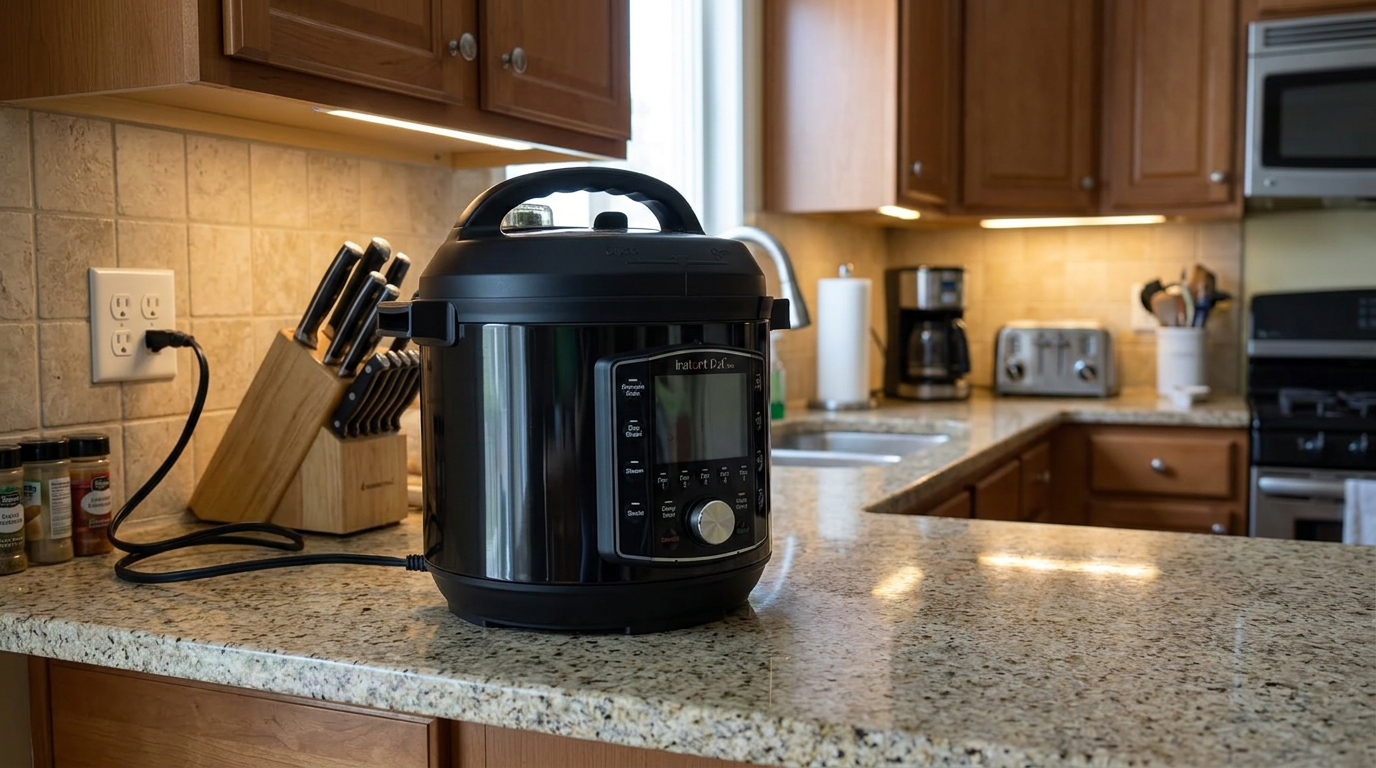
The flat-bottomed stainless steel pot with stay-cool handles.
Our tip: Use the stay-cool handles but still keep oven mitts nearby, because the handles stay comfortable while the pot’s sides and contents can be extremely hot right after pressure cooking.
Sautéing and searing
The Sauté function offers a range of heat levels, from gentle to very hot.
Browning beef needed one of the higher settings, while onions and garlic did best on a lower one.
On simpler models, high can be too fierce and low too weak, but the Pro’s range felt practical.
It remembers your last sauté setting, which saved me a few taps every evening.
You can also change the heat while cooking, so if things get too hot, you turn it down without stopping.
With the flat pot, searing felt close to using a heavy pan on the stove.
I got a deep, even crust on chuck roast and nicely caramelized onions.
| Task | Sauté level I used | Result |
|---|---|---|
| Browning beef | High | Deep, even crust |
| Chicken thighs, skin down | Medium-high | Golden, crisp skin |
| Onions and garlic | Low to medium | Soft, sweet, no burning |
| Reducing sauce | Medium | Thickened in minutes |
Our tip: Heat the empty pot on Sauté until the display shows Hot before adding oil and meat, because a fully preheated stainless pot browns evenly and releases the meat once the crust has formed.
Five customizable favorite programs
The Pro has five favorite buttons where you save your own settings.
I saved steel-cut oats, white rice, brown rice, beans and a quick chicken program.
After that, each one started with a single press.
My morning oats were the best example.
I added oats and water, pressed the favorite button and walked away.
No remembering the time, pressure level or release.
The real benefit is consistency.
Once you find the settings you like, you get the same result every time.
Our tip: Save your most common dishes as favorites in the first week, because the time you spend setting them up pays back on every busy morning and evening afterward.
Rice and grains
The Pro is an excellent rice cooker.
Basmati, brown basmati and jasmine all came out consistently well, with separate grains and no scorching.
Brown rice in particular was faster and more even than on my stove.
A high-end dedicated rice cooker may still have an edge for some varieties.
For everyday rice, though, the Pro was more than good enough, and it does everything else too.
| Rice or grain | Water ratio I used | Pressure time | Result |
|---|---|---|---|
| White basmati | 1 : 1 | About 4 minutes | Fluffy, separate |
| Brown basmati | 1 : 1.25 | About 20 minutes | Tender, not mushy |
| Jasmine | 1 : 1 | About 4 minutes | Soft, fragrant |
| Steel-cut oats | 1 : 3 | About 10 minutes | Creamy |
Our tip: Rinse white rice until the water runs nearly clear before pressure cooking, because removing surface starch prevents foaming and gives you more separate, fluffy grains.
Homemade yogurt
Yogurt was one of the most satisfying extras.
I heated milk on the yogurt boil setting, let it cool, stirred in a spoonful of live yogurt and set the fermentation overnight.
In the morning, the yogurt was thick and creamy rather than watery, which is the sign of a good batch.
Straining it for an hour gave me a dense, Greek-style result.
Our tip: Check the milk temperature with a thermometer before adding the starter, because live cultures die if the milk is too hot and fermentation stalls if it is too cold.
Sous vide: good for occasional use
The Pro can hold a water bath for sous vide✕Sous videA method where food is sealed in a bag and cooked in water held at a precise, low temperature for even doneness from edge to center. cooking.
I made soft eggs and chicken breasts, and both turned out well.
It does not circulate the water like a dedicated sous vide stick, so the temperature is less even across the pot.
For the best results, I adjusted the temperature a degree or two and kept portions small.
For occasional sous vide, it is a nice bonus.
If you cook this way every week, a dedicated circulator is still better.
Our tip: Stir the water bath once or twice during long sous vide cooks, because the Pro does not circulate water and a quick stir evens out any warm or cool spots in the pot.
Steaming and the missing zero-minute setting
The Steam function works without building pressure, which is gentle on delicate foods like fish and green vegetables.
I used it with the included rack, and it worked well.
What I missed was a zero-minute pressure cook✕Zero-minute pressure cookBringing the cooker up to pressure and ending the cook immediately. The food cooks during the heat-up, which suits delicate vegetables like broccoli. setting.
The Pro’s minimum pressure time is one minute, which can overcook broccoli and other delicate greens.
There is a workaround.
Set one minute, watch the display and, as soon as it switches from preheating to the cooking countdown, release the pressure.
That gives you the same result as zero minutes.
Our tip: Cut broccoli into even florets when using the zero-minute workaround, because the cook time is so short that uneven pieces end up either crunchy or soft in the same batch.
Slow cooking: the Pro’s main weakness
Slow cooking was the one area where the Pro disappointed me.
My first slow-cooked pot roast was still firm after the time a traditional slow cooker would need.
The settings also felt less intuitive than the rest of the controls.
After some experimenting, I got good results by using the higher slow-cook setting and adding extra time.
It works, but it is not the set-and-forget experience a dedicated slow cooker gives you.
If you mostly pressure cook, this probably will not matter.
Pressure cooking can replace many slow-cooker recipes, and it is far faster.
If slow cooking is your main method, keep your slow cooker.
| Dish | Slow cooker habit | What worked on the Pro |
|---|---|---|
| Pot roast | Low for 8 hours | Higher setting, about 8 to 9 hours |
| Chili | Low for 6 hours | Higher setting, about 6 hours |
| Pulled pork | Low for 10 hours | Pressure cook about 75 minutes instead |
Our tip: Convert slow-cooker recipes to pressure cooking when you can, because the Pro’s pressure programs are far more reliable and a pot roast that needs eight hours slow takes about an hour under pressure.
The beeps, and how to turn them off
The Pro’s button beeps have a high, sharp tone that I found irritating within a day.
If you are sensitive to high-pitched sounds, you will notice them.
Luckily, you can turn them off.
With the cooker plugged in but not running, press and hold the central dial.
The first setting is Fahrenheit or Celsius, and pressing the dial again takes you to sound, where you can switch it off.
Important safety alerts still sound even with the beeps off.
After muting, the Pro became a much more pleasant kitchen companion.
Our tip: Mute the button sounds on day one if the beeps bother you, because important safety alerts still sound and the change makes daily use far more pleasant.
Cleaning and care
Cleaning was easy.
The stainless inner pot and the lid are dishwasher safe, and the flat bottom does not collect water the way some curved liners do.
After searing, a short soak loosened any brown bits.
The sealing ring needs regular washing to stop it from holding onto smells.
I removed it after savory dishes, washed it and let it air dry.
Our tip: Clean stainless steel discoloration with a little white vinegar on a soft cloth, because the rainbow tint that sometimes appears after cooking is mineral residue that wipes away easily.
Beef stew test
For my main pressure test, I made a classic beef stew.
I seared chuck in two batches on high Sauté, softened onions, deglazed with stock and added carrots and potatoes.
Then I locked the lid and pressure cooked for about 35 minutes.
After a ten-minute natural release, timed with the reminder, I vented the rest and opened the lid.
The beef was fork-tender, the potatoes held their shape and the broth was rich and glossy.
From the first sear to the table, it took about an hour and a quarter.
The same stew takes three hours or more in my oven.
This was the moment the Pro earned its place on my counter.
Our tip: Thicken pressure-cooked stew on Sauté afterward with a little cornstarch slurry, because the lid traps all the moisture and a few minutes of simmering turns thin broth into a proper gravy.
Beans from dried
Dried beans are where a pressure cooker saves the most time.
I soaked chickpeas overnight, then pressure cooked them for about 15 minutes with a natural release.
They were creamy inside and perfect for hummus.
I also cooked unsoaked black beans for about 35 minutes.
They took longer but came out evenly tender, which made last-minute bean dishes possible.
| Beans | Soaked? | Pressure time | Release |
|---|---|---|---|
| Chickpeas | Yes | About 15 minutes | Natural |
| Black beans | No | About 35 minutes | Natural |
| Pinto beans | Yes | About 10 minutes | Natural |
| Lentils | No | About 8 minutes | Natural 10 minutes |
Our tip: Never fill the pot more than halfway with beans and water, because beans foam heavily under pressure and the extra space keeps the foam away from the steam release.
Baking, proofing and sterilizing
The Pro has a cake setting for steamed cakes and cheesecakes.
I made a small cheesecake in a springform pan on the rack, and it was creamy and even, without cracks.
The low-temperature settings also worked for proofing bread dough.
It is not an oven replacement, though: normal cakes and cookies are still better in a real oven.
The sterilize function is handy for baby bottles or jars, though not every household needs it.
Keep Warm held cooked food at a safe serving temperature for evening meals that ran late.
Our tip: Cover cheesecakes and steamed cakes with foil before pressure cooking, because condensation drips from the lid and a foil cover keeps the surface smooth and dry.
Capacity and family meals
The 6-quart pot handles about six servings.
It comfortably fit a full stew for my family, a whole chicken cut into pieces and a big batch of chili.
| Dish | How much fit | Servings |
|---|---|---|
| Beef stew | About 3 lb meat plus vegetables | 6 |
| Chili | Full family batch | 6 to 8 |
| Rice | Up to several cups dry | Family side dish |
| Chicken pieces | One cut-up chicken | 4 to 6 |
For larger families or big batch cooking, the 8-quart version may be worth considering.
For most households, 6 quarts is the sweet spot.
Our tip: Remember the max fill line is lower for foods that foam or expand, because rice, beans and grains need extra headroom and overfilling can block the steam release.
A typical weeknight with the Pro
By the second week, my weeknight routine relied on the Pro.
Sear chicken thighs, add rice and stock, pressure cook for ten minutes, release and serve.
Thirty-five minutes, one pot.
On another night, I made a chickpea curry from soaked beans in about 40 minutes.
The flat pot made it easy to bloom spices properly before adding the liquid.
| Night | Dish | Hands-on time | Total time |
|---|---|---|---|
| Monday | Chicken and rice | 10 minutes | About 35 minutes |
| Tuesday | Chickpea curry | 15 minutes | About 40 minutes |
| Wednesday | Beef stew | 20 minutes | About 75 minutes |
| Thursday | Steamed fish and vegetables | 5 minutes | About 15 minutes |
Our tip: Bloom ground spices in hot oil on Sauté for 30 seconds before adding liquid, because pressure cooking locks in flavors and well-toasted spices make curries and chili far more aromatic.
Pressure safety features
The Pro has more than ten safety features, including overheat protection and a locking lid.
The lid cannot open while there is pressure inside, and a small float valve✕Float valveA small pin in the lid that rises when the cooker is under pressure and locks the lid shut. When it drops, the pressure is gone and the lid can be opened safely. shows you the state at a glance.
In three weeks, I never felt unsafe.
The auto-sealing lid removes the most common beginner mistake, which is forgetting to close the valve.
- Never force the lid open; wait for the float valve to drop.
- Keep your face and hands away from the steam path during release.
- Check the sealing ring is seated properly before each use.
- Stay below the max fill line, and lower still for beans and grains.
Our tip: Look at the float valve before you twist the lid, because if the pin is still up there is pressure inside and the lid should stay closed until it drops.
Bone broth and chicken soup
Broth is a great pressure cooker job.
I made chicken bone broth with a carcass, vegetables and water, pressure cooked for about 90 minutes and let it release naturally.
It was golden and rich, and it set to a light jelly in the fridge.
On the stove, that broth would simmer most of a day.
Here, I had it in about two hours with no watching and no steam filling the kitchen.
For a quick chicken soup, I pressure cooked chicken thighs with vegetables for about ten minutes, shredded the meat and added noodles on Sauté.
Dinner was ready in under 40 minutes.
Our tip: Let broth release naturally and cool before straining, because a quick release can make the liquid sputter and cloud the broth, while a slow release keeps it clear.
Sunday meal prep
The Pro made Sunday meal prep efficient.
In one afternoon, I cooked a pot of brown rice, a batch of chickpeas, shredded chicken and a pot of vegetable soup, one after the other.
The favorite buttons sped this up, because the rice and chickpeas were already saved.
Rinsing the stainless pot between rounds took only a minute.
| Round | Dish | Total time |
|---|---|---|
| 1 | Brown rice | About 35 minutes |
| 2 | Chickpeas (soaked) | About 35 minutes |
| 3 | Shredded chicken | About 30 minutes |
| 4 | Vegetable soup | About 25 minutes |
Our tip: Cook the plainest food first when meal prepping, because rice and beans leave little flavor behind while spicy or tomato dishes are best saved for the last round.
Noise, storage and counter space
Apart from the button beeps, the Pro is quiet.
Pressure builds silently, and the diffused steam release is noticeably softer than on simpler models.
Once I muted the beeps, it was one of the quietest cookers I have tested.
It needs a permanent spot on the counter, because it is tall and weighs about 16 pounds.
If you must store it, keep the lid upside down on the base so the sealing ring can air out.
Our tip: Store the lid upside down on the cooker instead of locked on, because trapped moisture makes the sealing ring smell and airflow keeps it fresh between uses.
Potatoes, eggs and vegetables
Small side dishes were quick and easy.
Whole baby potatoes on the rack took about eight minutes at pressure and came out creamy all the way through.
Larger potatoes for mash took a little longer and mashed smoothly with butter right in the pot.
Hard-boiled eggs on the rack were a weekly favorite.
After a few minutes at pressure and an ice bath, the shells slipped off in large pieces.
For carrots, green beans and squash, short pressure times worked well.
Broccoli was the only vegetable that needed the zero-minute workaround to stay bright and crisp-tender.
| Side dish | Method | Result |
|---|---|---|
| Baby potatoes | About 8 minutes on the rack | Creamy, intact |
| Potatoes for mash | About 10 minutes in water | Soft, easy to mash |
| Hard-boiled eggs | A few minutes on the rack | Easy to peel |
| Carrots | About 2 minutes | Tender, sweet |
| Broccoli | Zero-minute workaround | Bright, crisp-tender |
Our tip: Put eggs and potatoes on the steaming rack instead of directly in the water, because the steam cooks them evenly and keeps the bottom layer from cracking or turning waterlogged.
My three weeks with the Instant Pot Pro
In week one, I focused on pressure cooking: stew, beans, rice and chicken.
It was fast, reliable and easy, and I quickly started trusting the auto-sealing lid.
In week two, I tested the extras: yogurt, sous vide eggs, steaming, cheesecake and slow cooking.
Most worked well, but slow cooking needed adjustments.
In week three, I set up favorite buttons, used the inner pot on the stove and in the oven and checked cleaning and long-term details.
The pot stayed in excellent condition, and muting the beeps made everyday use much nicer.
| Week | Focus | Main finding |
|---|---|---|
| 1 | Pressure cooking | Fast, reliable, effortless |
| 2 | Extras and slow cooking | Good extras, slow cooking needs tweaks |
| 3 | Favorites, inner pot, details | Huge everyday convenience |
Our tip: Spend your first week only pressure cooking, because it is the Pro’s strength and builds the confidence you need before experimenting with slow cooking and sous vide.
Troubleshooting what I ran into
A few small problems came up, each with a simple fix.
| Problem | Cause | Fix |
|---|---|---|
| Burn warning | Food stuck after searing | Deglaze well before pressure cooking |
| Slow-cooked roast still firm | Low slow-cook setting too gentle | Use the higher setting and add time |
| Broccoli too soft | One-minute minimum time | Release as soon as the countdown starts |
| Lingering smell in yogurt | Savory sealing ring | Use the spare ring for sweet dishes |
| Annoying beeps | Default sound on | Turn off sound in settings |
Our tip: Deglaze the pot with a splash of stock and scrape the bottom thoroughly after searing, because stuck-on bits are the most common cause of the burn warning under pressure.
Who it suits in real life
The Instant Pot Pro suits people who pressure cook regularly and want more control, better searing and a more versatile pot.
It is ideal for households that cook stews, beans, rice, grains and meat dishes during the week.
It is less ideal if slow cooking is your main method, or if you steam delicate vegetables at zero minutes every day.
In both cases, there are workarounds, but they take a little effort.
For anyone upgrading from a basic pressure cooker, the inner pot alone is a compelling reason to choose this model.
Our tip: Decide which three dishes you would cook most often before buying, because the Pro excels at pressure-cooked meals and the honest answer tells you whether its slow-cooking weakness matters to you.
Is the Instant Pot Pro 6 Qt worth the money?
Yes, for anyone who pressure cooks often.
The auto-sealing lid, easy steam release, natural release reminder, favorite buttons and excellent stainless pot are practical upgrades you notice every day.
The trade-offs are slow cooking, the missing zero-minute setting and the default beeps.
If slow cooking matters most to you, keep a dedicated slow cooker alongside it.
My category scores after three weeks.
How it compares with other kitchen tools
| Feature | Instant Pot Pro | Basic pressure cooker | Slow cooker | Stovetop pot |
|---|---|---|---|---|
| Pressure cooking | Excellent | Good | No | No |
| Auto-sealing lid | Yes | Usually no | No | No |
| Searing | Excellent, flat pot | Fair | Usually no | Excellent |
| Pot on stove or in oven | Yes | Usually no | Sometimes | Yes |
| Slow cooking | Fair, needs tweaks | Fair | Excellent | Not practical |
| Saved favorites | 5 buttons | No | No | No |
| Your priority | Fit | Why |
|---|---|---|
| Frequent pressure cooking | Excellent | Fast, easy, reliable |
| Searing before cooking | Excellent | Flat stainless pot |
| Repeating favorite dishes | Excellent | Five saved programs |
| Slow cooking | Fair | Needs higher setting and extra time |
| Delicate vegetables | Good | Use the zero-minute workaround |
Which one is right for you: is the Instant Pot Pro your match?
4 quick questionsInstant Pot Pro 6 Qt specifications
From manufacturer data, retailer listings and my own testing.
How I tested and scored the Instant Pot Pro 6 Qt
For three weeks, the Instant Pot Pro was my main cooker.
I ran structured pressure tests (beef stew, chickpeas, black beans, rice, oats, chicken), tested the extras (yogurt, sous vide, steaming, cheesecake, slow cooking) and used the inner pot on the stove and in the oven.
I timed preheating, cooking and release, and cleaned the pot, lid and rings after each use.
- Pressure cooking (9.3): fast, reliable, auto-sealing and easy release.
- Inner pot (9.2): flat, stay-cool handles, stovetop and oven safe.
- Controls (8.6): wide sauté range and five favorites, shrill default beeps.
- Slow cooking (6.8): works with adjustments, not set-and-forget.
My test scores were: beef stew 9.4, chickpeas 9.2, rice 9.0, steel-cut oats 9.0, yogurt 8.6, sous vide eggs 7.8 and slow-cooked pot roast 6.8. The overall score of 8.4 is an editorial rating that reflects those results and three weeks of daily use.
Instant Pot Pro 6 Qt FAQ
Is the Instant Pot Pro 6 Qt worth it?
Yes, if you pressure cook often. The auto-sealing lid, easy steam release, five favorite buttons and stovetop- and oven-safe stainless pot are practical upgrades.
Does the lid seal automatically?
Yes. Closing the lid sets it up for pressure cooking, so there is no valve to remember.
How do you release pressure?
With a simple steam release switch. A diffusing cover softens the steam, and a reminder can tell you when a timed natural release is finished.
Can the inner pot go on the stove?
Yes. It works on electric, ceramic and induction cooktops and is oven safe up to 450°F.
What are the favorite buttons?
Five buttons where you save your own settings, such as steel-cut oats or rice, so they start with one press.
Is it good at slow cooking?
It works, but it needed the higher setting and extra time in my tests. Dedicated slow-cooker users may prefer to keep theirs.
Does it have a zero-minute setting?
No. The minimum is one minute. Release the pressure as soon as the countdown starts to get the same result.
Can I turn off the beeps?
Yes. With the cooker idle, press and hold the dial, move to the sound setting and switch it off. Safety alerts still sound.
How well does it make rice?
Very well. Basmati, brown basmati and jasmine all came out separate and evenly cooked.
Can it do sous vide?
Yes, for occasional use. It does not circulate water, so stir the bath and adjust the temperature slightly.
What comes in the box?
The cooker, auto-sealing lid, stainless steel inner pot, a steam rack with handles and an extra sealing ring.
Is it easy to clean?
Yes. The inner pot and lid are dishwasher safe, and the flat bottom does not trap water.
Senior home appliance tester
Emily has tested home appliances for a living since 2016, first as a test coordinator at a national consumer advocacy group and, since 2021, at HouseholdMe. She has a degree in industrial design from Ohio State, so she looks at how a product is built, not just how it performs. She used the Instant Pot Pro as her main cooker for three weeks for this review.
- Three weeks of hands-on testing of the Instant Pot Pro 6 Qt
- Instant Pot product information and manual