Gourmia French Door Oven review
The Gourmia French Door Air Fryer Toaster Oven is a 25-quart countertop oven that air fries, bakes, broils, toasts, roasts and dehydrates. It has French doors, 17 presets, digital controls from about 90°F to 450°F, a 1–99 minute timer and 1,700-watt FryForce convection, plus a fry basket, baking pan, rack and crumb tray. I tested it for three weeks for a family of four. Wings and fries came out crisp, a 12-inch pizza and a 4-pound chicken fit, and it replaced two appliances. The back runs slightly hotter and the outside gets hot.

Emily Carter
Hands-on review
Hands-on testing, research, specs
3 weeks
26 minutes
Jargon helpNew to this kind of product? Tap any dotted term to see what it means.
In this review
Yes, if you want one countertop oven that can replace a toaster oven and an air fryer. The Gourmia French Door Oven made crisp wings, golden fries and melty mozzarella sticks, toasted six slices at once and fit a 12-inch pizza and a 4-pound chicken. The French doors made loading and unloading easy, and the 17 presets were helpful starting points. The back runs slightly hotter, the top gets hot and toast is slower than a pop-up toaster, but for family cooking in a busy kitchen, it is a versatile, useful upgrade.
Gourmia French Door Oven at a glance
Gourmia French Door Oven pros and cons
- Crisp air frying for family batches
- French doors make loading easy
- Fits a 12-inch pizza and a 4 lb chicken
- Back of the oven runs slightly hotter
- Top and door get hot
- Toast is slower than a toaster
Who should buy the Gourmia French Door Oven?
- Families of four
- Small kitchens replacing two appliances
- People who air fry often
- Single-portion cooks
- Very small counters
- People who only want toast
First impressions of the Gourmia French Door Oven
The Gourmia French Door Air Fryer Toaster Oven is a 25-quart countertop oven that air fries, bakes, broils, toasts, roasts and dehydrates.
Its standout feature is a pair of French doors.
Instead of one drop-down door, two doors swing open outward to give wide access to the oven.
It has a digital display, 17 presets and a temperature range of about 90°F to 450°F.
Out of the box, it looked smart on my counter, with a stainless-steel front, a glass window in each door and a clear control panel.
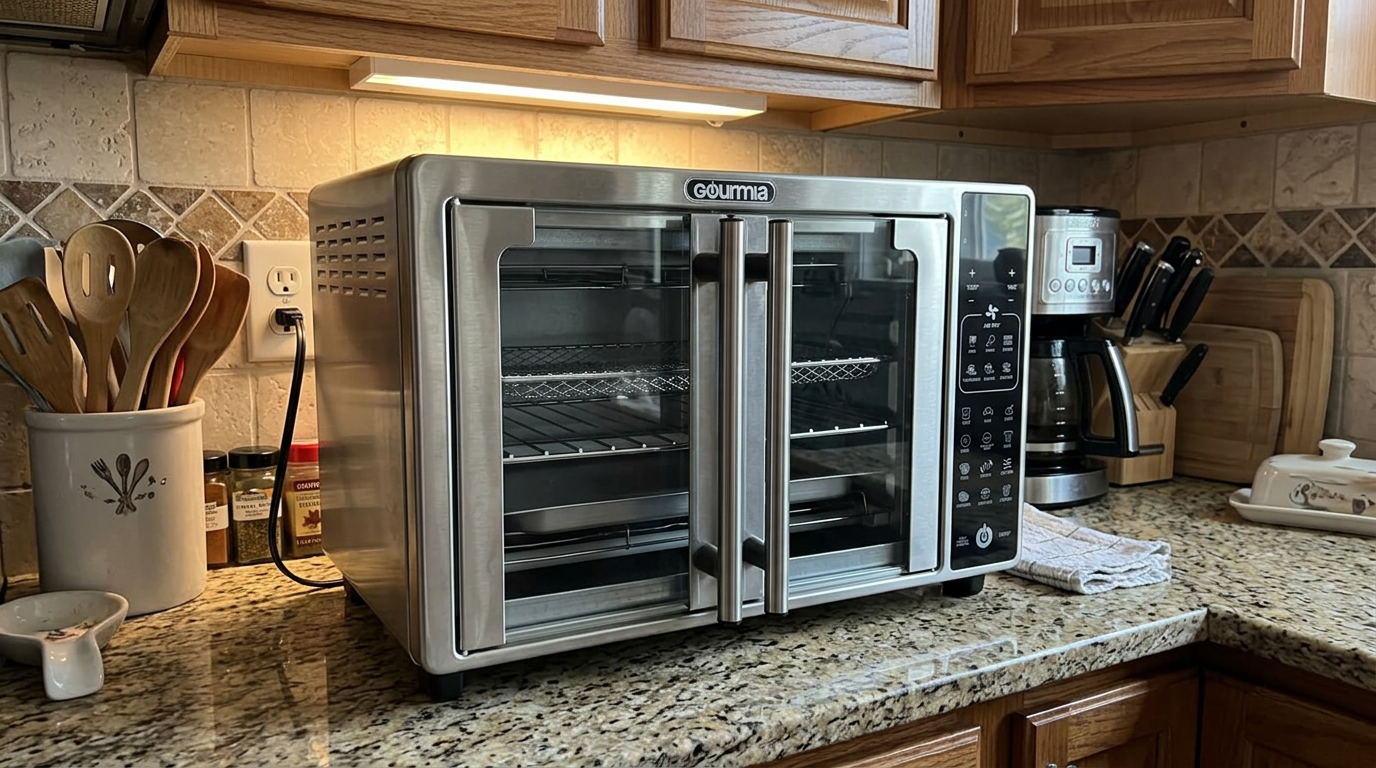
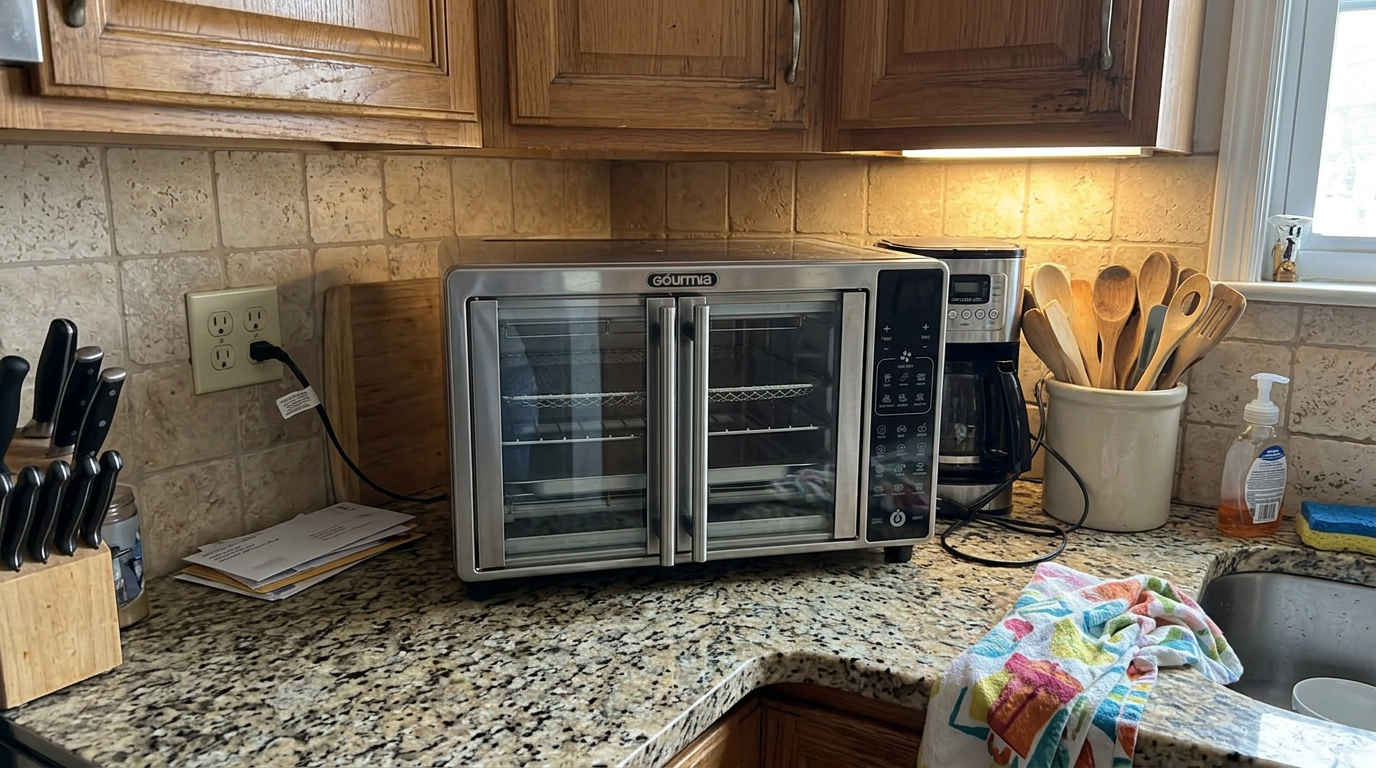
The Gourmia French door oven on my kitchen counter.
I tested it for three weeks, cooking breakfast, lunch, dinner and snacks for a family of four.
I made toast, bagels, fries, wings, frozen snacks, pizza, roast chicken, vegetables, cookies and dried fruit.
Our tip: Run the empty oven at a high temperature for 15 minutes in a ventilated kitchen before first use, because new heating elements can give off a faint smell the first time.
Setup and first use
Setup took about ten minutes.
I removed the packaging, washed the basket, pan and rack and slid the crumb tray into place.
I gave it plenty of space on the counter, with a few inches clear on every side and nothing above it.
The first burn-off produced a mild smell that faded within 15 minutes.
| Setup step | Time | Notes |
|---|---|---|
| Remove packaging | About 3 minutes | Check inside the oven |
| Wash accessories | About 4 minutes | Warm soapy water |
| Insert crumb tray | A few seconds | Slides under elements |
| Burn-off run | About 15 minutes | High heat, window open |
| First cook | Frozen fries | Crisp in about 15 minutes |
My first real cook was frozen fries on the air fry preset.
They came out golden and crisp.
Our tip: Leave at least 4 to 5 inches of space around the oven and nothing on top, because it vents heat during cooking and the outside gets hot.
The French door design
The French doors were my favorite feature.
Opening both doors gave a wide, unobstructed view of the oven.
Sliding the baking pan or basket in and out was easy, with no door to lean over.
Opening one door lets you check or turn food without letting all the heat out.
The doors open together when you pull one, which kept things simple.
On a crowded counter, the outward-swinging doors needed less space in front of the oven than a drop-down door.
Our tip: Open the doors fully before reaching in, because the inside glass and frame are hot and a wide opening keeps your arms well away from them.
25 quarts of space
The 25-quart interior is roomy for a countertop oven.
- A 12-inch pizza without trimming
- Six slices of toast at once
- A whole chicken of about 4 pounds
- A full tray of fries or wings for the family
- A sheet of cookies or roasted vegetables
Compared with a typical 18-quart toaster oven, it has about 39 percent more room on paper.
In practice, that meant cooking dinner for four in one batch instead of two.
Interior capacity compared with other countertop cookers.
Our tip: Leave space between pieces of food rather than filling the tray edge to edge, because hot air needs room to circulate for crisp, even results.
Digital controls and presets
The digital panel lets you choose a function, set the temperature and set the time.
The temperature goes from about 90°F to 450°F, and the timer runs from 1 to 99 minutes.
There are 17 presets, including fries, pizza, roast chicken, bagel, toast and dehydrated fruit.
Presets were a helpful starting point.
I adjusted the time or temperature slightly for my own preferences.
Precise digital settings made recipes repeatable.
Setting 325°F for a cake was easier than guessing on a dial.
| Preset | Default I saw | My adjustment |
|---|---|---|
| Fries | 400°F, about 15 min | Shook halfway |
| Wings | 400°F, about 25 min | Added 5 min for extra crisp |
| Pizza | About 400°F | Middle rack |
| Roast chicken | About 375°F | Checked with thermometer |
| Dehydrate | About 135°F | Times vary by food |
Our tip: Treat presets as a starting point and note your own adjustments, because food size, quantity and personal taste all change the ideal time and temperature.
Air frying with FryForce
Air frying uses Gourmia's convection✕ConvectionCooking with a fan that circulates hot air around food. It cooks more evenly and browns surfaces faster than still oven heat. system, called FryForce, powered by 1,700 watts.
A fan pushes hot air around the food at high speed, crisping the surface with little or no oil.
Frozen fries in the basket came out golden and crisp in about 15 minutes at 400°F, with one shake halfway.
Fresh-cut sweet potato fries with a light spray of oil took about 20 minutes and were crisp outside and soft inside.
Air frying results in my tests.
Our tip: Spray or toss fresh vegetables with a little oil before air frying, because a thin coating helps them brown and crisp much better than cooking them completely dry.
Test one: chicken wings
Wings were one of the best results.
I patted two pounds of wings dry, tossed them in salt and baking powder and spread them in the basket.
At 400°F for about 30 minutes, turning once, the skin turned crisp and golden while the meat stayed juicy.
The perforated basket let hot air reach every side, so there were no soggy spots underneath.
Two pounds fit in one layer, which fed my family in a single batch.
Our tip: Dry chicken wings thoroughly with paper towels before air frying, because surface moisture turns to steam and stops the skin from crisping.
Test two: toast and bagels
The oven fits six slices of bread on the rack.
On the toast preset with a medium setting, the slices browned fairly evenly.
The back corners were slightly darker than the front.
Swapping the front and back slices halfway gave more even results.
The bagel preset toasted the cut side well while warming the outside.
Toast took longer than in a pop-up toaster, about four to five minutes for medium.
Toasting results.
Our tip: Rotate toast halfway through when making a full batch, because ovens are often slightly hotter at the back and rotating gives more even browning.
Test three: 12-inch pizza
A 12-inch frozen pizza fit on the rack with room to spare.
At 400°F on the middle rack, it cooked in about 14 minutes, with a crisp base and bubbling cheese.
A homemade pizza on the baking pan took a little longer, about 16 minutes, and the crust was nicely browned underneath.
The French doors made sliding the pizza out much easier than leaning over a drop-down door.
Leftover pizza reheated at 375°F for about five minutes and came out crisp, much better than in the microwave.
Our tip: Reheat leftover pizza in the oven at about 375°F for a few minutes, because convection heat restores the crisp base that a microwave turns soft.
Test four: whole roast chicken
I roasted a 4-pound chicken on the roast chicken preset.
It fit on the baking pan with a little room around it.
After about 70 minutes, the skin was golden and the meat was juicy.
A thermometer read 165°F in the thickest part of the thigh.
The top near the upper element browned faster, so I covered it loosely with foil for the last 15 minutes.
A bigger chicken would not have fit comfortably, so about 4 pounds is the practical limit.
Our tip: Always check poultry with a meat thermometer for 165°F in the thickest part, because preset times are estimates and chicken size and starting temperature vary.
Roasted vegetables and sheet-pan dinners
Roasted vegetables were easy and delicious.
Broccoli, peppers and potatoes tossed in oil roasted at 425°F in about 20 minutes, with crisp, caramelized edges.
Convection made them brown faster than in my full-size oven.
Sheet-pan dinners worked well, too.
Chicken thighs with potatoes and carrots cooked together on the baking pan in about 35 minutes.
The baking pan caught juices, which kept the oven cleaner.
Our tip: Cut vegetables into even-sized pieces before roasting, because uniform pieces cook at the same rate and you avoid some burning while others stay hard.
Baking cookies and cakes
I baked chocolate chip cookies and a small loaf cake to test baking.
Cookies at 325°F on the baking pan baked evenly in about 11 minutes.
The ones at the back browned a little faster.
A loaf cake at 325°F took about 50 minutes and rose well, though the top browned before the center was done.
Covering it loosely with foil for the last 15 minutes fixed that.
Convection ovens often cook faster and brown more than standard ovens, so I lowered recipe temperatures by about 25°F.
Our tip: Lower conventional baking temperatures by about 25°F in a convection oven, because circulating air browns food faster and can dry out cakes and cookies.
Dehydrating fruit and herbs
The low temperature range makes dehydrating✕DehydratingDrying food at a low temperature with steady airflow to remove moisture, which preserves fruit, vegetables and herbs for longer storage. possible.
I dried thin apple slices at 135°F for about six hours.
They came out chewy and sweet, with no browning.
Fresh herbs dried in about two hours at 120°F and kept their color well.
Capacity was the limit.
Without extra racks, I could only dry one layer at a time.
Dehydrating results.
Our tip: Slice fruit as thin and evenly as you can before dehydrating, because uniform slices dry at the same rate and finish at the same time.
Frozen snacks and quick lunches
For quick lunches, the air fry function was very handy.
Mozzarella sticks cooked in about eight minutes at 390°F, with melty centers and crisp coating and no cheese bursts.
Chicken nuggets, potato wedges and breaded vegetables all crisped in 10 to 15 minutes.
The large basket meant I could cook snacks for the whole family at once.
Package instructions were a good guide, but most items cooked a few minutes faster than oven instructions.
Our tip: Check frozen snacks a few minutes before the package time, because air frying usually cooks faster than the conventional oven times printed on the box.
Heat evenness and the outside temperature
Like most countertop ovens, the back was a little hotter than the front.
I saw it with toast, cookies and the chicken, where the back browned faster.
Rotating the pan halfway through solved it.
The outside got hot during long cooks, especially the top.
I kept the area clear and never stored anything on top of it.
How hot each part of the oven felt during a long cook.
Our tip: Rotate trays front to back halfway through longer cooks, because most countertop ovens run a little hotter at the back and rotating gives more even results.
Cleaning and the crumb tray
Cleaning was manageable with a few simple habits.
The removable crumb tray caught crumbs and drips under the elements.
I emptied it after every few uses.
The basket, pan and rack washed easily by hand.
Wing grease came off the basket after a short soak.
The interior walls needed a wipe once a week with a damp cloth once the oven had cooled.
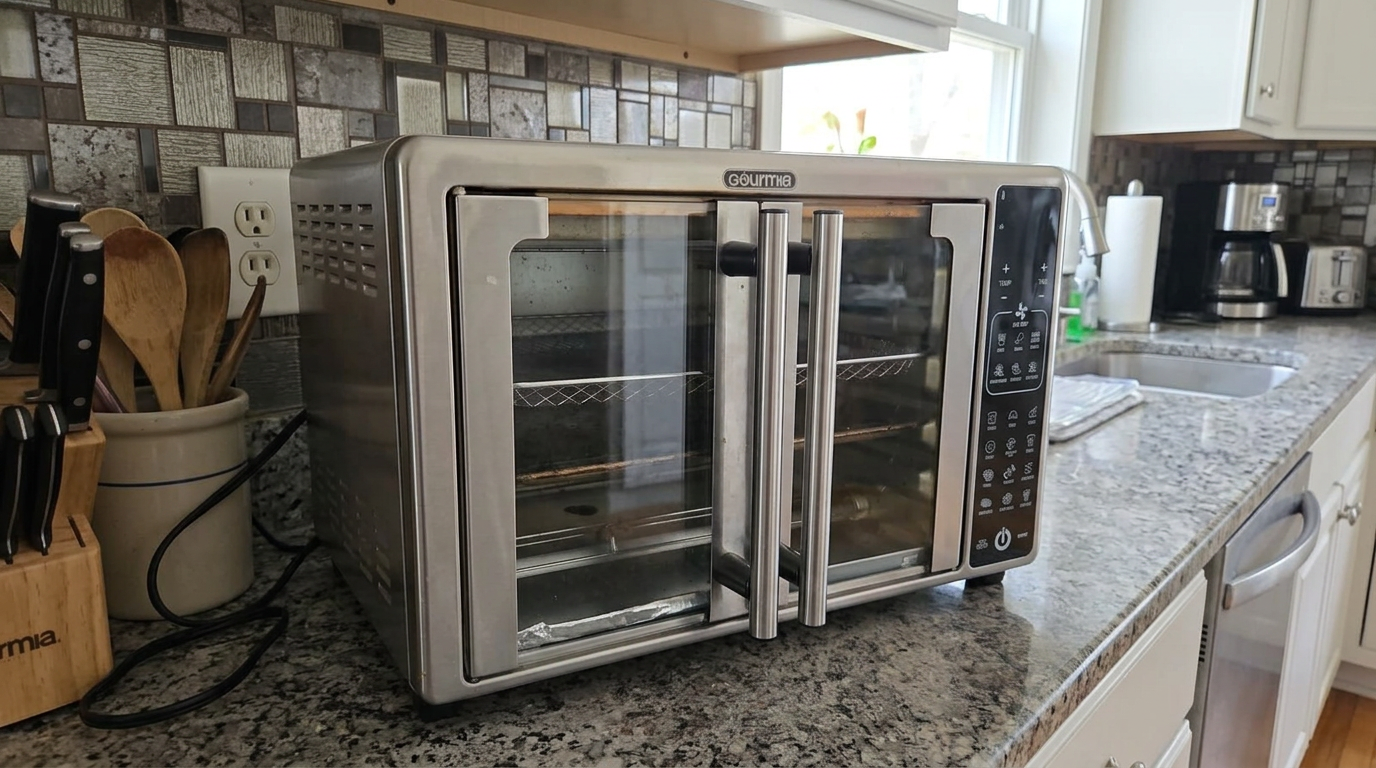
The basket, baking pan, rack and crumb tray.
| Part | How to clean | How often |
|---|---|---|
| Crumb tray | Empty and wash | Every few uses |
| Air fry basket | Soak and wash | After each use |
| Baking pan | Hand wash | After each use |
| Interior walls | Damp cloth when cool | Weekly |
| Door glass | Damp cloth | Weekly |
Our tip: Line the baking pan with foil or parchment for greasy foods, because it makes cleanup much faster and stops baked-on grease building up on the pan.
Replacing other appliances
The biggest benefit was replacing two appliances.
Before the test, I had a toaster oven and a basket air fryer on my counter.
The Gourmia did both jobs, plus dehydrating, which I could not do before.
It takes more space than either appliance alone, but less than both together.
In a small kitchen or apartment, that trade is worth making.
Our tip: Measure your counter depth and the height under your wall cabinets before buying, because a 25-quart oven needs room around and above it to vent safely.
Compared with a basket air fryer
A basket air fryer is faster to preheat and convenient for one or two people.
The Gourmia's larger, flat cooking area spreads food in a single layer, so family-size batches cook more evenly.
It can also toast, bake a pizza and roast a whole chicken, which a basket air fryer cannot do well.
For a quick snack for one, a basket air fryer is a little quicker.
For family meals, the Gourmia was more useful.
Our tip: Choose by how many people you usually cook for, because a large oven shines for family batches while a small basket air fryer suits quick single portions.
What I would change
The Gourmia is versatile, but not perfect.
- Back of the oven runs slightly hotter
- The top and door get hot during long cooks
- Toast is slower than a pop-up toaster
- Only one cooking layer for dehydrating
- Takes a fair amount of counter space
None of these stopped me from using it every day.
Rotating food and giving it space solved most of them.
If you only air fry small portions, a compact air fryer may suit you better.
Our tip: Keep a pair of heat-resistant gloves near the oven, because the basket, pan and door frame get very hot and gloves make handling them safer.
How air frying actually works
Air frying is really a strong form of convection baking.
A fan blows very hot air around the food at high speed.
The moving air pulls moisture off the surface quickly, which lets it brown and crisp.
That browning comes from the Maillard reaction✕Maillard reactionThe browning reaction between proteins and sugars at high heat that creates the golden color and savory flavor on fried, roasted and toasted food., the same reaction that browns toast and seared meat.
Oil helps the heat transfer evenly, which is why a light spray made my fresh fries crisper than dry ones.
Compared with deep frying, I used a fraction of the oil, and the kitchen did not smell of fryer grease afterward.
Our tip: Shake or flip food halfway through air frying, because turning it exposes every side to the moving hot air and gives more even browning.
Preheating and timing
The oven preheated quickly for its size.
It reached 400°F in about five minutes and 350°F in about four.
That was much faster than my full-size oven, which takes about 12 minutes to reach 400°F.
Preheat times in my kitchen.
For weeknight dinners, the shorter preheat made a real difference.
Dinner was often ready before my big oven would have even preheated.
In summer, it also heated the kitchen far less than the full-size oven.
Our tip: Preheat before adding food for baking and roasting, because starting in a hot oven gives better rise in baked goods and better browning on meat and vegetables.
Reheating leftovers
Reheating was a surprise highlight.
Leftover fries came back crisp in about four minutes at 400°F on air fry.
Fried chicken reheated at 375°F for about eight minutes, with crunchy skin and hot meat.
Roasted vegetables regained their caramelized edges instead of turning soft and steamy as they do in the microwave.
It took a few minutes longer than microwaving, but the results were far better.
Our tip: Reheat crispy leftovers on the air fry setting instead of in the microwave, because circulating hot air restores crunch while a microwave makes coatings soggy.
A typical family dinner
By week two, the Gourmia was handling most weeknight dinners.
A typical evening: chicken thighs and potato wedges on the baking pan at 400°F, then green beans added for the last ten minutes.
Everything finished together, and there was only one pan to wash.
On Fridays, homemade pizza went in on the rack while I made a salad.
The children liked watching through the door windows as the cheese bubbled.
Our tip: Add quick-cooking vegetables partway through a sheet-pan dinner, because staggering by cooking time lets everything finish together without overcooking.
Safety in a busy kitchen
Countertop ovens get hot, so I followed a few habits with children in the house.
- Keep 4 to 5 inches clear around the oven and nothing on top
- Push it back from the counter edge
- Use heat-resistant gloves for the basket and pan
- Keep children away from the hot door glass
- Unplug it when not in use for long periods
The control panel stayed only warm, but the top and door glass got hot during long cooks.
I never left it running unattended and always switched it off at the end.
Our tip: Place the oven toward the back of the counter, away from the edge, because it keeps hot doors and surfaces out of reach of small children.
Energy use versus a full oven
Running a 1,700-watt countertop oven uses less energy than heating a full-size oven for the same meal.
The smaller space heats faster and holds heat around the food, so cooking times were often shorter, too.
For small and medium meals, I left my big oven off almost entirely during the test.
A wattage✕WattageThe rate at which an appliance uses electricity. Higher wattage means more power, but total energy use also depends on how long it runs. figure alone does not tell the full story.
How long the appliance runs matters just as much.
For big holiday roasts, a full-size oven is still necessary, but for everyday meals, the Gourmia was more efficient.
Our tip: Use the countertop oven instead of your full-size oven for everyday meals, because heating a smaller space for less time usually uses less energy overall.
A busy family breakfast
Weekday breakfasts were a good test of speed and capacity.
I toasted six slices of bread on the rack while frozen hash browns crisped in the basket below.
Both finished within about ten minutes, and everyone got breakfast at the same time.
On weekends, I baked a tray of breakfast muffins at 325°F, and they rose evenly with golden tops.
Bagels on the bagel preset came out crisp on the cut side and soft inside, the way my children like them.
Having one appliance handle toast and hot food together made mornings smoother.
Our tip: Use the rack and basket at the same time for breakfast, because toasting bread above while crisping hash browns below gets everything ready together.
Snacks for guests
For a small get-together, I made wings, mozzarella sticks and fries.
I cooked the wings first, kept them warm on the baking pan at 200°F in my full-size oven and then air fried the snacks.
Each batch took 10 to 15 minutes, and the large basket meant fewer batches than a compact air fryer.
Guests could watch through the door windows, which made the kitchen feel lively.
Everything came out hot and crisp, and the crumb tray caught the drips.
Our tip: Cook the longest items first when making several snacks for guests, because you can keep them warm while quicker snacks crisp in the air fryer oven.
Rack positions and what goes where
Where you place food matters in a countertop oven.
| Food | Position | Why |
|---|---|---|
| Toast and bagels | Middle rack | Even heat top and bottom |
| Pizza | Middle rack | Crisp base, melted top |
| Air fry basket | Upper middle | Close to the fan and heat |
| Roast chicken | Lower position on pan | Room for height |
| Cookies and cakes | Middle | Avoid burning tops |
Tall foods like chicken need the lower position so they do not sit too close to the top element.
Air frying worked best a little higher, closer to the fan.
Our tip: Keep tall foods low and away from the top elements, because food close to the upper heating elements browns or burns before the inside is cooked.
Cooking from frozen on busy nights
On the busiest nights, I cooked straight from the freezer.
Frozen chicken tenders and a bag of frozen broccoli went on the baking pan at 400°F for about 18 minutes.
The tenders came out crisp, and the broccoli roasted with lightly charred edges instead of turning soggy.
Frozen fish fillets in the basket took about 14 minutes and flaked nicely with a crisp coating.
It was a reliable way to get a hot, crisp dinner on the table with almost no preparation and very little cleanup afterward.
Our tip: Spread frozen foods in a single layer without thawing, because air frying from frozen keeps coatings crisp while thawed food tends to turn soggy.
My three weeks with the Gourmia French Door Oven
In week one, I tested air frying with fries, wings and frozen snacks.
In week two, I tested toast, bagels, pizza, roast chicken and vegetables.
In week three, I baked, dehydrated and focused on cleaning and counter space.
| Week | Focus | Main finding |
|---|---|---|
| 1 | Air frying | Crisp fries and wings |
| 2 | Toast, pizza, chicken | Roomy, back runs hotter |
| 3 | Baking, dehydrating, cleaning | Versatile and easy to clean |
Our tip: Keep a note of your favorite times and temperatures on the fridge, because a quick reference saves guessing when you cook the same meals each week.
Is the Gourmia French Door Oven worth the money?
Yes, for households that want air frying, toasting, baking and roasting in one countertop appliance.
It handled family meals well and freed up counter space.
The trade-offs are slightly uneven heat, a hot exterior and slower toast.
Rotating food and giving it space fixes most of that.
My category scores after three weeks.
How it compares with other countertop cookers
| Feature | Gourmia French Door Oven | Basic toaster oven | Basket air fryer | Full-size oven |
|---|---|---|---|---|
| Capacity | 25 quarts | About 18 quarts | About 4 to 6 quarts | Very large |
| Air frying | Yes, FryForce | Rarely | Yes | Sometimes |
| Doors | French doors | Drop-down | Drawer | Drop-down |
| Presets | 17 | Few | Several | Varies |
| 12-inch pizza | Yes | Sometimes | No | Yes |
| Preheat speed | Fast | Fast | Very fast | Slow |
| Your priority | Fit | Why |
|---|---|---|
| Wings and fries | Excellent | Crisp family batches |
| Pizza night | Excellent | 12-inch fits |
| Toast for four | Good | Six slices, slower |
| Roast chicken | Good | Up to about 4 lb |
| Single snacks | Good | A basket fryer is quicker |
Which one is right for you: is the Gourmia French Door Oven your match?
4 quick questionsGourmia French Door Oven specifications
From manufacturer data, retailer listings and my own testing.
How I tested and scored the Gourmia French Door Oven
For three weeks, the Gourmia French Door Oven cooked most of my family's meals.
I made toast, bagels, fries, wings, frozen snacks, pizza, roast chicken, vegetables, cookies, a loaf cake and dried fruit and herbs.
I checked evenness, outside temperatures and cleaning, and compared it with my old toaster oven and basket air fryer.
- Cooking results (8.8): crisp air frying and good roasting.
- Versatility (9.4): many functions in one oven.
- Ease of use (8.4): clear presets and easy doors.
- Heat evenness (7.2): back runs slightly hotter.
My test scores were: wings 9.4, fries 9.2, pizza 9.0, roast chicken 8.4, roasted vegetables 9.0, toast 8.0, baking 8.0, dehydrating 8.6 and heat evenness 7.2. The overall score of 8.2 is an editorial rating that reflects those results and three weeks of family cooking.
Gourmia French Door Oven FAQ
Is the Gourmia French Door Oven worth it?
Yes, if you want one countertop oven that air fries, toasts, bakes and roasts for a family.
How big is it?
About 25 quarts inside.
Does a 12-inch pizza fit?
Yes, with room to spare.
Can it roast a whole chicken?
Yes, up to about 4 pounds.
How many slices of toast?
Six at once.
What is the temperature range?
About 90°F to 450°F.
How many presets does it have?
17, including fries, pizza, chicken, bagel and dehydrate.
How well does it air fry?
Very well. Wings and fries came out crisp.
Does it cook evenly?
Mostly. The back runs a little hotter, so rotate trays.
Can it dehydrate?
Yes. I dried apples at 135°F and herbs at 120°F.
What accessories come with it?
A fry basket, baking pan, oven rack and crumb tray.
Does the outside get hot?
Yes, especially the top. Leave space around it.
Senior home appliance tester
Emily has tested home appliances for a living since 2016, first as a test coordinator at a national consumer advocacy group and, since 2021, at HouseholdMe. She has a degree in industrial design from Ohio State, so she looks at how a product is built, not just how it performs. She used the Gourmia French Door Oven at home for three weeks for this review.
- Three weeks of hands-on testing of the Gourmia French Door Oven
- Manufacturer product information and instruction manual