Crock-Pot Cook & Carry review
The Crock-Pot Cook & Carry Digital Slow Cooker is a 6-quart slow cooker with a clip-down locking lid and gasket, simple high and low programs of 4, 6, 8 and 10 hours, an automatic warm setting and a removable stoneware pot that is oven-safe to 400°F and dishwasher-safe. I tested it for three weeks with a family of four, cooking stews, chili, pulled pork and mac and cheese, and carried it to family dinners and a picnic. It cooked evenly, the lid held, and auto warm made busy days easier. You cannot set custom times, and the lid is spill-resistant rather than leakproof.

Emily Carter
Hands-on review
Hands-on testing, research, specs
3 weeks
26 minutes
Jargon helpNew to this kind of product? Tap any dotted term to see what it means.
In this review
Yes, if you want a simple, roomy slow cooker you can take to gatherings. The Crock-Pot Cook & Carry cooked beef stew to fork-tender, shredded pork shoulder easily and kept chili hot on its automatic warm setting until we were ready to eat. Its locking lid and gasket stopped spills on my car trips, and the stoneware and lid went straight into the dishwasher. The fixed programs limit you to 4, 6, 8 or 10 hours, there is no delayed start and the lid can still seep through the vent if tilted, but for families and potluck regulars, it is an easy pick.
Crock-Pot Cook & Carry at a glance
Crock-Pot Cook & Carry pros and cons
- Locking lid and gasket for travel
- Auto warm after cooking
- Dishwasher-safe stoneware and lid
- Only fixed cooking programs
- No delayed start
- Vent can seep if tilted
Who should buy the Crock-Pot Cook & Carry?
- Families of four or more
- Potluck and party regulars
- Busy weekday cooks
- Cooks who want exact temperatures
- Singles cooking small portions
- People who want to sear in one pot
First impressions of the Crock-Pot Cook & Carry
The Crock-Pot Cook & Carry is a 6-quart digital slow cooker with a lid that clips down for travel.
It combines simple timed settings, an automatic warm mode and a removable stoneware pot.
Out of the box, it looks clean and understated in matte black.
There are no shiny chrome bands or busy graphics, just a flat control panel on the front and two sturdy side handles.
The lid is glass with a rubber gasket around the rim.
Two metal clips on the sides swing up and hook over the lid to hold it down.
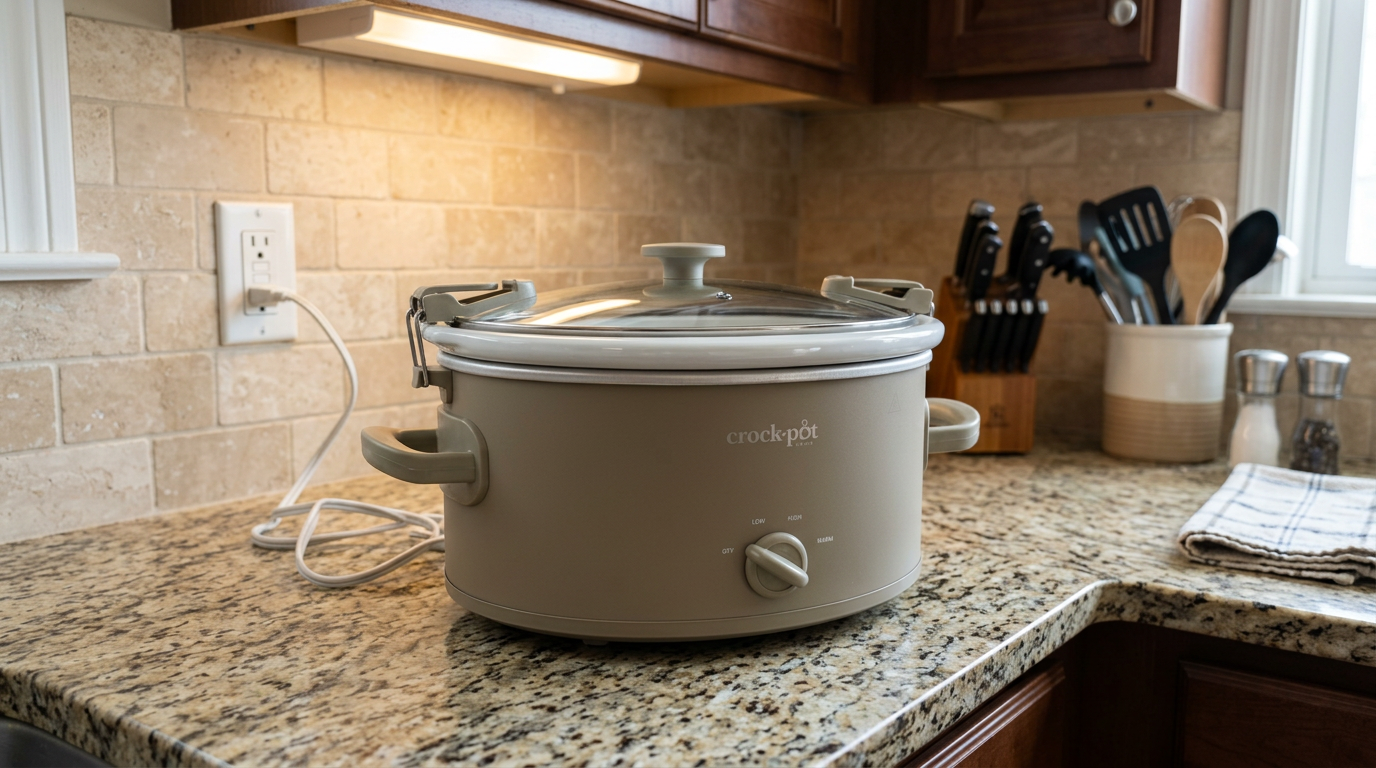
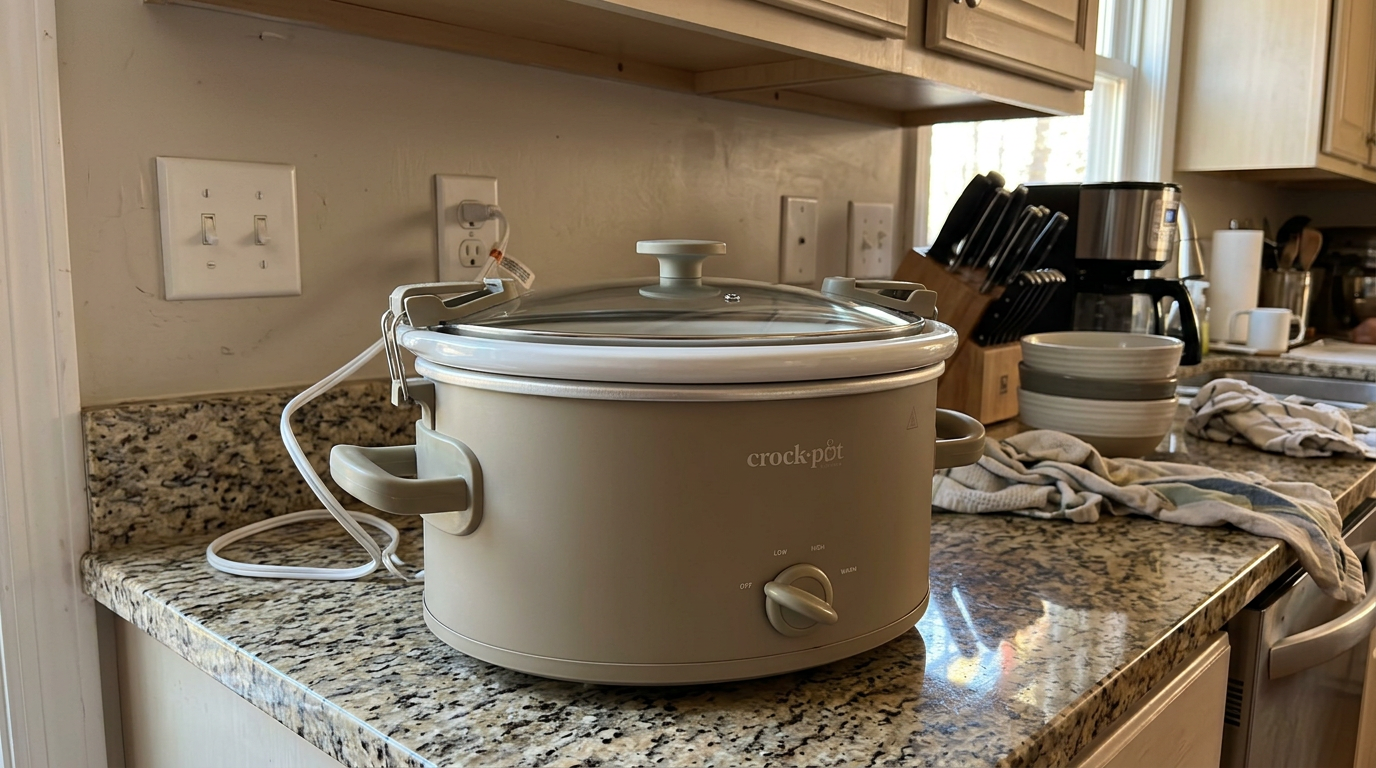
The Cook & Carry with its lid clipped down for travel.
I tested it for three weeks in a family kitchen, cooking for two adults and two small children, with leftovers for lunches.
I also carried it to two family dinners and one weekend picnic to see how well the lid held up on the road.
Our tip: Wash the stoneware and lid before the first use and run one simple recipe, like a pot of beans, so you get a feel for how your cooker behaves before you cook for guests.
Unboxing and the first run
Setup takes about five minutes.
You wash the stoneware and lid, set the pot into the base, plug it in and you are ready.
There is no app, no Wi-Fi pairing and no clock to set.
For a slow cooker, I see that as a plus, because there is nothing to update and nothing to forget.
My first run was a pot of dried pinto beans on low for 8 hours.
They came out soft and evenly cooked, with no hard beans at the bottom and no split skins at the top.
| Setup step | Time | Notes |
|---|---|---|
| Unpack and remove tape | About 2 minutes | Clips are taped down for shipping |
| Wash stoneware and lid | About 3 minutes | Warm soapy water |
| Seat pot in base | A few seconds | Drops in easily |
| Pick a setting | A few seconds | One button cycles through options |
| First recipe | 8 hours on low | Beans cooked evenly |
The power cord is on the short side, which is normal for slow cookers and is meant to stop it from being pulled off the counter.
Our tip: Place the cooker near an outlet with a hand's width of space on all sides, because the base and lid get hot and steam rises out of the vent during long cooks.
How the digital controls work
The control panel is the simplest part of this cooker.
Instead of setting hours and minutes, you choose from four fixed cooking programs.
- High, 4 hours for shorter cooks
- High, 6 hours for larger roasts on high
- Low, 8 hours for a working day
- Low, 10 hours for the longest, gentlest cooks
You press the select button until the light next to your choice comes on, and the cooker starts after a few seconds.
A countdown shows how much time is left.
When I wanted to stop early, I pressed the button until the cooker switched off.
That was handy on days when dinner was ready sooner than I expected.
The fixed programs mean you cannot set odd times like 5 hours or 7 hours.
In practice, I rarely missed that, because most slow-cooker recipes give times in these same blocks.
Our tip: If a recipe calls for a time between two programs, pick the shorter one and check the food near the end, because the auto warm mode will hold it safely if you need a little more time.
High and low settings in my tests
Slow cookers do not hold a single temperature like an oven.
Both high and low heat the food to just below boiling; high simply gets there faster.
I filled the stoneware two-thirds full with cold water and logged the temperature with a probe thermometer to see how quickly each setting heated up.
Water temperature in my heat-up test, with the pot two-thirds full.
Both settings brought the water to a gentle simmer, which is exactly what you want for stews, braises and beans.
On high, it reached that point in about half the time.
Food behaved the same way.
A chicken stew on high for 4 hours and the same stew on low for 8 hours tasted nearly identical, though the low version had slightly more tender chicken thighs.
Our tip: Use low for tough cuts and long-simmered dishes, and save high for dishes with more tender ingredients, because the extra hours on low give connective tissue time to soften.
The automatic warm setting
When the timer runs out, the cooker switches to warm on its own.
It does not simply shut off and let dinner cool on the counter.
This was the feature I leaned on most.
On busy days, I started dinner at 8 a.m. on the 8-hour low setting, and it switched to warm at 4 p.m. until we ate at 6.
In my water test, the warm setting held the pot at about 160 to 165°F, which keeps cooked food above the temperatures where bacteria grow quickly.
Stews and chili were still steaming when we sat down.
Pasta dishes like mac and cheese held less well on warm, getting thicker and a little softer the longer they sat.
How each dish held up on the automatic warm setting.
Our tip: For pasta and rice dishes, plan to eat close to the end of the cooking program, because starchy foods keep absorbing liquid on warm and can turn soft and stodgy.
Six quarts in real life
Crock-Pot rates the 6-quart pot for seven or more people.
In my tests, that matched my experience.
A 4-pound chuck roast with potatoes and carrots fit comfortably.
A double batch of chili, about 5 quarts, fed eight people at a family dinner, with enough left over for two lunches.
For a household of four, the size is ideal.
It makes dinner plus leftovers without needing a second pot.
| Dish | Amount | Fit in 6 quarts |
|---|---|---|
| Chuck roast with vegetables | 4 lb roast | Comfortable |
| Whole chicken | About 5 lb | Snug but fits |
| Chili | About 5 quarts | Fits, two-thirds to three-quarters full |
| Pulled pork shoulder | About 5 lb | Comfortable |
| Mac and cheese | About 2 lb pasta | Plenty of room |
It is less suited to very small portions.
A single serving of soup in a 6-quart pot can cook too quickly and reduce too much.
Our tip: Fill the stoneware between half and three-quarters full for the best results, because too little food overcooks and too much can bubble out of the vent.
The locking lid and gasket
The locking lid is the reason to choose this model.
Two clips on the base swing up and hook over the rim of the lid, holding it down firmly.
A rubber gasket✕GasketA flexible rubber or silicone ring that sits between two surfaces, here the lid and the stoneware, to form a tighter seal and reduce leaks. around the lid presses against the stoneware.
Together, the clips and the gasket made a much tighter seal than a standard loose-fitting slow-cooker lid.
I tested the seal with a full pot of chili on a 25-minute car ride, on the floor of the passenger footwell, with turns and a few speed bumps.
Nothing spilled into the car.
On a second trip, I tilted the cooker slightly while lifting it into the trunk.
A small amount of sauce seeped out of the steam vent, so the lid is spill-resistant rather than fully leakproof.
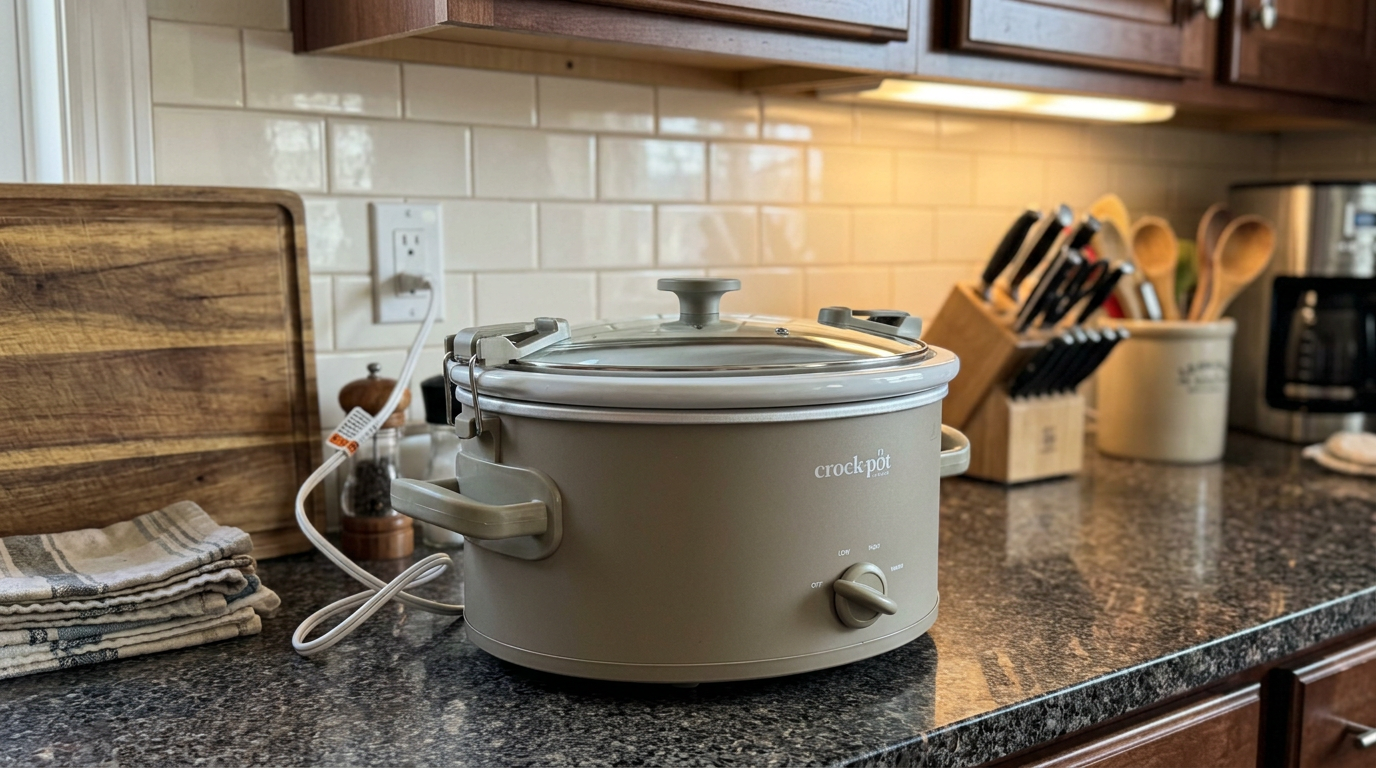
The side clips hook over the glass lid to hold it in place.
Our tip: Unplug the cooker and let it stop bubbling for a few minutes before you clip the lid and travel, because a calmer surface is much less likely to push liquid out of the vent.
Carrying with the handles
The two side handles are molded into the base and give you a solid grip.
A full 6-quart pot of chili is heavy.
With the stoneware, food and base, it was about as heavy as a full laundry basket, and the handles made that easy to manage.
The handles stayed cool enough to hold during cooking, though they got warm after several hours.
I used oven mitts when lifting the cooker straight after cooking.
The lid has a printed warning not to carry the cooker by the lid.
The clips secure the lid but are not built to carry the full weight of the cooker.
Our tip: Always lift with both side handles and keep the cooker level, because the locking clips are designed to hold the lid on, not to carry the weight of the pot.
The steam vent and condensation
The glass lid has a small vent hole that lets steam escape.
It stops pressure from building up and keeps the cooker working as a slow cooker rather than a pressure cooker.
During cooking, condensation forms on the lid and drips back into the food.
That is normal and helps keep dishes moist over long cooks.
The gasket held more moisture in than a standard lid.
Recipes came out a little saucier than I expected, so I learned to reduce added liquid by about a quarter.
The vent should never be covered.
I kept kitchen towels and paper towels away from the lid while it cooked.
Our tip: Cut the liquid in older family recipes by about a quarter, because the gasketed lid traps more steam than a loose lid and dishes can otherwise come out watery.
The removable stoneware pot
The stoneware pot lifts out of the base for serving and cleaning.
It is heavy and holds heat well, which helps food cook evenly.
Crock-Pot says the stoneware is oven-safe up to 400°F.
I used that to finish a mac and cheese under a crumb topping and to brown the top of a shepherd's pie.
The main caution is thermal shock✕Thermal shockCracking caused by sudden temperature changes, such as moving cold stoneware into a hot oven or pouring cold water into a hot pot..
I never moved the pot straight from the fridge into a hot oven or rinsed a hot pot under cold water.
The stoneware cannot go on a stovetop burner, so I seared meat in a separate pan when a recipe called for browning.
Our tip: Let a refrigerated stoneware pot sit on the counter for about 20 minutes before cooking or baking, because gradual warming protects it from cracking.
Test one: homemade mac and cheese
Homemade mac and cheese was my first real family recipe.
I added uncooked macaroni, milk, butter and seasonings to the stoneware, and stirred in the cheese later.
Adding the cheese partway through helped keep the sauce creamy rather than grainy.
I cooked it on low and stirred it twice.
The result was rich and creamy, and the pasta was tender without falling apart.
Serving straight from the stoneware saved a dish.
It is a recipe that needs some attention.
Left too long on warm, it thickened, so I added a splash of warm milk before serving.
Our tip: Stir in the cheese during the last part of cooking rather than at the start, because adding it later keeps the sauce smooth and creamy instead of oily or grainy.
Test two: beef stew and pot roast
Stew and pot roast are what slow cookers do best.
I used chuck, which is a tough, well-marbled cut that needs long, gentle heat.
On low for 10 hours, the beef turned fork-tender.
The long cook breaks down collagen✕CollagenThe connective tissue in tougher cuts of meat. Long, gentle cooking turns it into gelatin, which makes meat tender and gives sauces body. in the meat, which gives the sauce a rich, silky body.
The pot roast fit with potatoes and carrots underneath.
Placing the vegetables at the bottom, closer to the heat, made sure they cooked through.
My results for beef stew and pot roast.
Our tip: Put firm root vegetables at the bottom and the meat on top, because the bottom and sides of the stoneware get the most heat and vegetables cook more slowly than meat.
Test three: chili and beans
Chili was the dish I carried most.
I browned the meat first in a skillet, then added everything to the stoneware on low for 8 hours.
The flavors blended well and the beans held their shape.
It tasted best when I added a squeeze of lime and some fresh herbs at the end.
I also cooked dried black beans from scratch, with no soaking, on high for 6 hours.
They came out tender, though older beans took longer.
Acidic ingredients like tomatoes can slow down how quickly beans soften.
When I made chili with dried beans, I cooked the beans first and then added the tomatoes.
Our tip: Add tomatoes, vinegar or lime after dried beans have softened, because acid can keep beans firm even after many hours of cooking.
Test four: pulled pork and chicken
A 5-pound pork shoulder on low for 10 hours shredded easily with two forks.
It made dinner for four plus sandwiches for two more days.
Chicken was less forgiving.
Boneless breasts on low were done in about 4 hours and became dry if left on the 8-hour program.
Chicken thighs held up much better.
They stayed juicy even after a full 8 hours on low.
| Meat | Setting | Result |
|---|---|---|
| Pork shoulder | Low, 10 hours | Shreds easily |
| Chicken thighs | Low, 8 hours | Juicy and tender |
| Chicken breasts | High, 4 hours | Good if served promptly |
| Chicken breasts | Low, 8 hours | Dry |
| Beef chuck | Low, 10 hours | Fork-tender |
Our tip: Choose chicken thighs over breasts for long cooks, because the extra fat and connective tissue keep thighs moist through the full 8- or 10-hour programs.
Cleanup and dishwasher-safe parts
Cleanup was easy.
The stoneware and the glass lid both went into the dishwasher.
After the mac and cheese, I soaked the pot in warm soapy water for 20 minutes, and baked-on cheese came off with a soft sponge.
The gasket on the lid needs a little extra care.
Food can collect in the groove, so I wiped it after each use and let it dry fully.
The heating base must never go in the dishwasher or under water.
I unplugged it, let it cool and wiped it with a damp cloth.
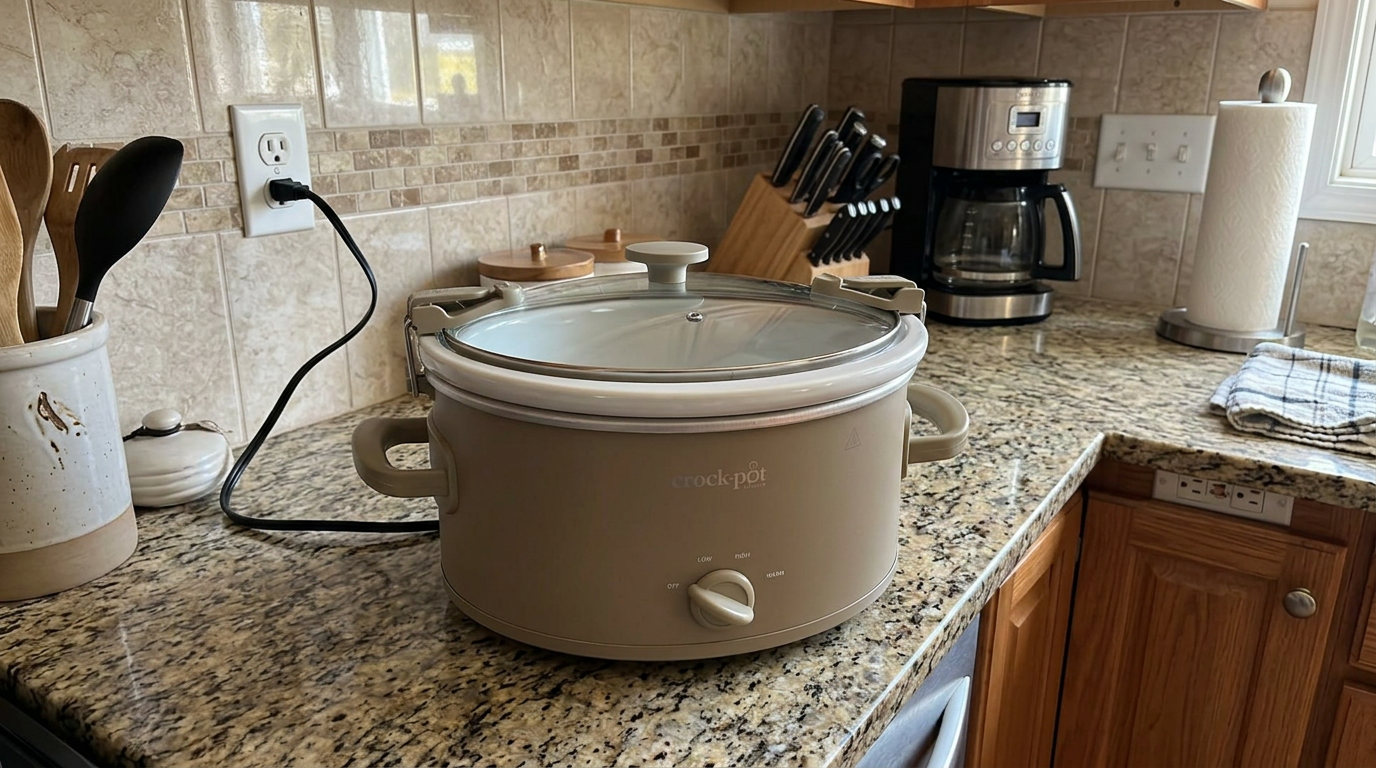
The stoneware pot and lid are both dishwasher-safe.
Our tip: Soak baked-on dishes in warm soapy water before scrubbing, and avoid steel wool, because abrasive pads can scratch the glaze on the stoneware.
The heating base
The metal base holds the heating element.
The stoneware sits inside it, and heat comes from the sides and bottom.
The base is not a cooking surface.
A warning on the cooker says not to cook food directly in it, and the stoneware must always be in place before you turn it on.
I found the heat even.
Food at the edges cooked a little faster, which is normal for slow cookers, but nothing scorched.
The base got warm on the outside during long cooks.
It was fine on my quartz countertop, but I kept it away from the edge so small hands could not reach it.
Our tip: Never switch on the base without the stoneware in place, because the heating element is designed to heat the pot, not to cook food or run empty.
Food safety with a slow cooker
Slow cookers are safe when used correctly, because they heat food to well above the danger zone✕Danger zoneThe temperature range between about 40°F and 140°F, in which bacteria can multiply quickly. Cooked food should be kept above or below it..
I followed a few simple rules during my testing.
Frozen meat never went straight into the cooker, because it can sit too long in the danger zone while thawing.
- Thaw meat in the fridge before slow cooking
- Do not lift the lid often, because each lift loses heat
- Use the warm setting only for cooked food
- Refrigerate leftovers within about two hours
- Reheat leftovers on the stove or in the microwave, not on warm
The warm setting is meant to keep cooked food warm, not to cook raw ingredients or reheat cold leftovers.
Our tip: Keep the lid on as much as possible during cooking, because every lift lets out heat and steam and can add 15 to 20 minutes to the cooking time.
Camping, picnics and outdoor meals
The locking lid and handles make this cooker a good fit for camping trips, cabin weekends and picnics.
For our weekend picnic, I cooked pulled pork at home, then clipped the lid and drove it to a park shelter with an outlet.
Plugged in on warm, it kept the meat hot for the afternoon.
Outdoors, it needs a stable, dry, level surface and a suitable outlet.
I would not run it in the rain or leave it unattended where animals or weather could reach it.
On campsites without power, it is still useful as an insulated carrier for food you cooked at home.
The heavy stoneware held heat surprisingly well for the first hour.
Our tip: Wrap the cooker in a thick towel or blanket during the drive to a picnic, because the stoneware holds heat longer when insulated and food arrives hot.
Life with a busy family
With two small children, weekday dinners can be the hardest part of the day.
This cooker made them easier.
I prepared ingredients the night before, kept them in the fridge and dropped them into the stoneware in the morning.
By dinnertime, the meal was cooked and on warm.
It also cut washing up.
Many meals cooked entirely in the stoneware, which meant one pot instead of several.
When family members ate at different times, the warm setting kept a hot meal ready for each of them.
Our tip: Keep a list of three or four recipes that work well on the 8-hour low program, because having go-to meals makes it much easier to start dinner on a busy morning.
Design and countertop fit
The matte black finish is simple and modern.
It looks more current than older slow cookers with floral prints or chrome bands.
The matte surface hid fingerprints well.
Splashes wiped off easily with a damp cloth.
It is a large appliance.
It fit under my wall cabinets, but I stored it in a lower cupboard between uses.
The clips fold down flat against the base when not in use, so they do not catch on things in the cupboard.
Our tip: Store the lid upside down inside the stoneware with a paper towel between them, because it saves space and protects the gasket and glass in the cupboard.
What I would change
This is a simple cooker, and some of its limits come from that simplicity.
- No custom times, only 4, 6, 8 and 10 hours
- No delayed start, so it begins cooking as soon as you choose a program
- No built-in temperature probe
- The stoneware cannot sear on a stovetop
- The lid is spill-resistant, not leakproof
None of these were deal-breakers in my testing.
The fixed programs cover most recipes, and the auto warm mode makes up for the lack of custom times.
If you want to brown meat in the same pot or set exact temperatures, a multicooker would suit you better.
Our tip: Brown meat in a skillet before slow cooking when you have time, because searing adds deep, savory flavor that a slow cooker alone cannot create.
Getting the best from slow-cooker recipes
After three weeks, a few habits made a real difference to how my meals turned out.
- Cut meat and vegetables into even sizes so they finish at the same time
- Use less liquid than a stovetop recipe, because little evaporates
- Add delicate vegetables like peas and spinach in the last 30 minutes
- Stir in dairy, like cream or sour cream, near the end so it does not split
- Finish with fresh herbs, citrus or a splash of vinegar to brighten long-cooked flavors
The biggest change was cutting liquid.
With the gasketed lid, my old recipes came out thinner than I liked until I reduced the broth.
Thickening was easy at the end.
I stirred a little cornstarch mixed with cold water into stews for the last 20 minutes on high.
Our tip: Season again at the end of cooking, because long, gentle heat mellows salt and spices and most slow-cooked dishes taste better with a final adjustment.
Noise, smell and everyday comfort
Slow cookers are quiet, and this one was silent apart from a soft bubbling near the end of cooking.
There was a faint new-appliance smell during the first run, which disappeared by the second.
After that, the only smell was dinner.
The steam from the vent was gentle.
I kept the cooker out from under my wall cabinets during long cooks so the steam did not collect on the cabinet doors.
Leaving it on while out of the house felt comfortable, because the base stayed stable and the controls were simple.
Our tip: Pull the cooker forward from under your wall cabinets while it cooks, because hours of rising steam can leave moisture on cabinet doors and the underside of shelves.
My three weeks with the Crock-Pot Cook & Carry
In week one, I cooked beans, stew and chili to learn how the high and low programs behaved.
In week two, I tested mac and cheese, pulled pork and chicken, and tried the oven-safe stoneware.
In week three, I focused on transport, carrying the cooker to two family dinners and a picnic.
| Week | Focus | Main finding |
|---|---|---|
| 1 | Programs and heat-up | Both settings reach a gentle simmer |
| 2 | Recipes and stoneware | Great for stews, roasts and pork |
| 3 | Transport and auto warm | Lid held, warm mode kept food hot |
Our tip: Write down how long your favorite recipes take in this cooker, because every slow cooker heats slightly differently and your notes will make future meals more reliable.
Is the Crock-Pot Cook & Carry worth the money?
Yes, for families and anyone who often brings food to someone else's house.
It does the core job of a slow cooker very well and adds a locking lid that makes travel much easier.
The trade-offs are fixed programs and no delayed start.
If you mostly cook the same stews, roasts and chili, you will hardly notice them.
My category scores after three weeks.
How it compares with other ways to slow cook
| Feature | Crock-Pot Cook & Carry | Basic manual slow cooker | Multicooker | Dutch oven in the oven |
|---|---|---|---|---|
| Capacity | 6 quarts | Varies | Usually 6 to 8 quarts | Varies |
| Timer and auto warm | Yes | No | Yes | No |
| Locking lid for travel | Yes, with gasket | Rarely | Sealed lid | No |
| Custom times | No, 4 fixed programs | No | Yes | Manual |
| Searing in the pot | No | No | Yes | Yes |
| Dishwasher-safe pot | Yes | Often | Often | Rarely |
| Your priority | Fit | Why |
|---|---|---|
| Busy weekdays | Excellent | Auto warm holds dinner |
| Potlucks and parties | Excellent | Clip-down lid |
| Large batches | Excellent | 6-quart pot |
| Exact temperatures | Fair | Fixed programs only |
| One-pot searing | Poor | Use a separate pan |
Which one is right for you: is the Crock-Pot Cook & Carry your match?
4 quick questionsCrock-Pot Cook & Carry specifications
From manufacturer data, retailer listings and my own testing.
How I tested and scored the Crock-Pot Cook & Carry
For three weeks, the Crock-Pot Cook & Carry made dinner for my family of four several times a week.
I cooked beans, beef stew, pot roast, chili, pulled pork, chicken and mac and cheese, logged heat-up temperatures and carried it on three trips.
I also tested the warm setting, the oven-safe stoneware and dishwasher cleanup.
- Cooking results (8.8): even heat, fork-tender beef and great pork.
- Ease of use (9.2): one button and auto warm.
- Transport (8.2): lid held on trips, vent can seep if tilted.
- Flexibility (6.6): fixed programs and no delayed start.
My test scores were: ease of use 9.2, stews and roasts 9.4, pulled pork 9.2, cleanup 9.0, transport 8.2, mac and cheese 8.0, chicken breasts 6.8 and flexibility 6.6. The overall score of 8.3 is an editorial rating that reflects those results and three weeks of family use.
Crock-Pot Cook & Carry FAQ
Is the Crock-Pot Cook & Carry worth it?
Yes, if you cook for a family or often take food to gatherings. It cooks evenly, keeps food warm and has a locking lid.
What size is it?
It holds 6 quarts, which Crock-Pot rates for seven or more people.
What settings does it have?
High for 4 or 6 hours and low for 8 or 10 hours, then automatic warm.
Does it switch to warm automatically?
Yes. When the program ends, it switches to warm until you turn it off.
Is the locking lid leakproof?
No. It is spill-resistant, but liquid can seep through the steam vent if the cooker is tilted.
Can the stoneware go in the oven?
Yes, up to 400°F. Avoid sudden temperature changes.
Is it dishwasher-safe?
The stoneware and lid are. The heating base is not and must not get wet.
Can I sear meat in it?
No. Brown meat in a separate pan first.
Can I set a custom cooking time?
No. You choose from four fixed programs.
Does it have a delayed start?
No. It starts cooking when you choose a program.
Can I carry it by the lid?
No. Always use the side handles.
What warranty does it have?
A one-year limited warranty.
Senior home appliance tester
Emily has tested home appliances for a living since 2016, first as a test coordinator at a national consumer advocacy group and, since 2021, at HouseholdMe. She has a degree in industrial design from Ohio State, so she looks at how a product is built, not just how it performs. She used the Crock-Pot Cook & Carry at home for three weeks for this review.
- Three weeks of hands-on testing of the Crock-Pot Cook & Carry
- Manufacturer product information and instruction manual