CHULUX 20 Bar vs CASABREWS CM5418
The CHULUX 20 Bar and the CASABREWS CM5418 are two of the slimmest budget espresso machines you can buy, both about 5.5 inches wide with a pressure gauge on the front and a steam wand on the side. The CHULUX adds a cup warmer, a bigger tank and a steam dial; the CM5418 is the simpler machine with the clearer upgrade path. I used each one as my everyday espresso machine for four weeks to find out which is the better buy.
We choose products independently. We may earn a commission when you buy through our links. Affiliate policy
Jargon helpNew to espresso? Tap any dotted term to see what it means.
In this comparison
For most people, buy the CASABREWS CM5418. Its milk was better, it is easier to live with, and with a grinder, a three-tab portafilter and a single-wall basket it became a genuinely enjoyable espresso machine. Buy the CHULUX 20 Bar if you want better espresso straight out of the box, a cup warmer and a bigger tank, and you are happy to dry it after use and descale on schedule.
The two machines
Specs checked November 24, 2026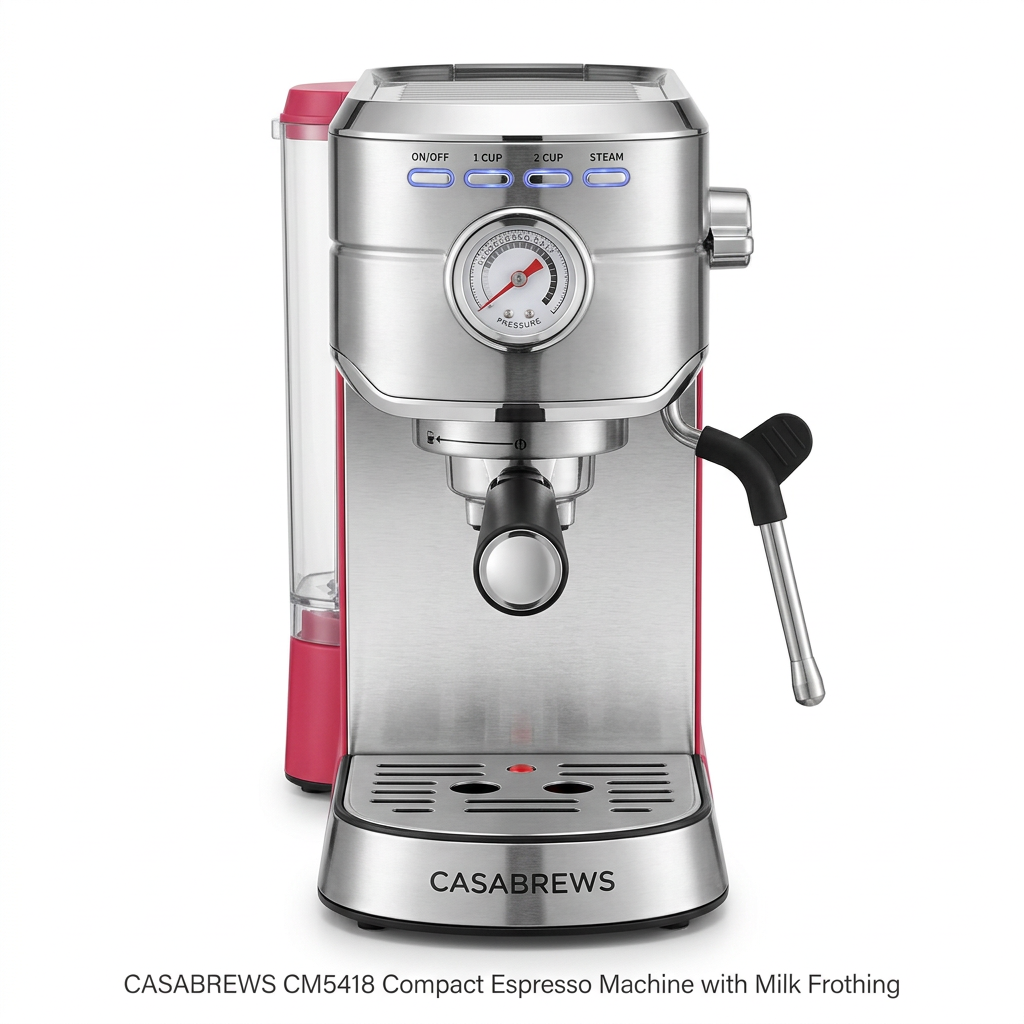
Slim 20-bar machine with a gauge, pressurized baskets, a steam wand and a clear upgrade path.
Check price on Amazon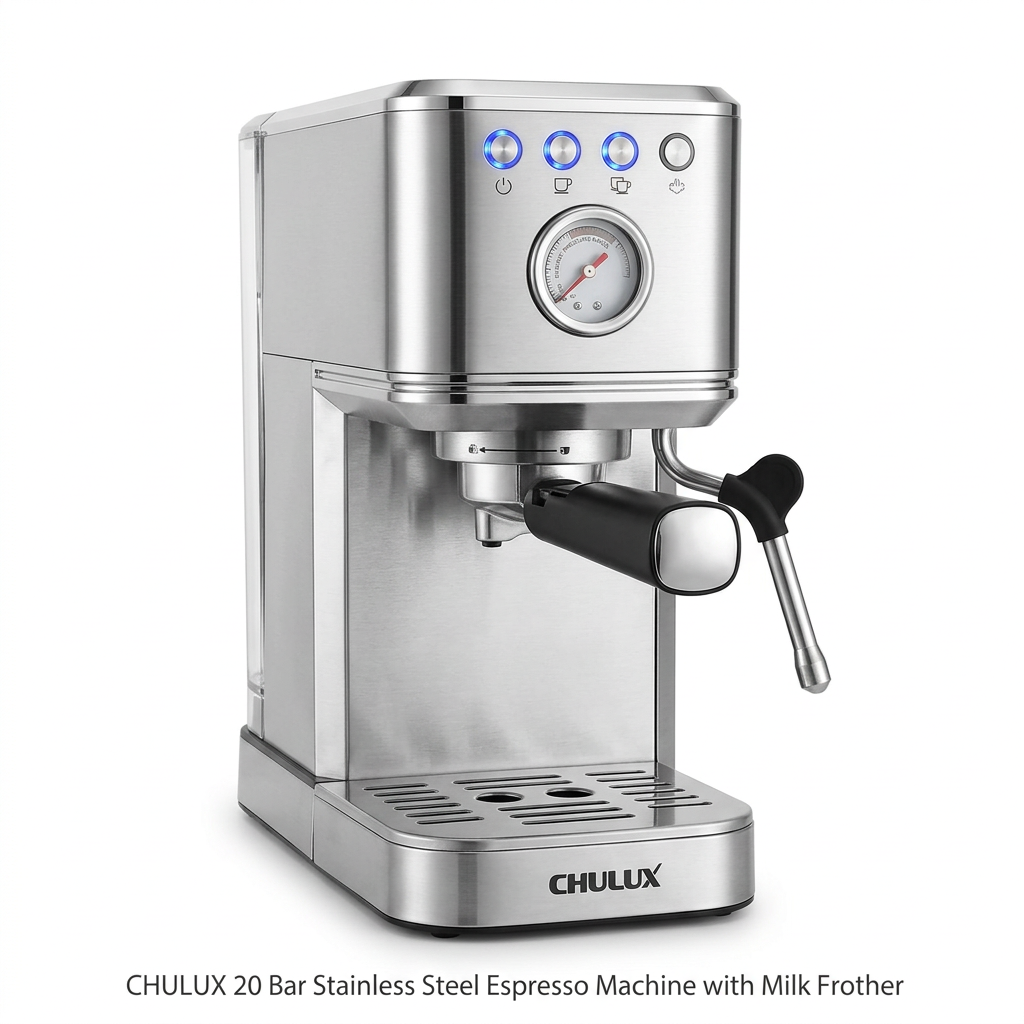
Slim stainless machine with a gauge, a heated cup tray, a 40 oz tank and a steam dial.
See Today’s PriceCHULUX vs CM5418 at a glance
- Both are slim, beginner-friendly machines with a gauge and steam wand.
- The CHULUX made better espresso as it comes and has a cup warmer.
- The CM5418 made better milk and improved the most with upgrades.
- The CHULUX needs a pause between back-to-back shots and a careful drying routine.
Head to head
The best result in each row is marked, based on my four weeks with each machine and the manufacturer specs.
This is close. The CHULUX wins on stock espresso and features; the CM5418 wins on milk, ease and upgrades.
| Spec | CM5418 | CHULUX |
|---|---|---|
| Espresso, stockmy tasting | Looks better than it tastes | Rich, smooth once dialled in ✓ Best |
| Espresso, upgraded | Smooth and sweet ✓ Best | Not tested |
| Milk | Smooth, glossy in small batches ✓ Best | Good once the dial is learned |
| Ease of use | Very easy ✓ Best | Easy |
| Cup warmer | No | Yes ✓ Best |
| Water tank | 34 oz | 40 oz ✓ Best |
| Back-to-back shots | Steady ✓ Best | Needs a pause |
| Width | About 5.5 to 5.9 in | About 5.5 in |
| Durability concerns | Fewer reported ✓ Best | Leaks, rust, fading pressure reported |
| Cleaning | Easier ✓ Best | Needs drying routine |
| Rows won | 6 | 3 |
Six rows to the CM5418, three to the CHULUX, and one tie on width.
Is It On Sale? Check NowCHULUX vs CM5418 pros and cons
CASABREWS CM5418
- Slim, simple and easy to learn
- Forgiving pressurized baskets for pre-ground coffee
- Big jump in quality with cheap upgrades
- Stock espresso can taste flat and bitter
- Modest steam power
- Stock portafilter limits basket upgrades
CHULUX 20 Bar
- Fast heat-up and simple controls
- Rich espresso with good crema once dialled in
- Slim stainless body with a cup warmer
- Needs a pause between back-to-back shots
- Loud steaming and a fiddly steam dial at first
- Owner reports of leaks, rust and fading pressure
Who should buy which machine?
- First-time espresso makers
- Tinkerers who want to upgrade
- Latte and Americano drinkers
- Better espresso without upgrades
- Warm cups and a bigger tank
- One or two drinks a day
What they are
Both are slim semi-automatic✕Semi-automatic espresso machineYou fill, tamp and lock in the portafilter; the machine controls the water and pressure. machines with a manual steam wand and no grinder. Both use a 20-bar pump, a fast heater, a short pre-infusion✕Pre-infusionA short, gentle wetting of the coffee before full pressure, so the water soaks the puck evenly. and a front pressure gauge✕ManometerA pressure gauge that shows roughly how much resistance the coffee is creating during a shot..
The CM5418 uses a 1,350-watt thermoblock✕ThermoblockA compact heater that warms water as it flows through, rather than keeping a boiler hot., a 51 mm portafilter and pressurized baskets. The steam wand also delivers hot water.
The CHULUX adds a heated cup tray on top, a 40 oz tank, a steam dial to adjust steam strength and overheat and over-pressure cut-outs.
The 20-bar figure is the pump’s maximum, not the pressure at the coffee; good espresso is brewed at around 9 bar. What matters is having enough headroom, and both had it.
| Feature | CM5418 | CHULUX |
|---|---|---|
| Pump | 20 bar | 20 bar |
| Heater | 1,350 W thermoblock | Fast heater |
| Gauge | Yes | Yes |
| Cup warmer | No | Yes |
| Steam control | Knob | Adjustable dial |
| Safety cut-outs | Standard | Overheat and over-pressure |
My guide to espresso pressure explains why the pump rating is not the brewing pressure.
Design and size
Both are built for small kitchens. The CM5418 is about 5.5 to 5.9 inches wide, 12.3 inches deep and 12 inches tall, at about 8.6 pounds, with a brushed steel front and top and some plastic around the sides and base. It tucked between my toaster and knife block.
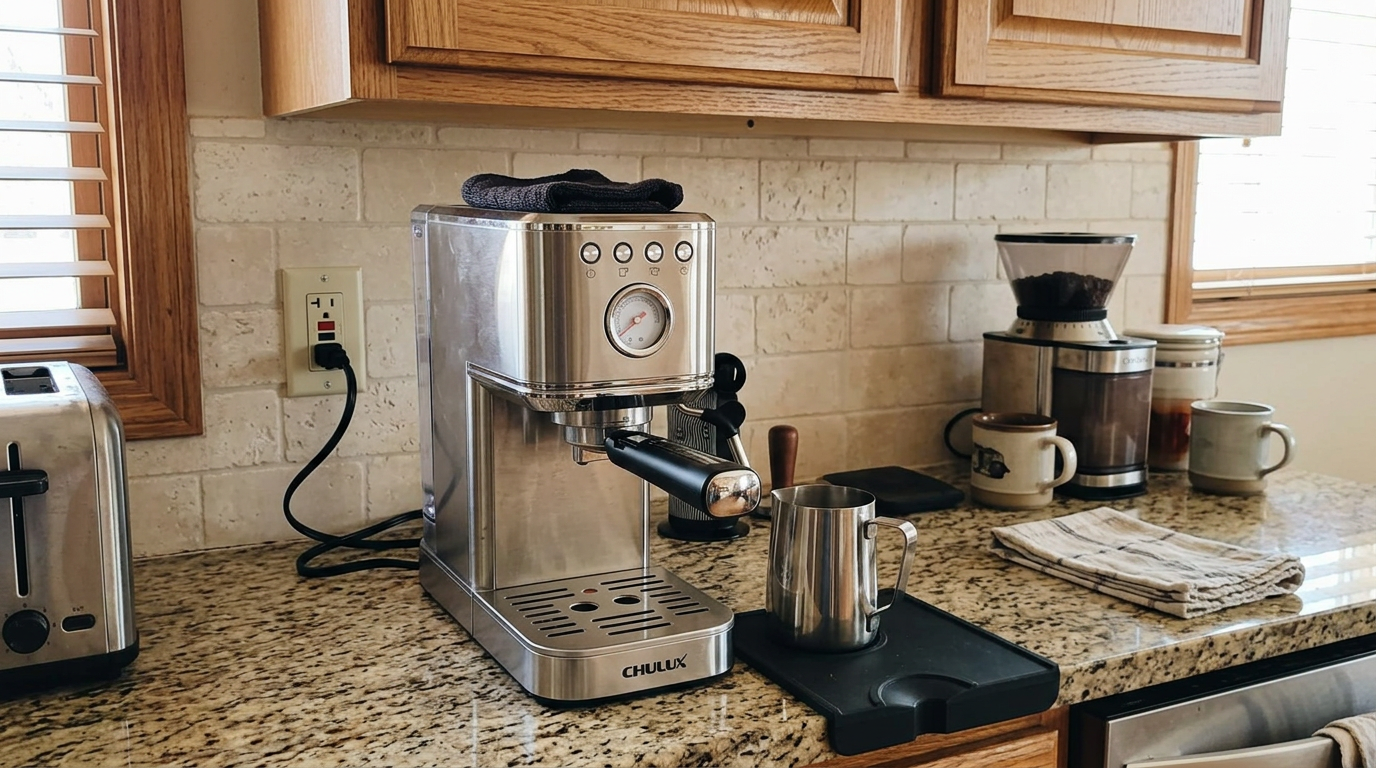
The CHULUX is about 5.5 inches wide, 11.7 inches deep and 12.5 inches tall, all stainless, with a round gauge on the front and a flat top that doubles as a cup warmer. It looked the more premium of the two.
The tanks are the main difference. The CM5418’s 34 oz tank is very narrow with a small opening; I splashed water down the back on day one and filled it at the sink from then on. The CHULUX’s 40 oz tank is bigger and lifts out from the back, and its drip tray slides out without moving the machine.
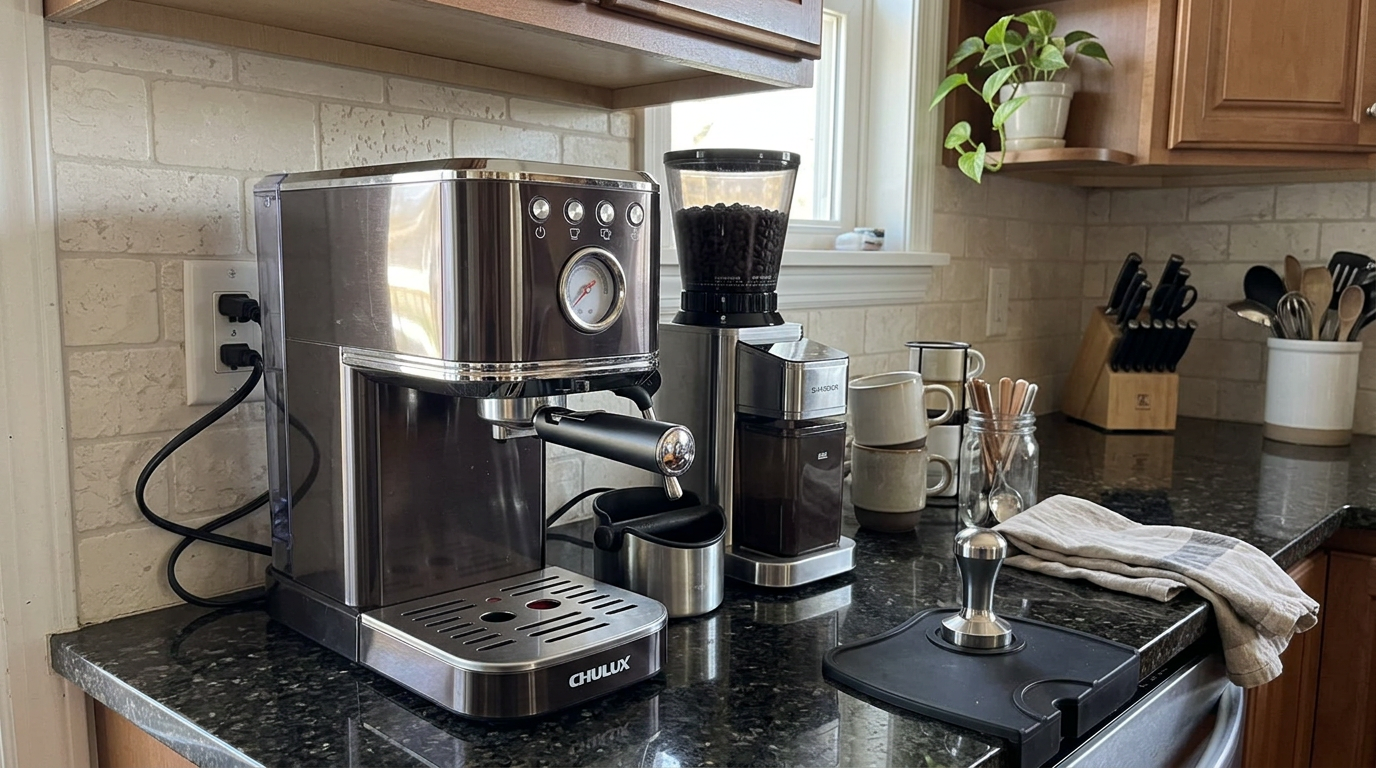
The CHULUX’s flat top doubles as a cup warmer.
Our tip: Lift either tank out and fill it at the sink; pouring onto the machine spills down the back.
On my counter, both left room for a grinder beside them, which is the real point of a slim machine: you want the space for the grinder that makes the biggest difference to the coffee. The CHULUX’s cup warmer was a small daily pleasure, especially on cold mornings, and its gauge sat a little higher and was easier to read from where I stood.
Setup and first shot
Both took about ten minutes: rinse the parts, fill the tank and run water through the group and steam wand.
My first CHULUX shot, with freshly ground beans in the double basket, came out dark and syrupy with a thick, golden crema and tasted bold and rich. My first milk was big-bubbled and loud while I learned the dial.
My first CM5418 shot, with a medium grind, ran quickly with a tall layer of foam. It looked like something from a café, but on its own it tasted a little bland and bitter. That gap between looks and taste became the story of my first week.
The CM5418 comes with a 51 mm portafilter, single and double pressurized baskets and a combined plastic scoop and tamper, but no milk pitcher.
| Setup step | CM5418 | CHULUX |
|---|---|---|
| Unbox to first shot | About 10 min | About 10 min |
| First shot | Looks great, tastes flat | Rich and bold |
| First milk | Fine in a small jug | Bubbly until I learned the dial |
| Trickiest part | Narrow tank | Steam dial |
Heat-up and recovery
Both heat quickly. The CHULUX was ready to brew in well under a minute from cold. The CM5418 was similar, and switching it to steam took about half a minute while the thermoblock heated up.
The bigger difference is back-to-back shots. When I pulled a second shot straight after the first on the CHULUX, the gauge needle did not climb as high and the shot ran faster and thinner. A one-minute pause brought it almost back to the first. The CM5418 needed no such pause in my testing.
CHULUX second-shot quality by pause length
My average ratings out of 10.
Our tip: On the CHULUX, wait about a minute between back-to-back shots; the second tastes almost as good as the first.
For one or two drinks a day, you will never notice the CHULUX’s recovery. For a household making four in a row, it is something to plan around. The CM5418 cannot brew and steam at the same time either, so for milk drinks on both machines I always brewed first and steamed second.
Dose and tamp
Good prep mattered on both. On the CHULUX, a level double basket of about 14 to 15 g worked best; overfilling made the portafilter stiff to lock in. On the CM5418, the double basket holds up to about 15 g, and weighing 15 g every time stopped my shots swinging between watery and bitter.
Both include basic plastic tampers. With pressurized baskets, a light, level press is enough. With single-wall baskets, a solid metal tamper made a clear difference. On both, wiping grounds off the rim before locking in stopped small leaks around the group.
| Prep | CM5418 | CHULUX |
|---|---|---|
| Dose | About 15 g | About 14 to 15 g |
| Distribute | Tap and level, WDT when upgraded | Tap twice, level |
| Tamp | Light with stock baskets | Firm, then stop |
| Rim | Wipe before locking in | Wipe before locking in |
Distribution helped more than I expected on both. On the CHULUX, tapping the portafilter on the counter twice and levelling the top with a finger gave steadier pressure on the gauge. On the upgraded CM5418, stirring the grounds with a WDT tool before tamping made the biggest difference to evenness.
Espresso out of the box
As they come, the CHULUX made the better straight espresso. With a fresh medium-dark roast, my doubles were rich and smooth, with chocolate and toasted-nut notes, a syrupy body and a crema that held for a good minute. Shots were hot enough to drink straight, especially from a cup off the warmer.
The CM5418’s pressurized baskets✕Pressurized basketA double-wall basket with one tiny exit hole that builds pressure for you, so even pre-ground coffee makes foamy crema. make a thick, attractive crema almost every time, but that foam is made by the basket rather than by a well-made shot. On their own, its stock shots tasted thin with a bitter edge. In milk and in Americanos, though, they were perfectly pleasant.
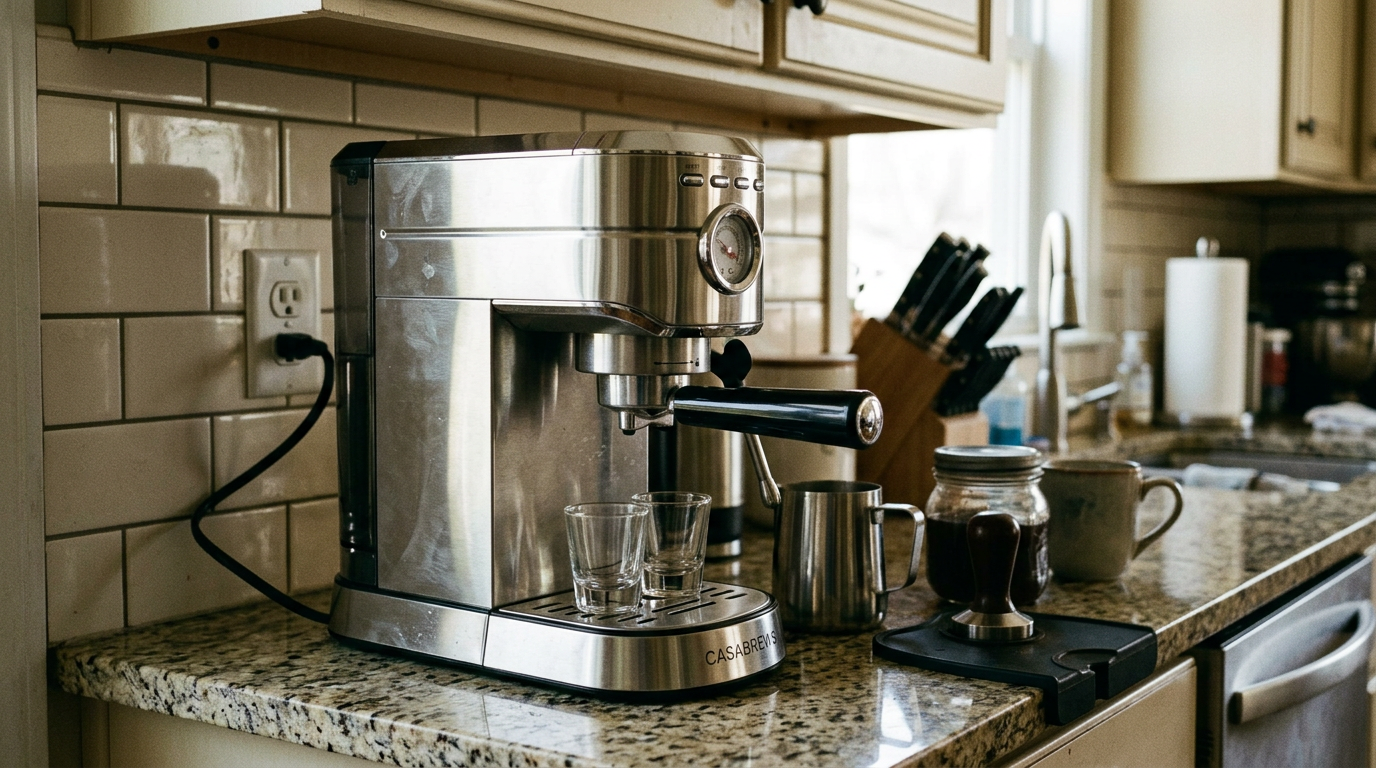
The CM5418’s stock baskets make a tall layer of foam.
Stock espresso ratings
My flavor ratings out of 10.
Reveal Today’s DealGrind matters differently on each. With the CM5418’s pressurized basket, a medium-fine grind worked best; going very fine made the shot slow to a drip, because the basket’s tiny exit hole plus a dense puck was too much resistance. On the CHULUX, a proper espresso grind and a firm tamp gave the best shots, and the pump had the headroom to handle it.
Reading the gauge
Both gauges are guides, not precise instruments, but both showed me when my grind or dose was off.
A needle that barely moves means too little resistance: grind finer or add coffee. One that rises steadily to the middle means good resistance. One that jumps to the top and sticks means too much: grind coarser or tamp lighter. A needle that wobbles or drops mid-shot means an uneven puck, or on the CHULUX, a machine that has not recovered.
Some CHULUX owners report the gauge losing accuracy over time; mine worked throughout my test.
| Needle | Meaning | Change |
|---|---|---|
| Barely moves | Not enough resistance | Grind finer, add coffee |
| Steady rise to the middle | Good | Keep settings |
| Jumps to the top | Too much resistance | Grind coarser |
| Drops mid-shot | Uneven puck or recovering | Level grounds, pause |
After a week with each, I barely needed to taste a shot to know whether it would be good; the needle told me most of what I needed. On the CM5418 with pressurized baskets, though, the gauge was less telling, because the basket creates much of the resistance itself. It became far more useful once I switched to a single-wall basket.
Baskets and upgrades
This is where the CM5418 pulls ahead. The stock portafilter is not great for swapping baskets, because the basket has a notch that lines up with the portafilter, and the alternative 51 mm single-wall baskets I tried did not fit. The fix is a compatible three-tab 51 mm portafilter, which takes standard single-wall baskets✕Single-wall basketA basket with many small holes, so the coffee itself creates the resistance. Less forgiving, but much better flavor..
I added, in order: a proper espresso grinder, a three-tab portafilter with a single-wall basket, a metal tamper, a WDT✕WDTStirring the grounds with fine needles to break up clumps before tamping. tool and a small scale.
I tested the CHULUX in its stock form, where it already did well with fresh beans.
| Upgrade | What it fixes | Effect on the CM5418 |
|---|---|---|
| Espresso grinder | Grind control, freshness | Big |
| Three-tab portafilter and single-wall basket | Real extraction | Biggest |
| Metal tamper | Level, consistent pucks | Medium |
| WDT tool | Clumps, channeling | Medium |
| Small scale | Repeatable dose and yield | Medium |
Our tip: If you can only buy one upgrade for either machine, buy the grinder first; everything else depends on it.
I briefly tried a bottomless portafilter on the CM5418 too. It taught me a lot about uneven pucks in a few days, but it sprayed coffee when my prep was sloppy, so for everyday use I went back to a spouted three-tab portafilter, which is tidier and perfectly good.
Upgraded espresso
With the single-wall basket, I aimed for 15 g in, 30 to 36 g out in 25 to 30 seconds. My first upgraded CM5418 shot ran in 14 seconds and tasted sour. Four grind steps finer, it ran in 27 seconds and tasted round and sweet, with clear nutty and chocolate notes, a heavier body and a finer, darker crema.
That upgraded CM5418 shot was better than anything I made on the stock CHULUX. The point is that the CM5418 itself was never the main limit; the stock basket and tamper were.
CM5418 straight espresso after each upgrade
My average ratings out of 10, same beans.
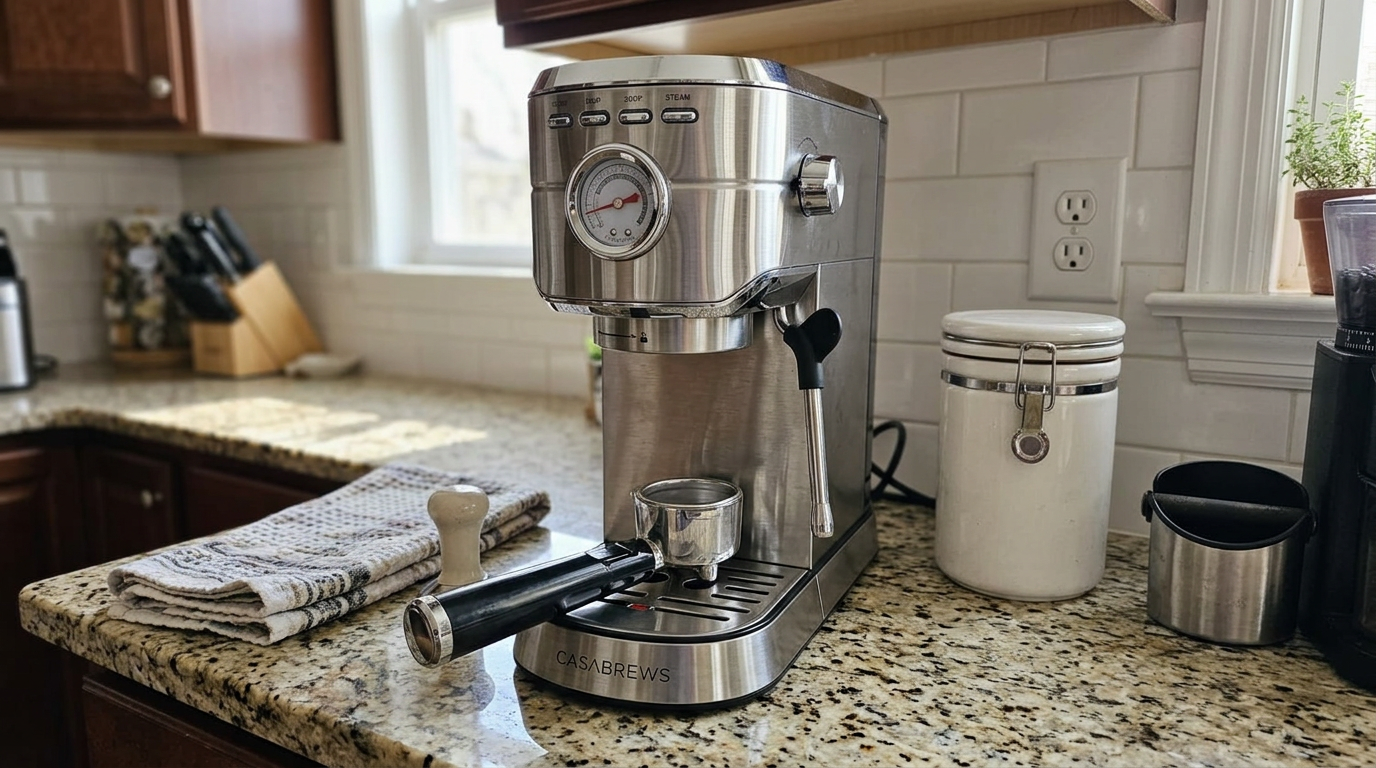
The CM5418’s portafilter is where the biggest upgrade starts.
Milk and steaming
The CM5418’s single-hole wand is modest, but it does the job. With a 12 oz pitcher about a third full of cold milk, I could build a steady whirlpool and get smooth, glossy milk. With more milk, the whirlpool weakened. It rewards small batches.
The CHULUX’s adjustable steam dial is more powerful once learned. My first jugs were full of big bubbles because I opened the dial too far. Half open to add air, then fully open to spin, gave me smooth, dense milk close to microfoam✕MicrofoamMilk foam with bubbles too small to see, silky enough for latte art. by the end of week one, and good enough for simple latte art by week three. It is loud, though.
Cold whole milk, texture
My ratings out of 10 for texture and stability.
| Milk | CM5418 | CHULUX |
|---|---|---|
| Power | Modest | Strong once learned |
| Control | Knob, on or off | Adjustable dial |
| Best batch | Small, one drink | One or two drinks |
| Barista oat milk | 7.2 | 6.8 |
| Noise | Moderate | Loud hiss |
Our tip: On the CHULUX, start steaming with the dial half open, then open it fully once the milk starts to spin.
My guide to the science of steamed milk explains how to build a whirlpool on a small wand.
See How Much You’ll SaveMilk choice mattered on both. Cold whole milk foamed best; barista oat milk was the best non-dairy option; regular almond drink made big bubbles that collapsed quickly on both. Starting with very cold milk in a cold pitcher gave me more time to texture it before it got too hot, which helped most on the CM5418’s gentler wand.
Hot water and Americanos
Both deliver hot water, which meant I did not need a kettle for long drinks. I brewed a double into a mug and topped it with about 5 oz of hot water. On the CHULUX, the rich shots made a satisfying, round Americano. On the CM5418, even stock shots made Americanos better than most pod coffee.
On both, the first second of hot water can spit, so keep your hand clear.
| Drink | How I made it | Better machine |
|---|---|---|
| Americano | Double plus about 5 oz hot water | CHULUX, stock |
| Long black | Water first, shot on top | Tie |
| Cup warming | Splash, swirl, pour away | CHULUX has a warmer anyway |
Drinks I made most
Espresso: the CHULUX as it comes; the CM5418 once upgraded.
Latte and flat white: both were good. The CM5418 was easier in a small pitcher; the CHULUX had more power once I had learned its dial.
Cappuccino: the CHULUX, because its stronger steam built a thicker foam more easily.
Americano: both, with hot water from the machine.
Iced latte: both, since there is no steaming involved. A double over ice with cold milk was a regular on warmer days.
| Drink | Better machine | Why |
|---|---|---|
| Espresso, stock | CHULUX | Richer as it comes |
| Espresso, upgraded | CM5418 | Single-wall basket |
| Latte, flat white | CM5418 | Easier small-batch milk |
| Cappuccino | CHULUX | Stronger steam |
| Americano, iced latte | Tie | Both good |
Our tip: For an iced latte on either machine, pull a double straight over a full glass of ice, then add cold milk.
Beans and water
Both rewarded fresh beans from a burr grinder. Medium-dark and dark roasts were the easiest on both; lighter roasts needed a finer grind and, on the stock CM5418, never tasted quite right. Filter-grind coffee ran fast and watery on both.
I used filtered water and refreshed both tanks each morning. That matters more on the CHULUX, where less scale means less strain on the pump and seals.
| Roast | CM5418 | CHULUX |
|---|---|---|
| Light | Hard on stock baskets | Bright, a little sharp |
| Medium | Sweet once upgraded | Sweet, nutty |
| Medium-dark | Easiest | Chocolatey, balanced |
| Dark | Good in milk | Bold, bittersweet |
My guides to roast levels, burr vs blade grinders and water chemistry go deeper.
Long-term durability
This is the CHULUX’s biggest question mark. In the first weeks, owners are overwhelmingly happy, but a share of longer-term owner reports describe leaks, rust along the lower seams and pressure fading after months of regular use. In my four weeks, the CHULUX’s pressure stayed steady and nothing leaked, apart from small drips when I left grounds on the rim.
To protect it, I dried the drip tray area and lower seams after use, descaled on schedule, used filtered water and avoided extremely fine grinds that strain the pump. I would also keep the receipt.
The CM5418 is a well-known budget machine with fewer durability complaints in the owner feedback I read. Its main reported quirk is a soupy puck, which is normal for a machine without a pressure-release valve.
To be fair to the CHULUX, every machine in this class has some owners who run into problems, and four weeks cannot show what happens after a year. What I can say is that the CHULUX’s reports cluster around the same few issues, so it makes sense to build the simple care habits in from day one rather than wait.
Cleaning and care
Daily care is similar: knock out the puck, rinse the basket, wipe and purge the wand straight after steaming and empty the drip tray. The CM5418’s puck comes out soupy because it has no three-way valve✕Three-way valveA valve that releases pressure from the puck after the shot so it comes out dry.; letting it rest for a minute made it easier to knock out.
The CHULUX needs the extra drying routine above. Both need regular descaling, more often with hard water.
| When | CM5418 | CHULUX |
|---|---|---|
| After each shot | Knock out, rinse | Knock out, rinse |
| After milk | Wipe and purge | Wipe and purge |
| Daily | Empty drip tray | Empty tray, dry the seams |
| Regularly | Descale | Descale on schedule |
Cleaning ratings
My single-review scores out of 10.
On both, the steam wand needs the most attention, because milk dries on it quickly. A damp cloth and a one-second purge straight after steaming kept both wands clean for the whole test.
Noise
Both pumps buzz while brewing at a similar level. Steaming is where they differ: the CHULUX’s steam was a sharp hiss, louder than most slim machines I have tested, and it carried through my open-plan kitchen. The CM5418 was noticeably quieter. In a quiet home with early risers, that may matter.
If noise matters, steam with the CHULUX’s dial only partly open at first; it was a little quieter that way while I built the foam.
Build quality
The CHULUX looks and feels more premium, with stainless panels all round that wipe clean easily. The CM5418 has a steel front and top but some plastic on the sides and base, and its stock portafilter has a plastic handle and spout.
Both are light, so I kept a hand on each when locking the portafilter in. Over four weeks, neither developed a fault in my kitchen.
Our tip: Keep a hand on either machine when locking in the portafilter; both are light enough to slide.
Serving guests
For one or two drinks, both were fine. For four in a row, both slowed down: the CHULUX needed a pause between shots, and the CM5418’s modest steam worked best one small jug at a time. The CHULUX’s cup warmer helped keep the first drinks hot.
Four lattes, start to finish
My timings, including pauses and steaming.
Our tip: When serving several drinks, pull all the shots first into warmed cups, then steam milk one small jug at a time.
If you regularly host, the CM5418’s steady back-to-back shots make it the calmer choice, while the CHULUX rewards a short pause between drinks, which is easy to fill by steaming the previous drink’s milk.
Mistakes to avoid
Judging the CM5418 by its foam. The stock crema looks better than the shot tastes.
Pulling back-to-back shots on the CHULUX without a pause. The second is thin.
Opening the CHULUX steam dial fully from the start. Big bubbles every time.
Buying single-wall baskets for the stock CM5418 portafilter. They did not fit; you need a three-tab portafilter.
Leaving the CHULUX wet. Dry it after use.
| Problem | Fix |
|---|---|
| Thin second shot on the CHULUX | Wait about a minute |
| Flat, bitter CM5418 espresso | Upgrade to a single-wall basket |
| Leaking at the group | Wipe grounds off the rim |
| Barely drips on the CM5418 | Grind coarser for the pressurized basket |
A typical morning on each
On the CM5418: weigh 15 g, grind, distribute, tamp, pull a double, switch to steam, wait about half a minute and steam a small jug. About five minutes in total.
On the CHULUX: two cups on the warmer as I switched on, weigh 14 to 15 g, tamp, pull a double, then steam with the dial half open, then fully. About the same time, with hotter cups.
| Step | CM5418 | CHULUX |
|---|---|---|
| Heat-up | Under a minute | Under a minute |
| Dose | About 15 g | About 14 to 15 g |
| Shot | Single or double button | Button |
| Steam ready | About 30 s | A short wait |
| Extra step | None | Dry the seams at day’s end |
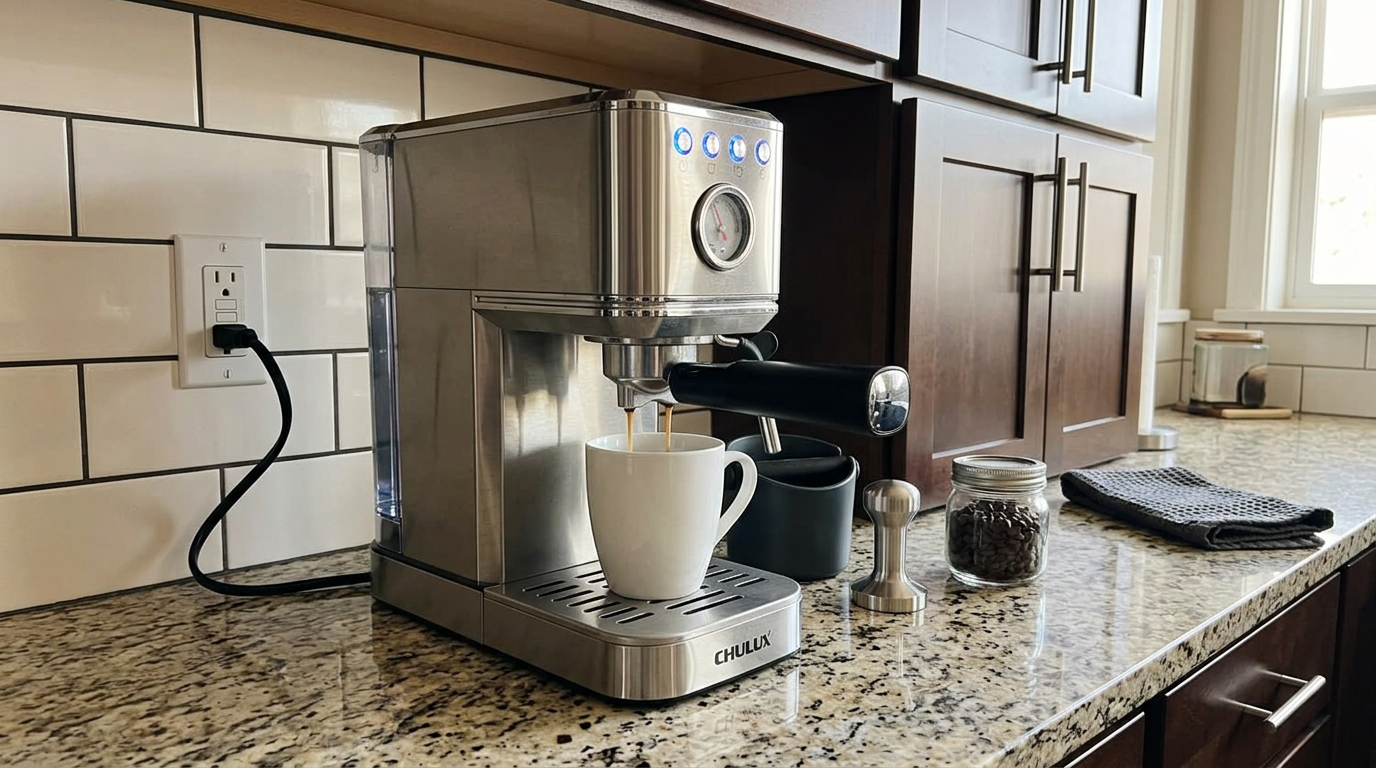
The CHULUX brewing a morning double.
On weekends, I had time to enjoy the CM5418’s upgrades: weighing, stirring, tasting and adjusting a new bag of beans. On weekdays, the CHULUX’s better stock shots meant less fuss for a good espresso, and the warm cups were a nice touch.
Which makes the better first machine?
For most beginners, the CM5418. It is very easy to learn, forgiving with pre-ground coffee, and it can grow with you through cheap upgrades.
The CHULUX suits beginners who want better espresso straight away and do not plan to upgrade, as long as they make only one or two drinks a day and keep up its care routine.
| Coming from | Better pick | Why |
|---|---|---|
| Pods or capsules | CM5418 | Easiest start |
| Wants good espresso now | CHULUX | Better stock shots |
| Loves tinkering | CM5418 | Clear upgrade path |
| Wants warm cups | CHULUX | Cup warmer |
Whichever you pick, the habits you learn, weighing your dose, wiping the rim, purging the wand and reading the gauge, carry over to any espresso machine you move up to later.
Four weeks with each: my diary notes
These are the notes I kept as each machine settled into my routine.
CASABREWS CM5418
Week 1: Lovely foam, flat taste; started weighing 15 g.
Week 2: Added a grinder; sweeter shots.
Week 3: Three-tab portafilter and single-wall basket: the big jump.
Week 4: Small-jug milk was smooth and glossy every morning.
CHULUX 20 Bar
Week 1: Rich shots from day one; learned the steam dial.
Week 2: Measured the back-to-back recovery; a one-minute pause fixed it.
Week 3: Simple latte art on good mornings.
Week 4: Pressure steady; dry-down routine became habit.
Real-life scenarios
These are the situations where one machine fit better in my four weeks.
Easiest to learn.
Better stock shots.
Three-tab portafilter path.
Cup warmer.
Quieter steam.
No recovery pause.
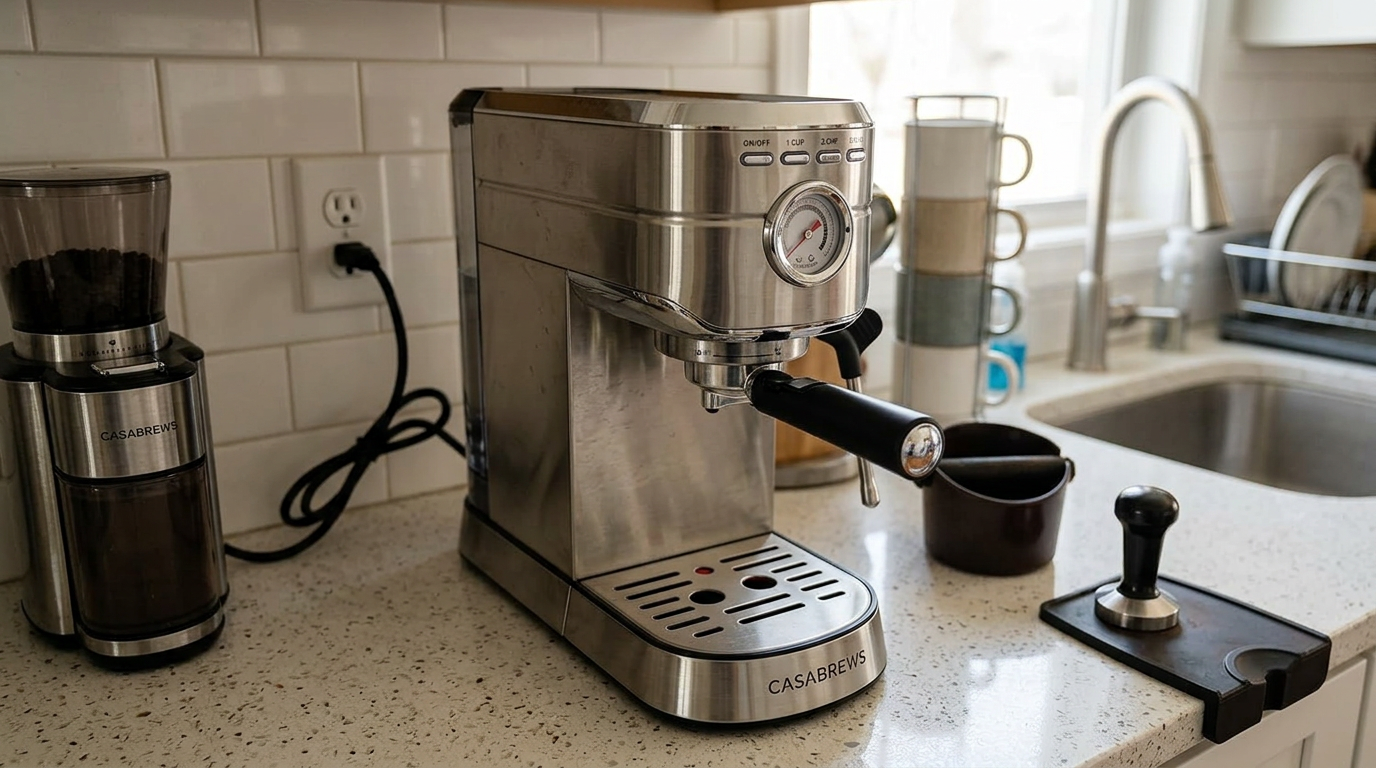
The CM5418 beside my grinder for four weeks.
My scorecard
These are my scores out of 10 from my single reviews.
CASABREWS CM5418
CHULUX 20 Bar
Overall, I rate the CM5418 7.2 and the CHULUX 7.1. The CM5418’s espresso score is for the stock setup; upgraded, it reached 8.0 in my tastings.
Find Out the Price TodayWhich one is right for you?
4 quick questionsWhich one should you buy?
For most people, the CASABREWS CM5418. It is easier, made better milk, has fewer durability worries and improves the most with upgrades.
If you want better espresso straight away, warm cups and a bigger tank, the CHULUX 20 Bar. For the full detail, read my reviews of the CASABREWS CM5418 and the CHULUX 20 Bar.
- You are a beginner
- You want to upgrade later
- You make mostly milk drinks
- You want great espresso with no upgrades
- You want a cup warmer
- You want better stock espresso
- You like warm cups
- You make one or two drinks a day
- You make many drinks in a row
- You want quiet steaming
My pick for most people is the CASABREWS CM5418. It is easy to learn, makes smooth milk in small batches and becomes a genuinely enjoyable espresso machine with cheap upgrades.
Choose the CHULUX 20 Bar if you want better espresso straight out of the box, a cup warmer and a bigger tank, and you will keep up its drying and descaling routine.
Whichever you choose, weigh your dose, wipe the rim and use filtered water.
CHULUX vs CM5418 specifications
From manufacturer specifications and my own testing.
| CASABREWS CM5418 | CHULUX 20 Bar | |
|---|---|---|
| Type | Semi-automatic | Semi-automatic |
| Pump | 20 bar | 20 bar |
| Heater | 1,350 W thermoblock | Fast heater |
| Portafilter | 51 mm | Included |
| Baskets | Single and double pressurized | Single and double |
| Gauge | Yes | Yes |
| Cup warmer | No | Yes |
| Water tank | 34 oz | 40 oz |
| Size | About 5.5 to 5.9 x 12.3 x 12 in | About 5.5 x 11.7 x 12.5 in |
| Weight | About 8.6 lb | Light |
How I tested and compared them
Michael Reynolds here. I used each machine as my everyday espresso machine for four weeks, with the same medium-dark beans and cold whole milk, and kept detailed notes throughout.
I used the CHULUX in its stock form. I used the CM5418 as it comes for the first part of the test, then added a grinder, a three-tab portafilter with a single-wall basket, a metal tamper and a WDT tool.
I timed heat-up and recovery, measured back-to-back shots, steamed whole, 2%, barista oat and almond milk, and followed each manual’s cleaning routine.
- Espresso: body, crema, flavor and consistency.
- Milk: foam texture and learning curve.
- Workflow: heat-up, prep and daily routine.
- Ownership: cleaning, noise, water and footprint.
CHULUX vs CM5418 FAQ
What is the difference between the CHULUX 20 Bar and the CASABREWS CM5418?
Both are slim 20-bar machines with a gauge and steam wand. The CHULUX adds a cup warmer, a 40 oz tank and a steam dial; the CM5418 is simpler, makes better milk in small batches and is easier to upgrade.
Which makes better espresso?
The CHULUX as it comes. The CM5418 made better espresso once upgraded with a grinder and single-wall basket.
Which is better for lattes?
The CM5418, slightly, in small batches. The CHULUX is stronger once you learn the dial, but louder.
Can I use a single-wall basket in the CM5418?
Not in the stock portafilter in my testing; a compatible three-tab 51 mm portafilter takes standard single-wall baskets.
Why is my second CHULUX shot weak?
The machine needs about a minute to recover between back-to-back shots.
Is the CHULUX reliable?
Mine worked well for four weeks, but some long-term owners report leaks, rust and fading pressure. Dry it after use and descale on schedule.
How much coffee should I use?
About 15 g on the CM5418 and 14 to 15 g on the CHULUX.
Which has a bigger water tank?
The CHULUX, at 40 oz versus 34 oz.
Do they need a grinder?
Not to start, but both are much better with fresh beans from a burr grinder.
Why is the CM5418 puck soupy?
It has no pressure-release valve; let it rest for a minute before knocking it out.