Chefman 4.5 Liter Deep Fryer RJ07-45-SS review
The Chefman 4.5 Liter Deep Fryer RJ07-45-SS is a big countertop deep fryer with an adjustable thermostat up to 375°F, a timer with automatic shut-off, a removable oil container and a magnetic breakaway cord. I used it for three weeks to make double-fried French fries, chicken wings, buttermilk chicken tenders, beer-battered onion rings and jalapeño poppers. The food was excellent, the capacity easily fed four, and being able to set the temperature made a real difference. The lid is the weak spot: steam vents out of the front slots and can scald your hand, and the charcoal filter does little. My first unit also died after one use, though the replacement worked perfectly.

Emily Carter
Hands-on review
Hands-on testing, research, specs
3 weeks
27 minutes
Jargon helpNew to deep fryers? Tap any dotted term to see what it means.
In this review
Yes, if you want a large, simple fryer and you'll respect its lid. The Chefman RJ07-45-SS heats quickly, holds temperature well enough for double-fried fries, and its big basket handled family-sized batches of wings, tenders and onion rings. The adjustable thermostat, timer shut-off, removable oil tank and magnetic cord are genuinely useful. But steam escapes through the front lid vents, the charcoal filter barely helps with smell, there's no separate power switch, and my first unit failed after one use, so buy where returns are easy.
Chefman RJ07-45-SS at a glance
Chefman RJ07-45-SS pros and cons
- Big capacity for family-sized batches
- Adjustable thermostat for proper double-frying
- Removable oil tank and magnetic breakaway cord
- Hot steam vents out of the front of the lid
- Charcoal filter does little for smell
- First unit failed; no separate power switch
Who should buy the Chefman RJ07-45-SS?
- Families of four or more
- Game nights and parties
- Cooks who want temperature control
- Small kitchens with poor ventilation
- Anyone sensitive to frying smells
- People who want the most polished design
First impressions of the Chefman deep fryer
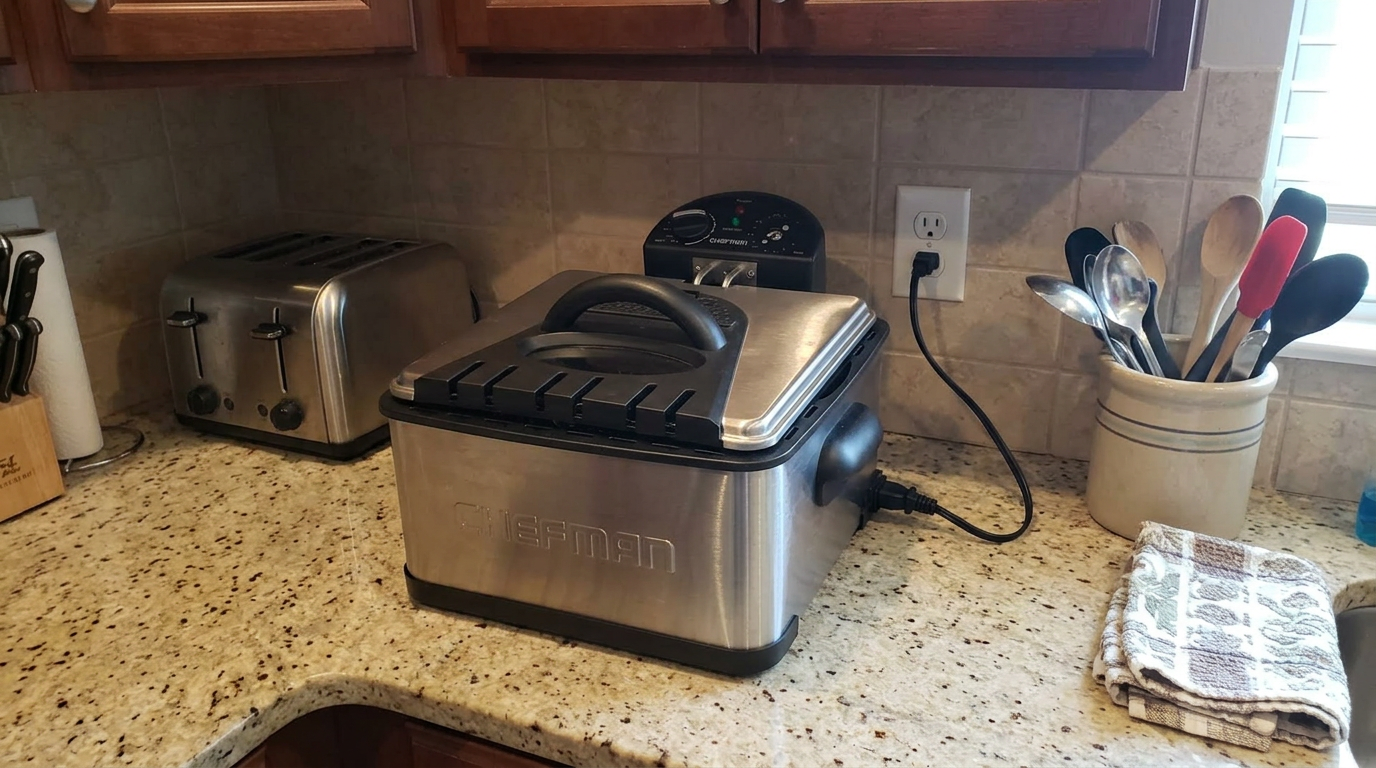
It's a big stainless steel box, and it looks smart on the counter.
Inside the outer housing sits a removable oil container with a maximum fill line.
The heating element and control panel lift off the top, and a large wire basket hooks onto the side.
The lid has a viewing window, vents and a charcoal filter.
The power cord connects with a magnet, so it pops off if someone catches it.
Assembly took five minutes: wash the basket and tank, slot everything together and fill with oil.
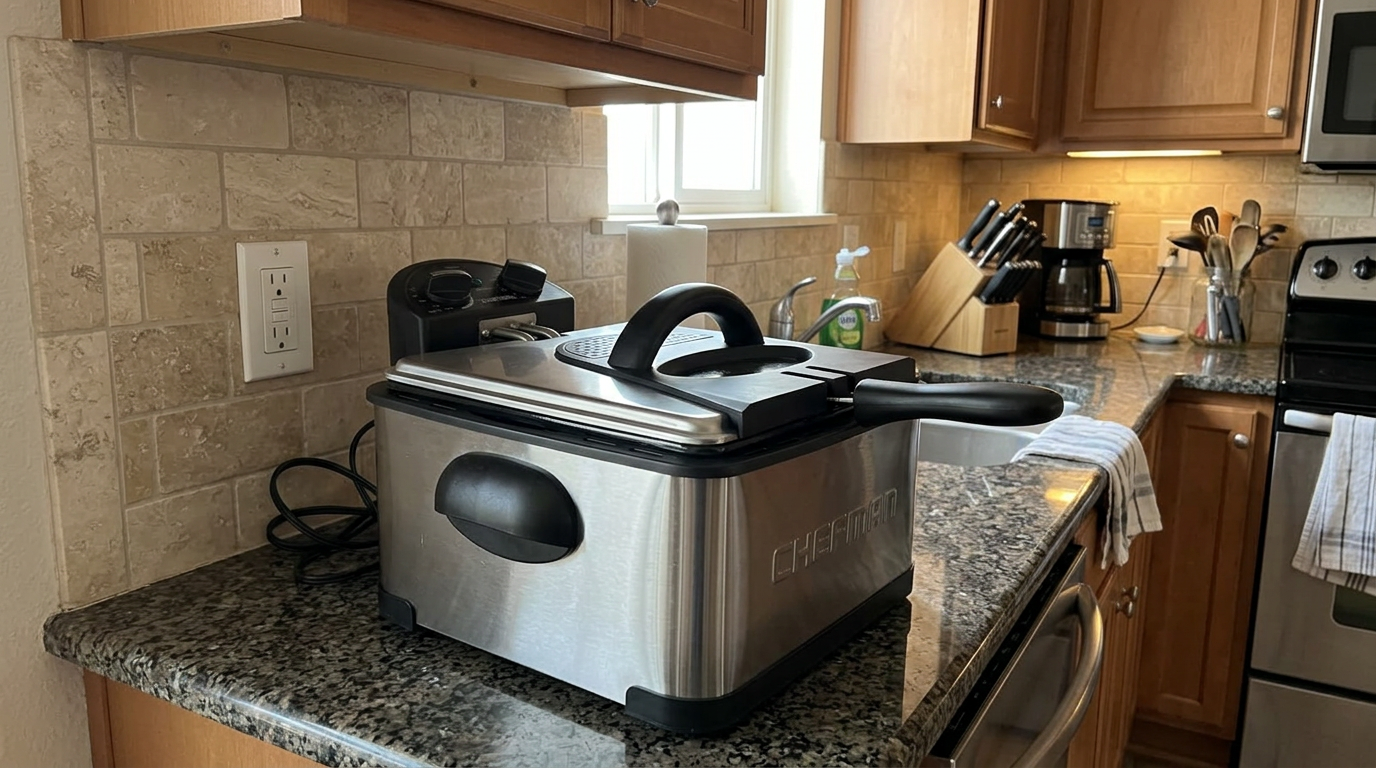
The lid with viewing window and the large basket.
Our tip: Wash and fully dry the basket, oil tank and lid before your first fry, because even a few drops of water left in the tank will spit violently when the oil heats up.
My first unit failed
I want to be upfront about this.
My first fryer worked for one session of fries, then wouldn't power on the next day.
The lights stayed off with the cord connected and the timer turned.
I returned it and received a replacement, which then worked perfectly for the rest of testing.
One faulty unit doesn't prove a pattern, but it's worth buying from a seller with easy returns.
Test a new fryer early, within the return window.
| Unit | Sessions | Result |
|---|---|---|
| First unit | 1 | Stopped powering on |
| Replacement | More than a dozen | Worked perfectly |
Our tip: Do a full test fry within the first few days of buying any deep fryer, because electrical faults usually show up early and you'll want to be well inside the return window.
How an immersion fryer works
This is an immersion fryer✕Immersion fryerA fryer whose heating element sits directly in the oil rather than under the tank, which heats the oil faster and recovers temperature more quickly..
The heating element sits right in the oil, which heats it faster than a fryer that warms the tank from underneath.
A temperature probe next to the element tells the thermostat when to switch heating on and off.
The control unit lifts out, which makes the oil tank easier to empty and clean.
It's a simple, proven design that's easy to understand.
| Part | What it does |
|---|---|
| Heating element | Sits in the oil and heats it |
| Temperature probe | Tells the thermostat the oil temperature |
| Thermostat dial | Sets the target temperature |
| Timer | Runs the fryer and shuts it off at zero |
| Oil tank | Holds the oil; lifts out for draining |
Our tip: Make sure the control unit is seated firmly in its slot before plugging in, because many fryers have a safety switch that won't let the element heat unless it's fully in place.
Capacity: big enough for a crowd
This is the fryer's biggest strength.
The tank holds 4.5 liters of oil, and the basket is wide and deep.
One batch held about a pound and a half of fries, enough for three people.
Wings went in eight to ten at a time without crowding.
For a family of four, I could make a full meal in two or three batches instead of five or six.
What fit comfortably in one batch.
Our tip: Fill the basket only about halfway for best results, because overloading drops the oil temperature sharply and leaves food greasy instead of crisp.
Filling it with oil
The oil tank has a clear minimum and maximum line.
It took most of a large bottle of vegetable oil to reach the max line.
I used canola for most testing and peanut oil once for wings.
Never fill above the max line, because the oil rises when food goes in.
Never run it below the minimum, or the element can overheat.
| Oil | Smoke point | My use |
|---|---|---|
| Canola | High | Everyday frying |
| Peanut | High | Wings, great flavor |
| Vegetable blend | High | Fries |
| Olive oil (extra virgin) | Lower | Not recommended |
Our tip: Fill to just below the max line rather than right to it, because wet food makes the oil foam up and a little headroom keeps it safely inside the tank.
The adjustable thermostat
The temperature dial goes up to 375°F, and this is the feature that makes it worth having.
Different foods need different heat.
Raw chicken needs a moderate temperature so the outside doesn't burn before the inside cooks.
Fries need a lower first fry and a hotter second fry.
I checked the oil with a probe thermometer, and the dial was close, usually within ten degrees once settled.
| Dial setting | My thermometer | Use |
|---|---|---|
| 325°F | About 320°F | Delicate foods |
| 350°F | About 345°F | Chicken, first fry |
| 375°F | About 370°F | Final crisp, wings |
Indicator lights and controls
There are two indicator lights.
One shows the fryer is on, and the other shows the element is heating.
When the oil reaches temperature, the heating light switches off.
Both lights are orange, which confused me at first, because I expected a green ready light.
Once I learned that "heating light off" means ready, it was fine.
Our tip: Wait for the heating light to switch off before adding food, then wait for it to cycle off again before each new batch, because that's your signal that the oil is back at temperature.
The timer and the missing on/off switch
There's no separate power switch.
Once it's plugged in, turning the timer starts the fryer, and when the timer reaches zero it shuts off.
That's a sensible safety feature, because it can't run forever if you forget it.
But it's awkward when you're preheating, because you have to set a long time and then remember to turn it back.
A dedicated power switch would make it easier to use.
| Action | How you do it |
|---|---|
| Turn on | Plug in, then turn the timer |
| Preheat | Set a long time on the timer |
| Turn off | Turn timer to zero or wait for it |
| Emergency stop | Turn timer to zero, then unplug |
Our tip: Set the timer for the whole session, including preheating, rather than for each batch, because the fryer shuts off at zero and reheating cold oil wastes ten minutes.
The magnetic breakaway cord
The power cord connects with a magnet.
If someone catches it, it pops off instead of dragging a tank of hot oil off the counter.
I tested this by tugging the cord gently, and it released cleanly.
It's one of the best safety features on the fryer.
The cord is long, though, so I still routed it away from where people walk.
Our tip: Route the cord along the back of the counter and away from the edge, because the magnetic release protects against a tug but you still don't want it hanging where kids or pets can grab it.
Heat-up and recovery time
From cold, it took about 10 minutes to heat to 350°F with a full tank.
Going from 350°F to 375°F for the second fry took another few minutes.
When I added a full basket of fries, the oil dropped by around 40 degrees.
It recovered in a couple of minutes, which is good for a fryer this size.
Overloaded batches took much longer to recover and came out greasier.
Heat-up times in my kitchen.
Our tip: Take food out of the fridge 15 minutes before frying, because ice-cold food drops the oil temperature further and slows recovery between batches.
Double-fried French fries
Fries are the reason most people buy a fryer, and the thermostat made proper double-frying easy.
I cut russet potatoes, soaked them overnight in cold water, rinsed and dried them completely.
A light dusting of cornstarch helped them crisp.
The first fry was at 340–350°F for six to eight minutes, just enough to cook them through without browning.
After a ten-minute rest, I fried them again at 375°F until golden, then salted them straight away.
They had fluffy middles and crisp outsides, better than anything from my oven.
| Stage | Temperature | Time | Goal |
|---|---|---|---|
| Soak | Cold water | Overnight | Remove starch |
| Dry | — | Until bone dry | Prevent spitting |
| First fry | 340–350°F | 6–8 min | Cook the inside |
| Rest | — | 10+ min | Let steam escape |
| Second fry | 375°F | 2–4 min | Crisp and color |
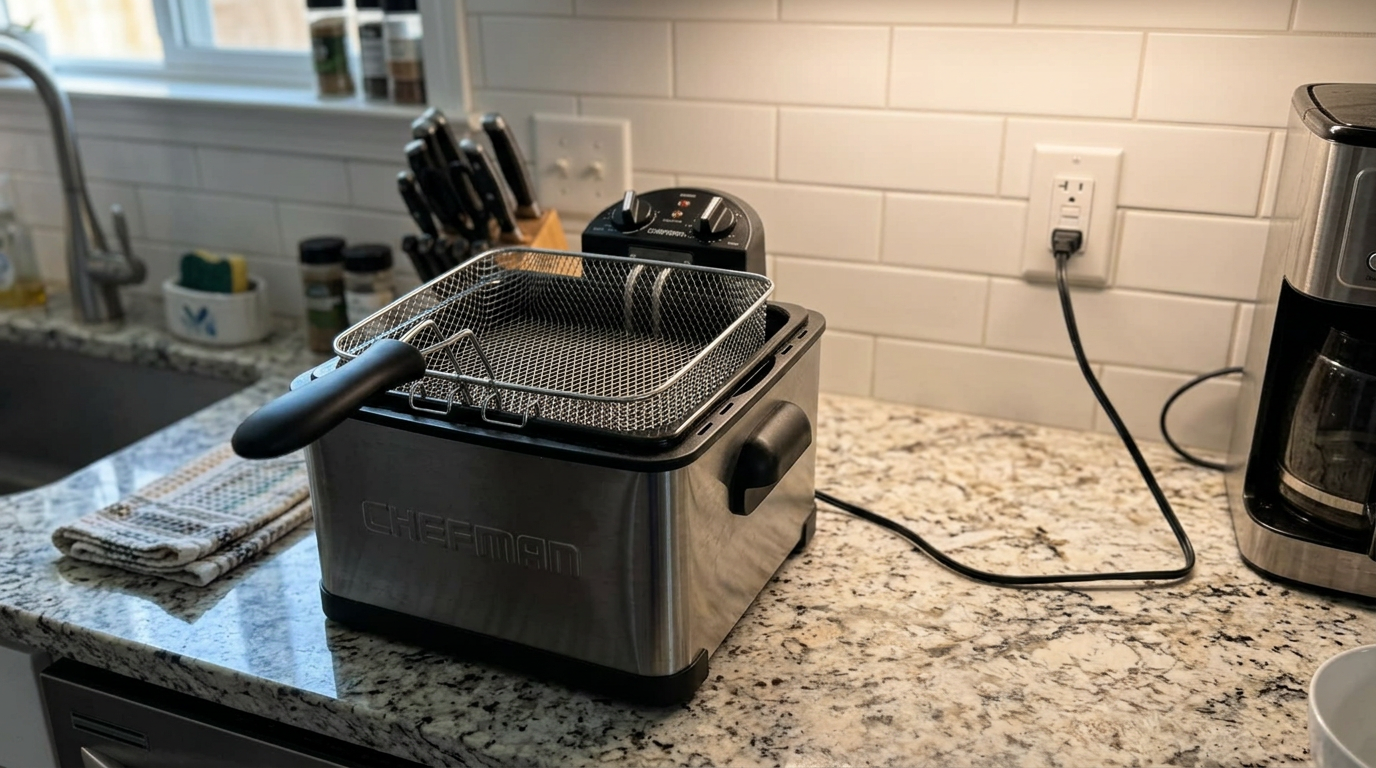
Double-fried russet fries straight from the basket.
Chicken wings
Wings were the easiest win.
I separated them, patted them very dry and fried them in batches of eight to ten.
They took about ten to twelve minutes until the skin was crisp and they reached 165°F inside.
I tossed them in a mix of melted butter and a cayenne-based hot sauce.
They tasted just like sports-bar wings.
A couple of extra minutes made the skin even crispier without drying the meat.
| Step | Detail |
|---|---|
| Prep | Separate and pat very dry |
| Temperature | About 375°F |
| Time | 10–12 minutes per batch |
| Done when | Crisp skin, 165°F inside |
| Sauce | Butter and hot sauce, tossed in a bowl |
Our tip: Check the thickest wing with a thermometer rather than going by color, because the skin can look perfect before the meat by the bone reaches 165°F.
Buttermilk chicken tenders
For tenders, I soaked chicken tenderloins in buttermilk with salt and hot sauce for two hours.
Then I rolled them in seasoned flour and let the coating rest while the oil heated.
Raw chicken needs a moderate temperature, so I fried at 350°F.
I lowered the empty basket first and placed each tender straight into the oil with tongs, so the wet coating didn't stick to the wire.
They came out juicy, with a crisp, craggy crust, and reached 165°F in about five to seven minutes.
| Step | Detail |
|---|---|
| Marinate | Buttermilk, salt, hot sauce, 2 hours |
| Coat | Seasoned flour, rest briefly |
| Temperature | 350°F |
| Method | Lower empty basket, add tenders with tongs |
| Done when | Golden and 165°F inside |
Our tip: Lower the empty basket into the oil first, then add battered or floured food with tongs, because wet coatings glue themselves to a cold wire basket and tear when you lift them.
Beer-battered onion rings
I mixed equal parts flour and beer with salt and pepper and let the batter rest for 15 minutes.
Sliced onion rings got a light dusting of flour first, which helps the batter cling.
Again, I lowered the empty basket and dropped each ring into the oil with tongs.
They puffed up golden in two to three minutes.
They were light and crisp, and disappeared within minutes at a family dinner.
| Step | Detail |
|---|---|
| Batter | 1 cup flour, 1 cup beer, salt, pepper |
| Rest | About 15 minutes |
| Dust | Flour the rings before battering |
| Fry | Into the oil with tongs, 2–3 min |
| Drain | On a rack or paper towel |
Our tip: Fry onion rings near the end of your oil's life, because batter and onion leave bits and flavor behind that you don't want in your next batch of fries.
Jalapeño poppers
I made a big batch of jalapeño poppers on the weekend.
I halved and seeded the peppers wearing gloves, then parboiled them for two to three minutes and chilled them in ice water.
Each half got a filling of cream cheese and shredded cheddar with a pinch of cayenne.
They were dipped in milk, floured, dipped again and rolled in breadcrumbs.
They fried in three to four minutes until golden.
I froze the extras and fried them later straight from the freezer for a quick snack.
| Step | Detail |
|---|---|
| Prep | Halve and seed with gloves on |
| Soften | Parboil 2–3 min, then ice water |
| Fill | Cream cheese and cheddar |
| Coat | Milk, flour, milk, breadcrumbs |
| Fry | 3–4 min until golden |
Our tip: Wear disposable gloves when cutting jalapeños, because the oils stay on your skin even after washing and will sting badly if you touch your eyes later.
Frying results across three weeks
Across everything I cooked, the results were consistently good.
Fries and wings were the standouts.
Battered foods were excellent once I stopped putting them in the basket before lowering it.
The only weak results came when I overloaded the basket and the oil temperature crashed.
Ratings from three weeks of cooking.
Our tip: Fry in more, smaller batches rather than fewer big ones, because the oil stays hotter and every batch comes out as crisp as the first.
Frozen fries, nuggets and snacks
Not every night is a from-scratch night, so I also fried frozen foods.
Frozen crinkle fries took about four to five minutes at 375°F and came out far crisper than in the oven.
Frozen chicken nuggets and fish sticks took three to four minutes.
The key was shaking off loose ice crystals first and frying smaller batches, because frozen food drops the oil temperature hard.
The oil spat a little when ice hit it, so I lowered the basket slowly.
| Frozen food | Temperature | Time |
|---|---|---|
| Crinkle fries | 375°F | 4–5 min |
| Chicken nuggets | 350–375°F | 3–4 min |
| Fish sticks | 350°F | 3–4 min |
| Mozzarella sticks | 350°F | 1–2 min |
| Homemade frozen poppers | 350°F | 4–5 min |
Our tip: Shake frozen food in the basket over the sink before lowering it into the oil, because loose ice crystals hit hot oil and make it spit far more than the food itself.
A Friday fish fry
I tried a simple fish fry with cod fillets cut into strips.
They got a light beer batter, the same one I used for onion rings.
At 350°F, the pieces turned golden in about four minutes and flaked perfectly inside.
I fried them straight into the oil with tongs and lowered the basket empty, as with the tenders.
Fish leaves a stronger smell and flavor in the oil, so I did this at the end of a batch of oil.
Our tip: Cut fish into even strips about an inch thick, because pieces the same size cook in the same time and you won't end up with some raw in the middle and others overdone.
Smoke point and choosing an oil
The right oil makes a big difference.
You want an oil with a high smoke point✕Smoke pointThe temperature at which an oil starts to break down and smoke. Oils for deep-frying should have a smoke point well above 375°F., comfortably above the fryer's 375°F maximum.
Canola, peanut and vegetable blends all worked well.
Peanut oil gave wings a lovely flavor but isn't suitable if anyone has a nut allergy.
Unrefined and extra virgin oils start smoking too early for deep-frying.
| Oil | Good for deep-frying? | Notes |
|---|---|---|
| Canola | Yes | Neutral, affordable |
| Peanut | Yes | Great flavor; allergy risk |
| Vegetable blend | Yes | Neutral |
| Sunflower (refined) | Yes | Neutral |
| Extra virgin olive | No | Smokes too early |
Our tip: Label your oil bottle with what you've fried in it and how many times, because it's easy to lose track and accidentally fry fries in oil that tastes of fish.
Draining and serving
The basket hooks onto the side of the tank so food can drain over the oil.
I let fries and wings drip for about 20 seconds before tipping them out.
Then they went onto a wire rack set over a tray, not paper towels, which keeps the bottoms crisp.
Salt and seasoning stick best in the first few seconds while the surface is still glossy.
For a crowd, I kept finished batches warm in a low oven.
Our tip: Drain fried food on a wire rack rather than a stack of paper towels, because food sitting on paper steams its own underside and loses the crispness you worked for.
Storing the fryer and oil
Between sessions, I either left the strained oil in the tank with the lid on or poured it back into its bottle.
Leaving it in the tank is fine for a few days if the fryer is kept somewhere cool and covered.
For longer gaps, I bottled the oil and stored the fryer in a cupboard.
The breakaway cord✕Breakaway cordA power cord that attaches with a magnet, so it detaches if pulled rather than dragging the appliance off the counter. detaches completely, which makes storage tidier.
Our tip: Store the fryer with the lid on and the cord detached, because dust settling on the oil or element is the quickest way to make your next batch taste stale.
The lid and the steam problem
This is the fryer's biggest flaw.
The lid has ventilation slots along the front.
When food releases a lot of steam, like fries or battered chicken, that hot steam pours out of the front slots.
The first time I lifted the lid, my hand was right in front of the vents, and the steam stung.
It wasn't a serious burn, but it could be.
From then on, I used an oven mitt every time and lifted the lid from the back.
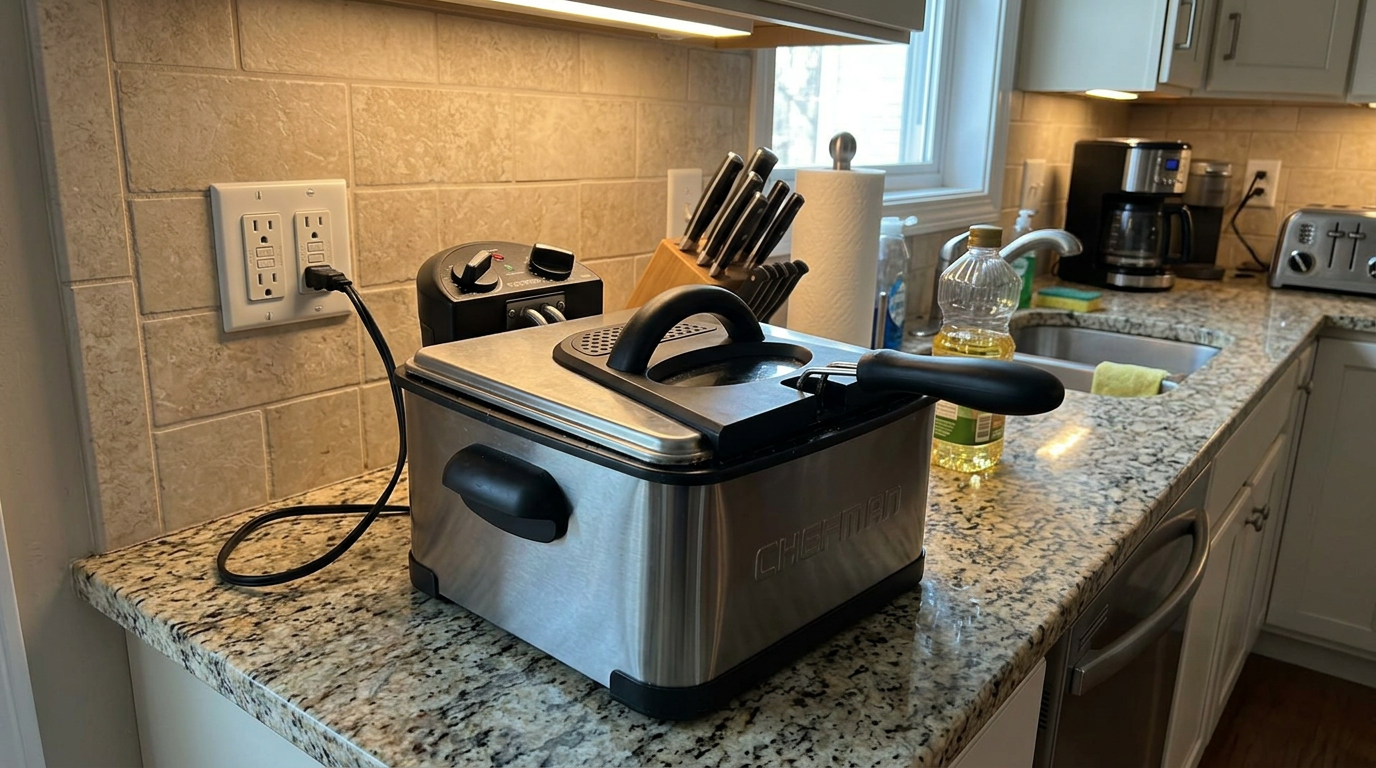
The front vents are where the hot steam escapes.
The charcoal filter and frying smells
The lid includes a charcoal filter✕Charcoal filterAn activated carbon pad in the lid meant to absorb cooking odors from the steam before it leaves the fryer. meant to reduce cooking smells.
In practice, most of the steam escapes through the front slots instead of going through the filter.
My kitchen smelled like fried food for hours after every session, just as it would with a pot on the stove.
Running the range hood and opening a window helped far more than the filter.
I'd treat the filter as a small bonus, not a solution.
Where steam seemed to escape during frying.
Our tip: Set the fryer up under or right next to your range hood, because most of the steam escapes from the front vents and the hood is the only thing that really clears the smell.
Basket clearance and the probe wires
Inside, the wires to the temperature probe are fairly stiff.
When I lowered the basket, it came very close to them, and once or twice it brushed them.
It never caused a problem in my testing, but more clearance would be better.
I learned to lower the basket slowly and make sure it hooked straight.
Our tip: Lower the basket slowly and check it sits level on its hook, because a basket that's tilted or forced can knock into the element or the temperature probe.
Reusing and storing the oil
You don't need fresh oil every time.
After it cooled completely, I strained it through a fine mesh sieve and a coffee filter back into the bottle.
Oil used only for fries lasted around five sessions in good condition.
Battered and spicy foods break oil down faster and leave flavors behind.
So I planned the order: fries first, then chicken, then onion rings and poppers last.
| Food | Effect on oil | Order to fry |
|---|---|---|
| Fries | Very little | First |
| Wings | Some flavor | Middle |
| Tenders (floured) | Some crumbs | Middle |
| Onion rings (battered) | Crumbs and flavor | Late |
| Poppers (breaded) | Crumbs and cheese | Last |
Our tip: Throw oil away once it turns dark, thick, smoky or smells off, because old oil makes food taste stale and its smoke point drops, making it less safe to heat.
Cleaning the fryer
Once the oil had cooled and been strained, cleaning was manageable.
The oil tank, basket and lid came out for washing, and the basket and lid went in the dishwasher.
I washed the tank by hand with hot soapy water to avoid scratching it.
The heating element got a careful wipe with a damp cloth, never immersed.
Everything had to be bone dry before the next fry.
| Part | How I cleaned it | How often |
|---|---|---|
| Basket | Dishwasher | Every use |
| Lid | Dishwasher or hand-wash | Every use |
| Oil tank | Hand-wash, hot soapy water | When changing oil |
| Heating element | Wipe with damp cloth | When changing oil |
| Charcoal filter | Replace | As recommended |
Our tip: Never put the control unit or heating element in water or the dishwasher, because it holds the electronics and should only be wiped with a damp cloth once it's cool.
Deep-frying safety
Hot oil demands respect, and this fryer made me think carefully about safety.
I never left it unattended while it was on.
I used long tongs and a slotted spoon, and wore an oven mitt for the lid.
I dried every ingredient thoroughly, and kept water well away.
And I always let the oil cool completely before moving or straining it.
| Rule | Why |
|---|---|
| Never leave it running alone | Hot oil can overheat or spill |
| Dry food thoroughly | Water makes oil spit |
| Use an oven mitt for the lid | Steam escapes from the front |
| Don’t overfill | Oil rises when food goes in |
| Cool before moving | Hot oil causes severe burns |
| Keep kids and pets away | The fryer gets very hot outside |
Our tip: Keep a metal lid or a fire blanket nearby, never water, because water on burning oil causes a violent flare-up that spreads the fire.
Noise, heat and counter space
The fryer is quiet apart from the sizzle of food.
The outside of the stainless steel housing gets very hot during use, so I kept a clear area around it.
It takes up a fair amount of counter space, roughly 15 by 15 inches.
I stored it in a cupboard between sessions and kept the strained oil in its bottle.
Our tip: Leave a few inches of clear space around the fryer and never push it against the wall or a cabinet, because the outside gets hot enough to discolor paint and soften plastic.
Who gets the most from it
Families who fry regularly get the most out of the capacity.
Anyone who wants proper double-fried fries will love the thermostat.
People who host game nights or parties can feed a crowd quickly.
If you only fry once in a while, a smaller fryer may be easier to live with.
Three weeks with the Chefman deep fryer
Week one: My first unit failed after one use, and the replacement arrived quickly.
I learned the controls and made my first batches of double-fried fries.
Week two: Wings, tenders and onion rings, plus the lesson about lowering the empty basket first.
I also got a steam burn from the lid and started using an oven mitt.
Week three: Jalapeño poppers for a family dinner, oil straining and a deep clean.
By then I had a safe, reliable routine.
How satisfied I felt each week.
Our tip: Plan your first session around fries, because they're forgiving, they don't break the oil down much and they teach you how the fryer heats and recovers.
Mistakes to avoid
Don't put battered food in the basket before lowering it.
Don't overload the basket.
Don't lift the lid with a bare hand near the front vents.
Don't fry wet food.
And don't pour hot oil down the sink; let it cool, strain it or seal it in a container for the trash.
Our tip: Pour cooled, used oil into its original bottle or a sealable container for disposal, because oil poured down the drain solidifies and blocks pipes.
Troubleshooting what I ran into
A few issues came up during testing.
| Problem | Cause | Fix |
|---|---|---|
| Won’t turn on | Timer not set or faulty unit | Turn the timer; return if dead |
| Greasy food | Oil too cool or basket overloaded | Smaller batches, wait for light |
| Batter stuck to basket | Food in basket before lowering | Lower empty basket first |
| Oil spitting | Wet food | Dry ingredients fully |
| Steam on hand | Front vents | Use a mitt, lift from front edge |
Our tip: If greasy food is your problem, check the oil temperature before anything else, because almost every soggy fry comes from oil that dropped too low when food went in.
Who it suits in real life
It suits families, hosts and fry enthusiasts with a decent kitchen hood.
It's less suited to small apartments with poor ventilation.
It's also not ideal if you're bothered by frying smells lingering.
If you want a more polished lid and filter system, look at a pricier fryer with an enclosed lid and better venting.
| Household | Fit | Why |
|---|---|---|
| Family of four | Excellent | Big capacity |
| Game-night host | Excellent | Fast big batches |
| Couple who fries rarely | Fair | Large to store |
| Small apartment | Fair | Smell and steam |
| Fry perfectionist | Very good | Adjustable thermostat |
Our tip: Think about where you'll store it before buying, because a 4.5-liter fryer plus its oil takes up a full cupboard shelf between uses.
Is the Chefman RJ07-45-SS worth the money?
For families who want big batches and real temperature control, yes.
It's one of the more affordable large fryers, and the food it makes is genuinely good.
But you're trading polish for capacity and value.
The lid venting, weak filter and my first-unit failure are real drawbacks.
Three questions to ask:
Do you fry for three or more people?
Do you have good ventilation?
And are you happy to use an oven mitt every time you lift the lid?
How it compares with other ways to fry
| Feature | Chefman RJ07-45-SS | Pot on the stove | Air fryer | Small 1-liter fryer |
|---|---|---|---|---|
| Capacity | Large | Varies | Medium | Small |
| Temperature control | Thermostat to 375°F | Manual, hard | Precise | Usually fixed |
| True deep-fried taste | Yes | Yes | No | Yes |
| Steam and smell | Front vents | High | Low | Moderate |
| Safety features | Breakaway cord, timer | None | Many | Varies |
| Cleanup | Moderate | Messy | Easy | Moderate |
| Your priority | Is it a fit? | Why |
|---|---|---|
| Big batches | Excellent | 4.5-liter tank and large basket |
| Proper fries | Excellent | Adjustable thermostat |
| Safety | Good | Breakaway cord and timer, but steam |
| Low smell | Poor | Filter barely helps |
| Polished design | Fair | Lid and controls are basic |
Which one is right for you: is the Chefman RJ07-45-SS your match?
4 quick questionsChefman RJ07-45-SS specifications
From manufacturer data, retailer listings and my own testing.
How I tested and scored the Chefman RJ07-45-SS
For three weeks, I used the Chefman RJ07-45-SS for every fried dish in my kitchen, including double-fried fries, wings, buttermilk tenders, beer-battered onion rings, jalapeño poppers and frozen snacks.
I checked the dial against a probe thermometer, timed heat-up and recovery, strained and reused oil, tested the breakaway cord and cleaned every part.
My first unit failed after one session and was replaced; all other testing used the replacement.
- Capacity (9.0): big batches for families.
- Frying results (8.8): excellent fries and wings; very good battered food.
- Controls (7.0): useful thermostat; confusing lights, no power switch.
- Lid and safety design (6.0): breakaway cord is great; front steam and weak filter are not.
The overall score of 7.6 is an editorial rating that reflects those four areas and the early unit failure.
Chefman RJ07-45-SS FAQ
Is the Chefman 4.5 Liter Deep Fryer worth it?
Yes, if you want a large fryer with real temperature control. The food is excellent, but use an oven mitt on the lid because steam escapes from the front vents.
How much oil does it hold?
The tank holds 4.5 liters of oil. Fill between the minimum and maximum lines.
What's the maximum temperature?
The thermostat goes up to 375°F. My thermometer showed it within about ten degrees once settled.
Does it have an on/off switch?
No. Turning the timer starts it, and it shuts off when the timer reaches zero.
Is the cord magnetic?
Yes. The magnetic breakaway cord pops off if it's tugged, so the fryer isn't dragged off the counter.
Does the charcoal filter stop frying smells?
Not much. Most steam escapes through the front lid vents. A range hood or open window helped far more.
How much food fits in one batch?
About a pound and a half of fries, or eight to ten wings. Fill the basket about halfway for the crispest results.
How do I make crispy double-fried fries?
Soak and dry the fries, fry at 340–350°F for 6–8 minutes, rest 10 minutes, then fry again at 375°F until golden.
Why does batter stick to the basket?
Wet batter glues to the wire. Lower the empty basket first, then add battered food with tongs.
Can I reuse the oil?
Yes. Let it cool, strain it and store it. Fry neutral foods like fries first and battered foods last.
Is it dishwasher safe?
The basket and lid can go in the dishwasher. Wipe the heating element and control unit with a damp cloth only.
Is it reliable?
My first unit stopped working after one use; the replacement worked perfectly for the rest of testing. Buy where returns are easy.
Senior home appliance tester
Emily has tested home appliances for a living since 2016, first as a test coordinator at a national consumer advocacy group and, since 2021, at HouseholdMe. She has a degree in industrial design from Ohio State, so she looks at how a product is built, not just how it performs. She used the Chefman RJ07-45-SS for every fried dish in her kitchen for three weeks for this review.
- Three weeks of hands-on testing of the Chefman RJ07-45-SS
- Chefman product information and user guide